Production Continuity Assumption in Corporate Gift Box Lead Time Quotes
Procurement teams receive lead time quotes assuming continuous production, then request split shipments or mid-production changes without realizing each interruption triggers 4-8 hours of changeover time that extends delivery dates beyond the original estimate.
When a procurement manager receives a quote for one thousand corporate gift boxes with a six-week production timeline, the number feels concrete. Six weeks from order confirmation to delivery. The supplier has committed to this timeline, the internal stakeholders have been informed, and the project plan reflects this delivery date. Three weeks into production, the procurement manager contacts the supplier with what appears to be a straightforward request: ship three hundred units immediately for an upcoming preview event, and deliver the remaining seven hundred units on the original schedule. The supplier responds that this change will push the final delivery date back by five days. The procurement manager is confused. Production has already been running for three weeks. Why would splitting the shipment affect the timeline?
This scenario repeats across procurement teams with predictable consistency. The confusion stems from a fundamental misunderstanding of how lead time quotes are constructed. When a supplier quotes six weeks for production, that timeline is built on a specific assumption: the production run will proceed continuously from start to finish without interruption. The factory will set up the production line once, manufacture all one thousand units in sequence, conduct a single quality inspection, package the complete order, and ship everything together. This continuous workflow is the foundation of the six-week estimate. Any deviation from this workflow—splitting shipments, modifying designs mid-production, or adjusting quantities—triggers production interruptions that consume time not budgeted in the original quote.
!Production Continuity Assumption Diagram
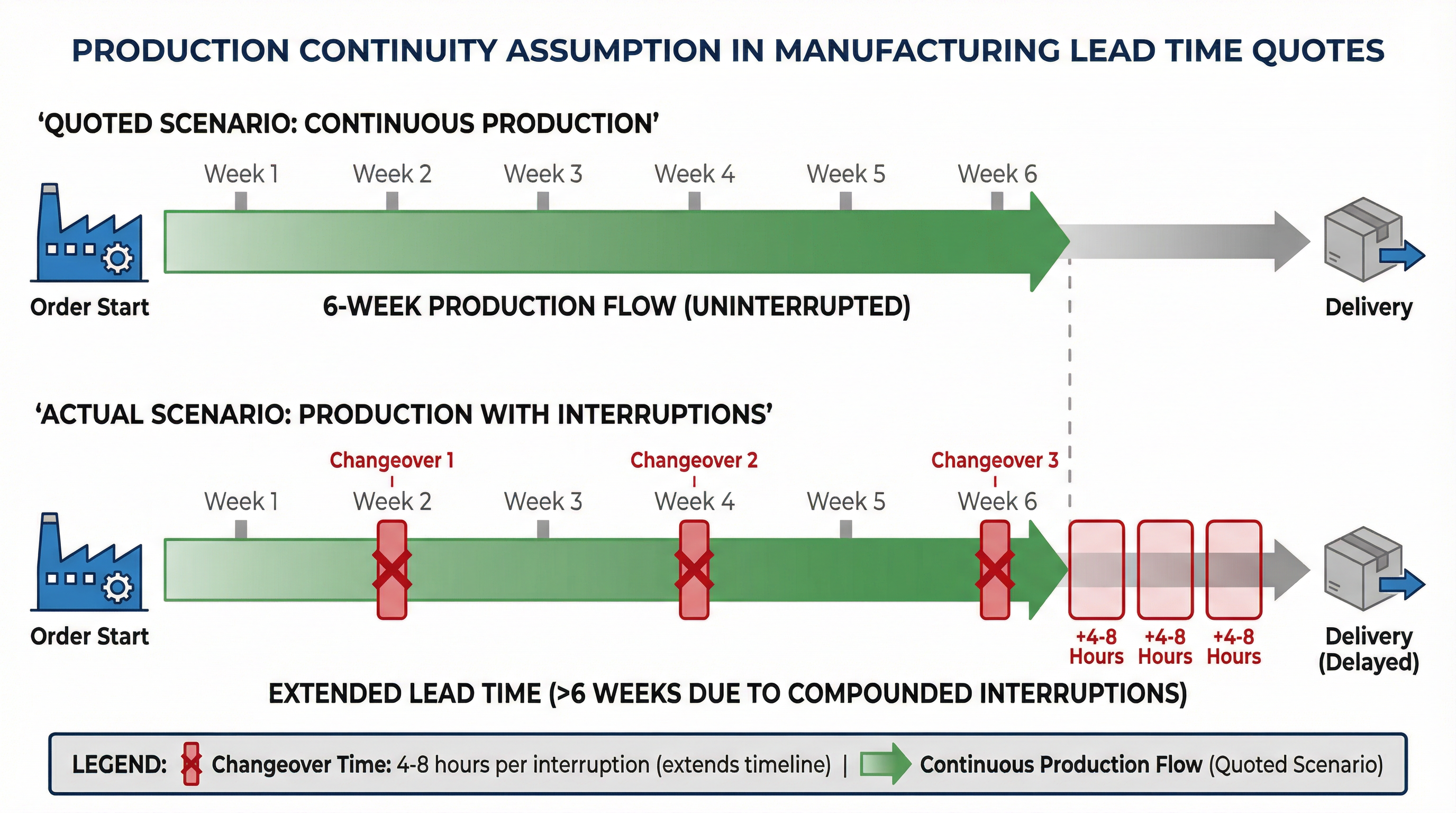
*Comparison of quoted continuous production timeline versus actual timeline with production interruptions. Each changeover adds 4-8 hours of unbudgeted time.*
The production continuity assumption is rarely communicated explicitly. Suppliers do not include a disclaimer in their quotes stating "this timeline assumes no changes to order specifications or delivery requirements." From the supplier's perspective, this assumption is self-evident. Manufacturing efficiency depends on minimizing setup and changeover time. A production line configured to manufacture corporate gift boxes operates most efficiently when it runs continuously until the order is complete. Stopping the line mid-production, reconfiguring equipment, conducting interim quality checks, and restarting production all consume time that extends the overall timeline. Suppliers build their quotes around optimal production scenarios because quoting for every possible variation would make estimates unmanageably complex and less competitive.
Procurement teams, however, operate in a different context. They view lead time as a fixed commitment rather than a conditional estimate. When a supplier quotes six weeks, the procurement team interprets this as a guarantee: if we place the order today, we will receive the finished goods in six weeks. This interpretation does not account for the possibility that the timeline might shift if the order requirements change. Procurement teams are accustomed to managing logistics variables—shipping delays, customs clearance, warehouse receiving schedules—but they often do not consider production variables. The factory floor is a black box. Orders go in, finished products come out, and the timeline quoted at the beginning is expected to hold regardless of what happens in between.
The request to split a shipment seems, from the procurement perspective, like a logistics decision. Ship part of the order now and the rest later. This should only affect shipping costs and coordination, not production time. The factory has already been running for three weeks. Surely they have produced at least three hundred units by now. Why can't they simply package those units and send them out? The answer lies in how production lines are organized. Manufacturing one thousand corporate gift boxes does not mean producing unit one, then unit two, then unit three in strict sequence. It means setting up the production line to manufacture all one thousand units as a batch. Components are staged, equipment is calibrated, quality parameters are established, and production proceeds in a continuous flow. At the three-week mark, the factory may have completed several hundred units, but those units are not necessarily packaged and ready for shipment. They are part of an in-process batch that will undergo final quality inspection and packaging once the entire production run is complete.
When the procurement team requests an early shipment of three hundred units, the factory must interrupt this continuous workflow. The production line stops. Workers identify three hundred completed units from the in-process batch. These units undergo an interim quality inspection to ensure they meet specifications before being shipped separately. This inspection duplicates work that would have been done once at the end of the full production run. The three hundred units are packaged for shipment, which requires materials and labor that were scheduled for later in the timeline. Once the partial shipment is prepared, the production line resumes for the remaining seven hundred units. This resumption is not instantaneous. Equipment must be recalibrated, quality parameters re-verified, and the production rhythm re-established. The entire interruption—stop, inspect, package, restart—consumes between four and eight hours of production time, depending on the complexity of the product and the factory's processes.
!Split Shipment Production Efficiency Comparison
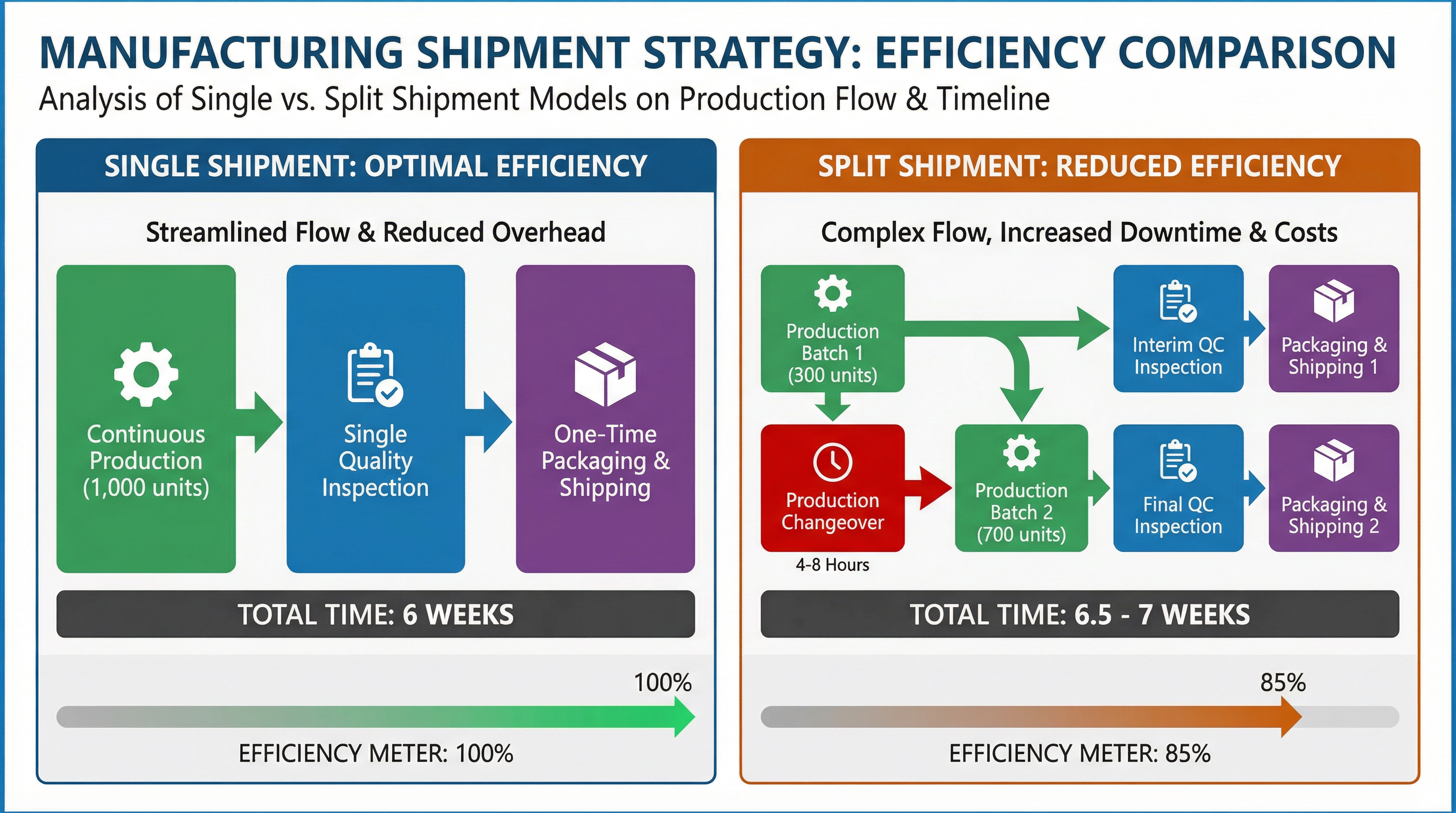
*Efficiency comparison between single shipment (optimal) and split shipment (reduced efficiency). Split shipments introduce additional quality inspections, packaging operations, and changeover time.*
Four to eight hours may not sound significant in the context of a six-week production timeline, but this time was not included in the original estimate. The six-week quote assumed continuous production with a single quality inspection and one packaging operation at the end. The split shipment request introduces an additional quality inspection, an additional packaging operation, and two production changeovers: one to stop the line and prepare the partial shipment, and one to restart the line for the remaining units. These additional steps extend the timeline by the equivalent of half a working day to a full working day. In a tightly scheduled production environment, this delay compounds. The factory may have scheduled another client's order to begin immediately after the original six-week window. The five-day delay in completing the corporate gift box order now affects the start date for the next project, creating a cascading effect across the production schedule.
The production changeover penalty is not unique to split shipment requests. Any mid-production modification triggers similar interruptions. A procurement team that requests a design change—adjusting the logo size, changing the interior lining color, or modifying the packaging insert—introduces a changeover that extends the timeline. The factory must stop production, reconfigure equipment to accommodate the new specifications, conduct test runs to verify the changes, and resume production. If the design change affects only part of the order, the factory must manage two separate production configurations: one for the units already completed under the original specifications, and one for the remaining units under the revised specifications. This dual-configuration scenario is more complex than a simple split shipment because it requires the factory to maintain quality control standards for two different product versions within the same order.
Quantity modifications present a different type of production disruption. A procurement team that reduces the order from one thousand units to eight hundred units mid-production creates inefficiencies that extend the per-unit production time. The factory has already procured materials for one thousand units, staged components for one thousand units, and calibrated equipment for a one-thousand-unit batch. Reducing the quantity does not proportionally reduce the setup time or the quality verification time. The factory still incurs the full setup cost, but that cost is now spread across fewer units, making the production run less efficient. If the quantity reduction occurs after production has already begun, the factory may have completed more than eight hundred units by the time the change request arrives. The excess units represent wasted materials and labor that cannot be recovered, and the factory must decide whether to complete the original one-thousand-unit run and hold the excess inventory, or stop production at eight hundred units and absorb the inefficiency.
Partial delivery requests—where the procurement team asks the factory to ship completed units as they are finished rather than waiting for the full order—introduce the most significant production disruptions. Continuous partial deliveries require the factory to conduct multiple quality inspections, multiple packaging operations, and multiple shipment preparations throughout the production timeline. Each of these operations interrupts the production flow and consumes time that was not budgeted in the original quote. Factories optimize for batch efficiency. Inspecting one thousand units in a single quality control session is far more efficient than inspecting two hundred units five times over the course of production. The same principle applies to packaging and shipping. Preparing one shipment of one thousand units requires less total labor than preparing five shipments of two hundred units each.
The cumulative impact of multiple mid-production changes can be substantial. A procurement team that requests a split shipment in week three, a design modification in week four, and a quantity adjustment in week five introduces three separate production interruptions. Each interruption consumes four to eight hours of production time, and each creates scheduling complexity that affects the factory's ability to maintain the original timeline. By the time the order is complete, the six-week estimate has stretched to seven weeks or more, and the procurement team is frustrated because they believe the supplier failed to meet the original commitment. From the factory's perspective, the timeline extension is a direct result of the changes requested by the procurement team, but this cause-and-effect relationship is not always communicated clearly.
Suppliers hesitate to communicate the production continuity assumption for several reasons. First, it adds complexity to the quoting process. Explaining that the six-week timeline is conditional on no mid-production changes requires the supplier to outline all the scenarios that could extend the timeline, which makes the quote less straightforward and potentially less competitive. Second, suppliers assume that procurement teams understand the basics of manufacturing efficiency. Continuous production is faster and more cost-effective than interrupted production. This principle is foundational to manufacturing operations, and suppliers expect their clients to recognize it. Third, suppliers do not want to appear inflexible. Highlighting all the conditions and assumptions upfront can create the impression that the supplier is unwilling to accommodate changes, which may discourage the client from placing the order.
The result is a communication gap. Suppliers build lead time quotes on assumptions that are obvious to them but invisible to procurement teams. Procurement teams interpret lead time quotes as fixed commitments that should hold regardless of changes. When the timeline extends due to mid-production modifications, both parties feel justified in their frustration. The procurement team believes the supplier failed to deliver on the quoted timeline. The supplier believes the procurement team introduced changes that made the original timeline unachievable. Neither party is wrong, but the lack of explicit communication about the production continuity assumption creates misalignment.
The relationship between production continuity and lead time accuracy is not always linear. A single split shipment request may add five days to the timeline, but two split shipment requests do not necessarily add ten days. The impact depends on when the changes occur, how they interact with the factory's existing production schedule, and whether the factory has buffer capacity to absorb some of the disruption. A factory operating at eighty percent capacity may be able to accommodate a split shipment request with minimal timeline impact because it has unused production hours that can absorb the changeover time. A factory operating at full capacity has no buffer, and any production interruption directly extends the timeline. Procurement teams rarely have visibility into the supplier's capacity utilization, which makes it difficult for them to predict how a change request will affect the delivery date.
Some procurement teams attempt to mitigate the risk of timeline extensions by building buffer time into their project plans. If the supplier quotes six weeks, the procurement team schedules the delivery for seven weeks, assuming that some delay is inevitable. This approach provides a safety margin, but it does not address the underlying issue. The buffer time compensates for timeline variability without improving the procurement team's understanding of what causes that variability. A more effective approach involves discussing the production continuity assumption with the supplier at the quoting stage. Procurement teams can ask: "This six-week timeline assumes continuous production with no changes, correct? If we need to split the shipment or modify the design mid-production, how much additional time should we expect?" This conversation makes the assumption explicit and allows both parties to plan for contingencies.
Suppliers can also improve communication by providing more detailed breakdowns of lead time estimates. Instead of quoting "six weeks for production," a supplier might specify: "two weeks for material procurement, three weeks for manufacturing, one week for quality inspection and packaging." This breakdown helps procurement teams understand which phases of the timeline are fixed and which are variable. Material procurement time is largely outside the supplier's control and depends on supplier lead times. Manufacturing time is where production continuity matters most. Quality inspection and packaging time can be extended if interim inspections are required for split shipments. By understanding the components of the lead time estimate, procurement teams can make more informed decisions about when and how to request changes.
The factory project manager's perspective on mid-production changes is shaped by daily exposure to the trade-offs between flexibility and efficiency. Every change request represents a decision point: accommodate the client's needs and accept the timeline extension, or push back and risk damaging the client relationship. Experienced project managers develop a sense for which changes are manageable and which will create significant disruptions. A split shipment request in the final week of production, when most units are already complete and awaiting final inspection, is relatively easy to accommodate. A split shipment request in the second week of production, when the line is in full operation and units are still in process, is far more disruptive. The timing of the change request matters as much as the nature of the change itself.
Factory project managers also consider the precedent that accommodating changes sets for future orders. If a procurement team learns that they can request split shipments or design modifications mid-production without significant penalty, they may continue to make such requests on subsequent orders. Over time, this pattern erodes the factory's ability to maintain efficient production schedules and competitive pricing. Some factories address this by implementing change order policies that specify the conditions under which mid-production changes are accepted and the timeline or cost implications of those changes. These policies create transparency and set expectations, but they also add administrative overhead and may be perceived as inflexible by clients who value responsiveness.
The production continuity assumption extends beyond corporate gift boxes to virtually all manufactured products. Whether the product is custom packaging, promotional items, or industrial components, the principle remains the same: continuous production is more efficient than interrupted production, and lead time quotes are built on the assumption of continuity. Procurement teams working across different product categories encounter this assumption repeatedly, but it is rarely articulated in the same way across suppliers. Some suppliers are proactive about explaining how changes affect timelines. Others assume the client understands and only raise the issue when a change request arrives. This inconsistency makes it difficult for procurement teams to develop a standardized approach to managing lead times across multiple suppliers.
Understanding how production scheduling decisions affect delivery timelines for corporate gift box production requires procurement teams to think beyond the logistics of moving finished goods from the factory to the destination. It requires recognizing that the factory floor operates under constraints that are different from those in warehousing or transportation. A warehouse can pick and ship partial orders with minimal disruption because the products are already finished and packaged. A factory cannot do the same because the products are in various stages of completion, and interrupting the production flow to prepare a partial shipment consumes time and resources that were allocated to continuous manufacturing. This distinction is fundamental, but it is not intuitive to procurement professionals whose primary focus is on coordinating logistics rather than managing production operations.
The most effective way to minimize the impact of mid-production changes is to finalize all order specifications before production begins. This means confirming quantities, delivery schedules, design details, and packaging requirements during the quoting and order confirmation phase, rather than making adjustments once production is underway. Procurement teams that invest time upfront to align internal stakeholders and lock in specifications reduce the likelihood of needing to request changes later. This upfront investment pays dividends in timeline predictability and cost control. Suppliers are more willing to commit to aggressive timelines when they have confidence that the order specifications will not change mid-production.
When mid-production changes are unavoidable, early communication is critical. A procurement team that informs the supplier of a potential change as soon as it is identified gives the supplier time to assess the impact and adjust the production schedule accordingly. A change request submitted three weeks into a six-week production timeline is easier to accommodate than a change request submitted five weeks in, when the factory has limited flexibility to adjust. Early communication also allows the supplier to propose alternatives that might achieve the procurement team's objectives with less disruption. For example, if the procurement team needs a preview shipment for an event, the supplier might suggest shipping sample units that were produced during the initial quality verification phase, rather than stopping the main production line to prepare a partial shipment.
The production continuity assumption is one of several assumptions embedded in lead time quotes that procurement teams often overlook. Other assumptions include consistent material availability, stable labor capacity, and predictable equipment uptime. Any of these assumptions can be violated by external factors—supplier delays, labor shortages, equipment breakdowns—that extend the timeline beyond the original estimate. Procurement teams that understand the full range of assumptions underlying lead time quotes are better equipped to assess the reliability of those quotes and to plan for contingencies when assumptions are not met.
The challenge for procurement teams is that lead time quotes are presented as single numbers—six weeks, eight weeks, ten weeks—that obscure the complexity of the production process and the assumptions on which those numbers are based. A more transparent approach would present lead times as ranges with explicit conditions: "six to seven weeks assuming continuous production with no design changes; seven to eight weeks if split shipments or design modifications are required." This level of detail is uncommon in practice because it complicates the quoting process and may make suppliers appear less competitive. However, it would provide procurement teams with a more realistic understanding of timeline variability and help them make better-informed decisions about when and how to request changes.
The production continuity assumption is not a limitation of manufacturing capability. It is a reflection of how manufacturing efficiency is achieved. Factories are designed to produce goods in batches with minimal setup and changeover time. This design principle drives cost efficiency and enables suppliers to offer competitive pricing. When procurement teams request changes that disrupt production continuity, they are not asking the factory to do something it cannot do. They are asking the factory to operate in a less efficient mode, and that inefficiency translates into extended timelines or higher costs. Recognizing this trade-off allows procurement teams to make more strategic decisions about which changes are worth requesting and which are better avoided.
The disconnect between how suppliers quote lead times and how procurement teams interpret those quotes is a recurring source of friction in manufacturing relationships. Bridging this disconnect requires both parties to communicate more explicitly about the assumptions and constraints that shape production timelines. Suppliers need to articulate the conditions under which their lead time estimates are valid. Procurement teams need to ask questions that surface those conditions and to plan their orders in ways that minimize the need for mid-production changes. When both parties operate with a shared understanding of how production continuity affects timelines, the result is fewer surprises, more predictable delivery dates, and stronger working relationships.