How Long Does It Take to Produce Corporate Gift Boxes in Singapore?
Discover realistic production timelines for corporate gift boxes in Singapore. Learn how to plan lead times for CNY, year-end gifts, and avoid costly delays.
Expert Quick Answer
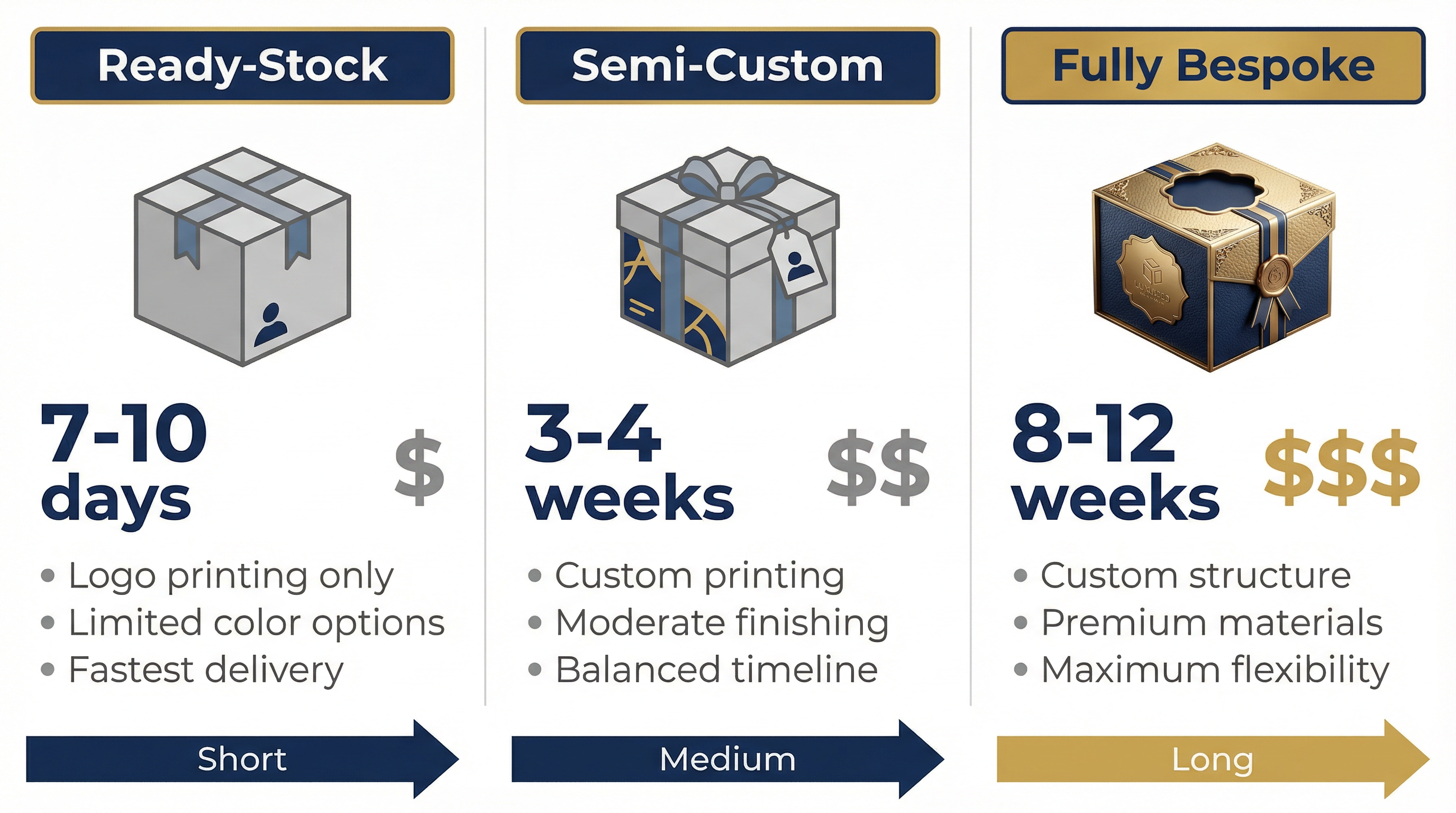
Production lead time for corporate gift boxes in Singapore typically ranges from 10 days to 12 weeks, depending on customization complexity and order volume. Ready-stock items with logo printing require 7-10 business days. Semi-custom gift boxes with moderate branding take 3-4 weeks. Fully bespoke corporate gifts involving custom packaging design, premium materials, and intricate finishes demand 8-12 weeks from initial brief to delivery. For peak seasons like Chinese New Year (CNY) or year-end corporate gifting, add 2-4 weeks to account for supplier capacity constraints and extended approval cycles.
---
為什麼生產交期對新加坡企業是關鍵決策?
The question "how long will this take?" appears deceptively simple during corporate gift procurement discussions, yet the answer determines whether your gifting initiative strengthens business relationships or becomes an embarrassing apology for late delivery. In our experience working with Singapore enterprises across financial services, technology, and manufacturing sectors, we've observed that lead time miscalculation ranks among the top three causes of corporate gifting project failure, alongside budget overruns and quality compromises.
The stakes are particularly high in Singapore's business environment, where gift-giving carries significant cultural weight. Delivering CNY corporate gifts after the festival begins signals poor planning to Chinese business partners. Presenting year-end appreciation gifts in January rather than December diminishes their symbolic value. These timing failures don't just waste procurement budgets—they actively damage the business relationships the gifts were meant to strengthen.
From a budget control perspective, lead time decisions directly impact total procurement costs through multiple mechanisms. Rush orders typically incur 15-30% premium charges for expedited production and air freight. Conversely, ordering too early creates inventory holding costs and ties up working capital that could serve other business priorities. We've seen companies pay SGD 8,000-12,000 in unnecessary rush fees simply because procurement teams underestimated the time required for internal stakeholder approvals and design iterations.
Brand image considerations compound these financial implications. When corporate gifts arrive late, recipients perceive the giving company as disorganized or indifferent, regardless of the gift's intrinsic quality. A premium leather notebook set delivered two weeks after CNY carries less brand value than a modest gift hamper delivered on time. The timing itself communicates respect for the recipient's schedule and cultural expectations—a message that cannot be retrofitted after the deadline passes.
Regulatory and compliance risks emerge when compressed timelines force procurement shortcuts. Singapore companies distributing corporate gifts must consider GST implications, corporate gift value limits under IRAS guidelines, and documentation requirements for cross-border shipments. Rushed procurement often bypasses proper compliance reviews, creating audit risks that surface months after the gifts are distributed. For regulated industries like banking and pharmaceuticals, these compliance gaps can trigger regulatory scrutiny and reputational damage far exceeding the original gift budget.
The lead time decision also reveals organizational maturity in supply chain management. Companies that consistently plan 10-12 weeks ahead for custom corporate gifts demonstrate procurement sophistication that extends beyond gifting to their core operations. Those perpetually caught in rush-order cycles signal deeper organizational challenges in planning, stakeholder alignment, and decision-making velocity.
Understanding how minimum order quantities interact with production timelines becomes critical when planning procurement schedules, as MOQ commitments often determine whether suppliers can accommodate your desired delivery date.
---
新加坡企業採購的實務流程與常見做法
Understanding how Singapore companies actually procure corporate gifts—as opposed to how procurement textbooks suggest they should—reveals why lead time planning so often fails. The theoretical procurement cycle assumes linear progression through defined stages, but real-world corporate gift projects follow a more chaotic path shaped by stakeholder politics, budget cycles, and last-minute executive interventions.
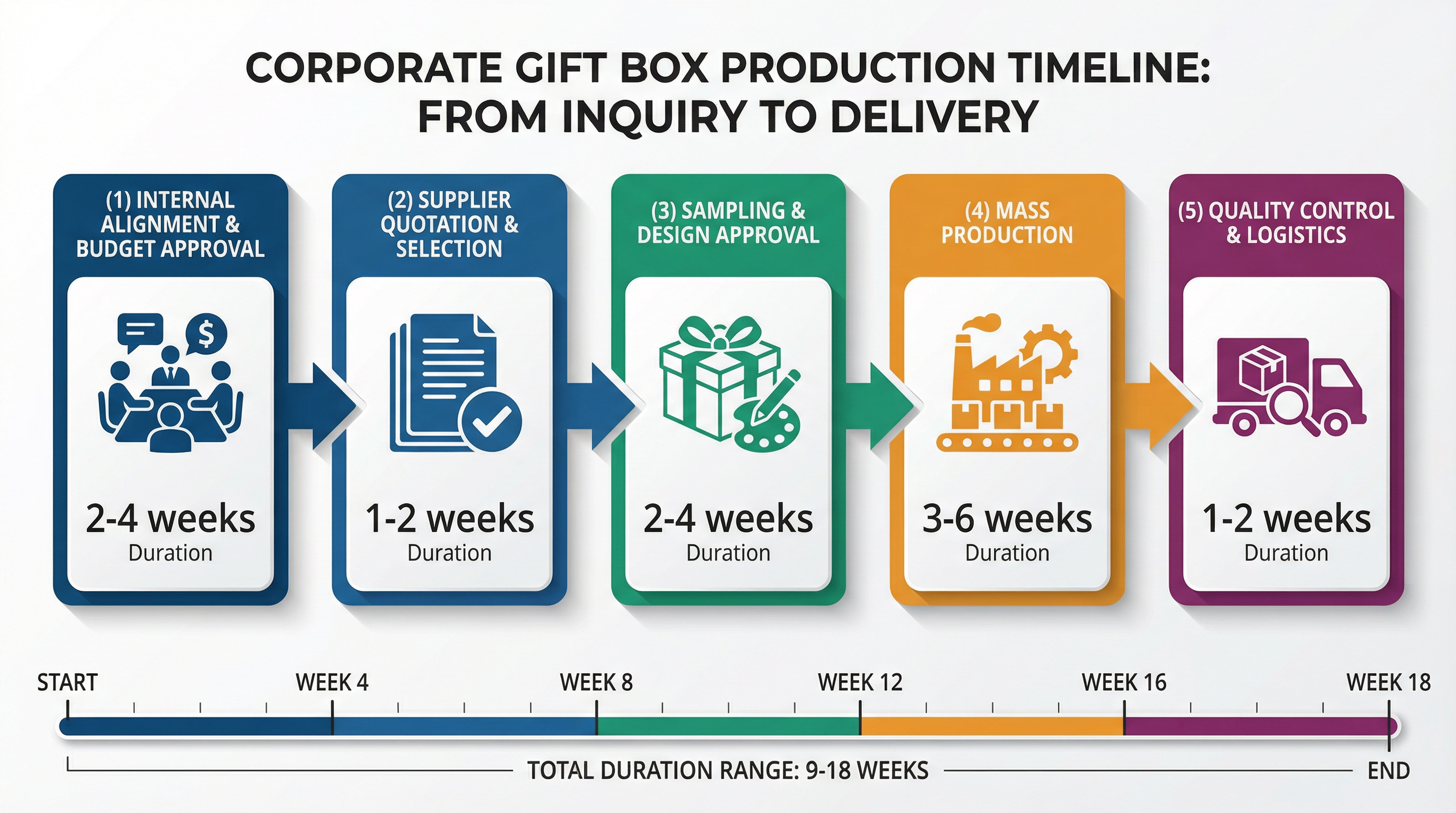
Phase 1: Internal Alignment and Budget Approval (2-4 weeks)
The clock starts ticking not when you contact suppliers, but when someone in your organization first proposes a corporate gifting initiative. In practice, this initial phase consumes far more time than procurement teams anticipate. Marketing wants gifts that reinforce brand positioning. Finance demands cost justification. HR insists on employee gift parity. The CEO's executive assistant has strong opinions about what "premium" means.
We've observed that companies with decentralized decision-making structures require 3-4 weeks for internal alignment, while those with clear procurement authority can complete this phase in 1-2 weeks. The execution difficulty lies in recognizing this internal negotiation as part of the lead time, not a preliminary step that happens "before the real work begins." Many procurement managers start their timeline calculation only after receiving budget approval, effectively losing 2-4 weeks of available lead time before contacting any suppliers.
A common pitfall specific to Singapore's business culture involves the "consensus-seeking delay." Unlike more hierarchical corporate environments where a single decision-maker can greenlight procurement, Singapore companies often seek input from multiple stakeholders to build consensus. This collaborative approach produces better outcomes but extends timelines. The practical implication: if your organization values consensus, add 1-2 weeks to your internal alignment phase.
Phase 2: Supplier Identification and Quotation (1-2 weeks)
Once internal alignment is achieved, procurement teams typically request quotations from 3-5 suppliers. The standard practice in Singapore involves sending detailed RFQs (Request for Quotation) specifying quantity, customization requirements, budget range, and delivery deadline. Suppliers respond within 3-5 business days for standard products, but custom gift box quotations require 5-10 business days as suppliers assess design feasibility and production capacity.
The execution difficulty here involves the "quotation iteration trap." Initial quotes rarely match buyer expectations perfectly, triggering a second round of quotation requests with adjusted specifications. Each iteration adds 5-7 business days to the timeline. We've seen procurement projects consume 3-4 weeks in quotation cycles alone when buyers lack clarity on their requirements or underestimate the cost of their desired customization level.
A Singapore-specific consideration involves the timing of quotation requests relative to major holidays. Requesting quotes in the two weeks before CNY, Hari Raya, or Christmas typically results in slower supplier responses as key personnel take leave. Experienced procurement managers in Singapore avoid initiating new projects during these pre-holiday windows.
Phase 3: Sampling and Design Approval (2-4 weeks)
For custom corporate gift boxes, suppliers produce physical samples or digital mockups for buyer approval before commencing mass production. This phase represents the highest-risk portion of the timeline because it involves iterative feedback cycles with unpredictable duration.
Standard practice involves suppliers producing initial samples within 7-10 business days after design confirmation. Buyers then review samples with internal stakeholders, request modifications, and wait for revised samples. Each revision cycle adds 5-7 business days. In our experience, corporate gift projects average 2.3 revision cycles before final approval, meaning the sampling phase typically requires 3-4 weeks rather than the 1-2 weeks procurement teams initially budget.
The execution difficulty stems from the subjective nature of design evaluation. What constitutes "premium quality" or "on-brand aesthetics" varies across stakeholders. The marketing director's vision of sophisticated minimalism may clash with the sales director's preference for bold branding. These internal disagreements surface during sample review, extending the approval timeline as stakeholders negotiate compromises.
A potent rule specific to Singapore's business environment: if your corporate gift will be distributed to Chinese business partners during CNY, ensure your design incorporates culturally appropriate colors and symbols. Discovering during sample review that your chosen color scheme carries negative connotations in Chinese culture forces a complete design restart, adding 2-3 weeks to your timeline.
Phase 4: Mass Production (3-6 weeks)
Once samples are approved, suppliers commence mass production. Lead times vary significantly based on order volume, customization complexity, and supplier production capacity. Ready-stock items with simple logo printing require 7-10 business days. Custom gift boxes with moderate complexity (custom printing, basic finishing) take 3-4 weeks. Fully bespoke gift boxes with premium materials, complex structural design, and intricate finishing techniques demand 6-8 weeks.
The execution difficulty involves the "production visibility gap." Unlike consumer e-commerce where buyers track packages in real-time, corporate gift production offers limited visibility into manufacturing progress. Buyers typically receive updates only at major milestones: production start, 50% completion, quality control, and shipping preparation. This opacity creates anxiety for procurement managers operating under tight deadlines, but excessive status inquiries can actually slow production by diverting supplier attention from manufacturing to customer service.
Singapore procurement managers should note that local suppliers typically offer 1-2 weeks faster turnaround than overseas manufacturers when factoring in shipping time, but may charge 10-20% premiums for this speed advantage. The decision between local and overseas sourcing should weigh timeline urgency against budget constraints.
Phase 5: Quality Control and Logistics (1-2 weeks)
The final phase involves quality inspection, packaging, and delivery to your specified location(s). For single-location delivery within Singapore, this phase requires 3-5 business days. Multi-location delivery across Singapore offices adds 5-7 business days for coordination. International delivery to regional offices requires 1-2 weeks depending on destination and customs clearance complexity.
The execution difficulty lies in the "last-mile coordination challenge." Corporate gifts often require delivery to multiple locations with specific timing constraints—arriving before recipients leave for holiday, coordinating with office reception hours, managing building access requirements. These logistical details, often treated as afterthoughts, can delay final delivery by 3-5 business days if not planned in advance.
The customization options you select from our custom gift box portfolio directly determine which timeline category your project falls into, making early design decisions critical to schedule feasibility.
---
影響成敗的關鍵因素
The lead time required for your corporate gift box project isn't determined by a single variable but by the interaction of multiple factors that compound or offset each other. Understanding these factor relationships allows procurement managers to make informed trade-offs rather than discovering constraints too late to adjust strategy.
Customization Complexity vs. Production Timeline
The relationship between customization level and production time follows a non-linear curve. Moving from ready-stock to semi-custom adds 1-2 weeks. Moving from semi-custom to fully bespoke adds 4-6 weeks—a disproportionate increase because bespoke projects require custom tooling, specialized materials sourcing, and extended quality control protocols.
In practice, this means the decision to add "just one more" customization element can push your project across a timeline threshold that forces you into a different procurement season. We've seen companies request custom-embossed leather notebooks in late October for December delivery, not realizing that embossing dies require 3-4 weeks to fabricate, pushing delivery into January and missing the year-end gifting window entirely.
The trade-off framework we recommend: if your delivery deadline is less than 8 weeks away, constrain customization to printing and basic finishing techniques. If you have 10+ weeks, bespoke structural design and premium finishing become feasible. The 8-10 week range represents a decision zone where customization ambitions must be carefully weighed against timeline risk.
Order Volume vs. Supplier Capacity
Order volume affects lead time through two opposing mechanisms. Larger orders require more production time (linear effect) but receive priority allocation of supplier capacity (non-linear effect). The net result depends on your order size relative to the supplier's typical order profile.
For Singapore corporate gift suppliers, the typical order profile ranges from 200-1,000 units. Orders below 200 units often receive slower service as suppliers prioritize larger clients. Orders above 1,000 units trigger priority handling but require extended production time. The "sweet spot" for balancing timeline and supplier attention falls in the 300-800 unit range, where orders are large enough to matter but small enough to complete quickly.
The execution implication: if your order volume is unusually large (2,000+ units) or unusually small (under 100 units), add 1-2 weeks to standard lead time estimates to account for capacity allocation dynamics. Suppliers rarely communicate these prioritization decisions explicitly, but they consistently affect actual delivery timelines.
Material Selection vs. Supply Chain Resilience
Material choices carry hidden timeline implications through supply chain complexity. Standard materials like kraft cardboard, basic leatherette, and common fabric types maintain consistent availability and predictable lead times. Premium materials like genuine leather, specialty papers, or imported fabrics introduce supply chain dependencies that can extend timelines by 2-4 weeks if materials are out of stock when you place your order.
We've observed that material availability fluctuates seasonally in Asia's manufacturing ecosystem. Q4 (October-December) sees heightened demand for premium packaging materials as brands prepare for holiday season, creating spot shortages that delay production. Procurement managers ordering during Q4 should either accept standard materials or add 2-3 weeks to their timeline for premium material sourcing.
The trade-off consideration: premium materials elevate perceived gift value but reduce timeline flexibility. If your deadline is fixed and non-negotiable (e.g., CNY distribution), prioritize materials with confirmed availability over aspirational premium options that introduce supply risk.
Internal Approval Velocity vs. External Production Time
The most frequently overlooked factor affecting lead time is internal approval velocity—how quickly your organization makes decisions and provides feedback to suppliers. In our experience, internal approval delays cause more timeline failures than supplier production delays. A supplier can produce custom gift boxes in 4 weeks, but if your organization requires 2 weeks to approve designs and another week to sign off on samples, the effective timeline becomes 7 weeks.
Singapore companies with mature procurement processes establish clear approval authority and decision-making protocols before engaging suppliers. Those with ad-hoc approval processes discover mid-project that the original decision-maker lacks authority to approve design changes, forcing additional review cycles that consume 1-2 weeks.
The practical implication: when calculating lead time, honestly assess your organization's decision-making velocity. If your company culture favors consensus-building over rapid decisions, add 2-3 weeks to supplier-quoted timelines to account for internal approval cycles. This buffer prevents the "supplier is ready but we're not" scenario that wastes the timeline advantage of early ordering.
Peak Season Multipliers vs. Off-Season Advantages
Lead times are not constant throughout the year but fluctuate based on seasonal demand patterns in Singapore's corporate gifting market. The two major peak seasons—CNY (January-February) and year-end corporate gifting (November-December)—see supplier capacity constraints that extend standard lead times by 30-50%.
A custom gift box order that requires 4 weeks during off-peak months (March-September) may require 6-7 weeks during peak season as suppliers manage higher order volumes and longer queues. The timeline multiplier effect is most severe in the 8-week window before CNY (mid-November to mid-January) when Singapore companies compete for limited supplier capacity.
The strategic implication: procurement managers operating on fixed annual gifting calendars should initiate orders 10-12 weeks before CNY and year-end deadlines rather than the 6-8 weeks sufficient during off-peak periods. This early ordering strategy not only ensures timeline reliability but often secures better pricing as suppliers offer early-bird discounts to smooth capacity utilization.
For a detailed breakdown of each manufacturing stage and quality control checkpoint, explore our production process documentation, which provides transparency into how we manage timeline commitments.
---
針對不同規模企業的策略建議
Corporate gift procurement strategies that work for a 30-person startup fail catastrophically for a 3,000-employee multinational, and vice versa. The lead time planning approach must align with organizational scale, procurement maturity, and decision-making structure.
新創/中小企業策略 (50 人以下)
Small and medium enterprises in Singapore face unique lead time challenges stemming from limited procurement resources and compressed decision-making cycles. Unlike large corporations with dedicated procurement teams, SMEs typically assign corporate gifting to office managers or executive assistants who manage multiple responsibilities simultaneously.
The primary advantage SMEs hold is decision-making velocity. A founder or managing director can approve gift designs in a single meeting, eliminating the multi-week approval cycles that plague larger organizations. This velocity advantage allows SMEs to operate on shorter timelines—6-8 weeks for custom corporate gifts versus 10-12 weeks for large enterprises.
However, SMEs face offsetting disadvantages in supplier prioritization and negotiating leverage. Smaller order volumes (typically 50-200 units) receive lower priority from suppliers during peak seasons. We've observed instances where SME orders placed in November for December delivery were delayed as suppliers prioritized larger corporate clients, forcing SMEs to accept January delivery or pay 25-30% rush premiums.
The recommended strategy for Singapore SMEs involves relationship-based supplier partnerships rather than transactional procurement. Establishing ongoing relationships with 1-2 preferred suppliers—even if it means paying slightly higher per-unit costs—ensures priority treatment during peak seasons and more flexible lead time accommodation when urgent needs arise. An SME that consistently orders 100-150 units quarterly receives better service than one placing a single 500-unit order annually.
Budget flexibility represents another critical consideration for SMEs. Unlike large corporations locked into annual budgets approved months in advance, SMEs can often reallocate funds more dynamically. This financial agility allows SMEs to pay rush premiums or upgrade to air freight when timeline pressures emerge, converting budget flexibility into timeline insurance.
For SMEs operating on tight timelines (less than 6 weeks to delivery), we recommend the "semi-custom compromise strategy": select from supplier's existing gift box designs and customize only through printing and basic branding. This approach delivers 70-80% of the brand impact of fully custom designs while reducing lead time to 3-4 weeks, making it feasible to execute corporate gifting initiatives on compressed schedules.
大型/跨國企業策略 (500 人以上)
Large enterprises and multinational corporations face lead time challenges stemming from organizational complexity, compliance requirements, and multi-location coordination rather than supplier capacity constraints. For these organizations, internal approval cycles typically consume more timeline than external production.
The procurement process for large enterprises involves multiple stakeholder layers: business unit leaders, procurement departments, legal teams, compliance officers, and executive approvers. Each layer adds 3-5 business days to the approval timeline. We've worked with Singapore-based regional headquarters where gift design approval required sign-off from 7 different stakeholders across 4 countries, consuming 6 weeks before any supplier engagement began.
The strategic imperative for large enterprises is front-loading the procurement timeline. Rather than compressing supplier production time (which is largely fixed), large organizations must compress internal decision-making time through structured procurement protocols. Best-practice approaches include:
Establishing standing approval authority for corporate gifting below specified thresholds (e.g., SGD 50,000), eliminating the need for executive sign-off on routine orders. Pre-approving 3-5 corporate gift designs at the beginning of each fiscal year, allowing business units to select from approved options without repeating design review cycles. Implementing parallel approval workflows where compliance, legal, and procurement reviews occur simultaneously rather than sequentially.
These process optimizations can reduce internal approval time from 6-8 weeks to 2-3 weeks, creating timeline capacity for more sophisticated customization or accommodating compressed delivery schedules when business needs shift unexpectedly.
Multi-location delivery coordination represents another large-enterprise challenge rarely faced by SMEs. A Singapore-based multinational distributing CNY gifts to offices across Singapore, Malaysia, Indonesia, Thailand, and Vietnam must coordinate customs clearance, local delivery logistics, and timing synchronization across time zones. This coordination adds 2-3 weeks to the overall timeline compared to single-location delivery.
The recommended approach involves appointing regional logistics coordinators in each country who manage local delivery details, allowing the central procurement team to focus on production timeline management. This distributed coordination model prevents the bottleneck of a single Singapore-based team attempting to manage logistics details across multiple countries.
Compliance and regulatory requirements impose additional timeline constraints on large enterprises, particularly those in regulated industries like banking, pharmaceuticals, and professional services. Corporate gift distributions must comply with anti-bribery regulations, gift value limits, and documentation requirements that vary by jurisdiction. Compliance reviews add 1-2 weeks to the procurement timeline but are non-negotiable for regulated entities.
For large enterprises in regulated industries, we recommend maintaining a "pre-approved gift catalog" of corporate gift options that have already cleared compliance review. When gifting needs arise, procurement teams select from pre-approved options, eliminating the 1-2 week compliance review delay and enabling faster execution.
The volume advantage large enterprises hold allows them to negotiate priority production slots with suppliers through annual framework agreements. A multinational committing to 5,000-10,000 units annually across multiple orders can negotiate guaranteed lead times and priority capacity allocation during peak seasons, converting order volume into timeline insurance.
Browse our product catalog to identify ready-stock and semi-custom options that offer faster turnaround when timeline constraints limit fully bespoke customization.
---
新加坡市場的特殊規範與避雷指南
Singapore's unique position as a multicultural business hub creates specific lead time considerations that don't apply in more homogeneous markets. Procurement managers must navigate cultural calendars, regulatory requirements, and local business practices that significantly impact timeline planning.
農曆新年 (CNY) 採購時間線
Chinese New Year dominates Singapore's corporate gifting calendar, accounting for an estimated 40-50% of annual corporate gift procurement volume. This concentration creates severe capacity constraints in the 10-week window before CNY (mid-November to late January), fundamentally altering normal lead time assumptions.
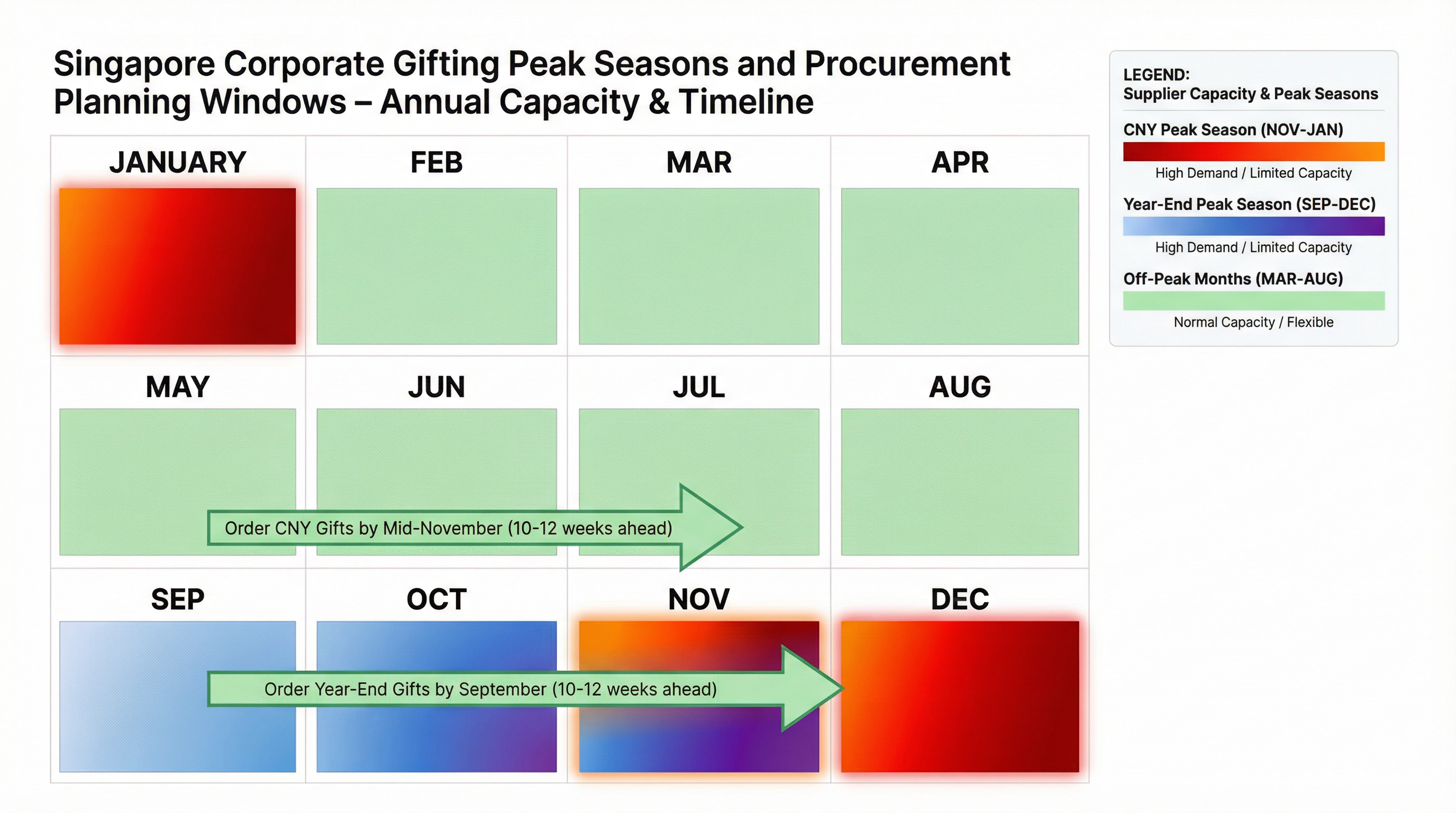
During CNY season, standard 4-week custom gift box projects extend to 6-8 weeks due to supplier capacity constraints and extended approval cycles as key decision-makers take pre-CNY leave. Suppliers prioritize orders based on client relationship strength and order size, meaning new clients or smaller orders face the longest delays.
The cultural imperative of delivering CNY gifts before the festival begins—not during or after—makes timeline failures particularly damaging. A gift delivered on February 5th when CNY began February 1st signals poor planning and cultural insensitivity to Chinese business partners, regardless of the gift's intrinsic quality.
Our recommended CNY procurement timeline for Singapore companies:
12 weeks before CNY: Initiate internal discussions on CNY gifting strategy, budget, and recipient list. This early start allows time for stakeholder alignment before engaging suppliers.
10 weeks before CNY: Request quotations from suppliers and begin design discussions. Suppliers still have available capacity at this point and can accommodate custom requests.
8 weeks before CNY: Finalize supplier selection and approve initial designs. This timing ensures sample production completes before the pre-CNY rush intensifies.
6 weeks before CNY: Approve final samples and authorize mass production. Production commences while suppliers still have capacity and key materials remain in stock.
3 weeks before CNY: Complete production and commence delivery logistics. This buffer accommodates unexpected delays without missing the CNY distribution window.
2 weeks before CNY: Complete all gift distributions. This timing respects the cultural expectation that CNY gifts arrive before the festival, allowing recipients to display or use gifts during CNY celebrations.
Companies that initiate CNY procurement less than 8 weeks before the festival should expect to pay 20-30% rush premiums, accept limited customization options, or risk missing the CNY distribution window entirely.
多元文化禮品禁忌
Singapore's multicultural environment requires procurement managers to consider gift appropriateness across Chinese, Malay, Indian, and Western cultural contexts. Certain gift categories carry negative connotations in specific cultures, creating reputational risks if not carefully considered.
For Chinese business partners, avoid gifts in sets of four (the number four sounds like "death" in Chinese), clocks (symbolizing death), sharp objects like knives (symbolizing severing relationships), and predominantly white or black packaging (funeral colors). Preferred colors include red and gold (prosperity), and gifts should be presented with both hands as a sign of respect.
For Malay Muslim business partners, avoid gifts containing alcohol, pork products, or non-halal food items. Leather gifts should specify "genuine leather" only if the leather source is halal-certified; otherwise, synthetic leather is safer. During Ramadan, avoid scheduling gift deliveries during fasting hours (sunrise to sunset).
For Indian business partners, avoid gifts made from cowhide leather (cows are sacred in Hinduism), and be mindful that some Indian cultures consider black and white inauspicious colors for gifts.
The practical timeline implication: cultural appropriateness reviews should occur during the design phase (weeks 3-4 of the procurement timeline), not after samples are produced. Discovering cultural issues during sample review forces design restarts that add 2-3 weeks to the timeline.
IRAS 企業禮品價值限制
Singapore's Inland Revenue Authority (IRAS) imposes specific rules on corporate gift tax deductibility that indirectly affect procurement timeline planning. While IRAS doesn't set absolute limits on corporate gift values, gifts exceeding SGD 200 per recipient face increased scrutiny regarding business purpose and tax treatment.
For procurement managers, the timeline implication emerges when gifts approaching or exceeding this threshold require additional documentation and compliance review. Finance teams may require 1-2 weeks to assess tax implications and prepare supporting documentation before approving procurement. This compliance review should be incorporated into the internal approval phase (weeks 1-2) rather than discovered after supplier engagement begins.
Gifts to government officials or employees of government-linked companies face stricter limits under Singapore's anti-corruption framework. Many government agencies impose gift value limits of SGD 50-100, and some prohibit gifts entirely. Procurement managers distributing gifts to mixed recipient lists (private sector and government) must either maintain separate gift tiers or constrain all gifts to the most restrictive limit. This segmentation decision should occur during the internal alignment phase to avoid timeline-consuming redesigns later.
GST 與進口清關時間
Corporate gifts imported from overseas suppliers require customs clearance, adding 2-5 business days to the delivery timeline depending on shipment complexity and documentation completeness. Gifts valued above SGD 400 (CIF value) are subject to GST, requiring additional documentation and payment processing that extends clearance time.
For procurement managers sourcing from overseas suppliers (China, Malaysia, Thailand), the recommended approach is to add 1 week to the supplier's quoted delivery timeline to account for customs clearance and potential documentation issues. This buffer prevents the scenario where production completes on time but gifts sit in customs for 3-5 days awaiting clearance, causing delivery delays.
Certain gift categories require import permits or regulatory approvals that significantly extend timelines. Food products require AVA (Agri-Food & Veterinary Authority) approval, adding 2-3 weeks. Electrical items require safety certification, adding 1-2 weeks. Procurement managers should verify regulatory requirements during supplier selection (week 2) rather than discovering permit needs after production begins.
物流與多點配送挑戰
Singapore's compact geography creates a false sense of delivery simplicity. While the island is small, coordinating multi-location delivery to corporate offices, retail locations, or employee homes introduces logistical complexity that extends timelines.
Standard single-location delivery within Singapore requires 1-2 business days. Multi-location delivery to 5-10 addresses requires 3-5 business days for coordination and execution. Delivery to 20+ addresses (common for employee gifts) requires 5-7 business days and often involves third-party logistics providers.
The timeline challenge intensifies during peak seasons (CNY, year-end) when logistics providers face capacity constraints. A delivery that requires 3 business days in March may require 5-7 business days in December as couriers manage higher volumes. Procurement managers should add 2-3 business days to standard delivery timelines for gifts distributed during October-December or January-February.
For companies distributing gifts to employee homes, additional considerations include recipient availability (many employees travel during CNY or year-end holidays), building access restrictions, and delivery time preferences. These coordination details add 3-5 business days to standard delivery timelines and should be incorporated into logistics planning during week 10-11 of the procurement timeline.
Additional guidance on cultural appropriateness, compliance requirements, and logistics coordination can be found in our frequently asked questions section.
---
常見問題集
Q1: Can I reduce lead time by paying a rush fee?
Rush fees can compress production timelines by 20-30% but cannot eliminate fundamental production constraints. A custom gift box requiring 6 weeks for tooling, material sourcing, and production cannot be delivered in 2 weeks regardless of premium paid. Rush fees are most effective for semi-custom projects where design and materials are already finalized—potentially reducing a 4-week timeline to 3 weeks. For projects requiring less than 4 weeks from inquiry to delivery, consider ready-stock options with printing customization only.
Q2: How far in advance should I order for CNY corporate gifts?
The recommended timeline is 10-12 weeks before CNY for custom gift boxes, 6-8 weeks for semi-custom options, and 4-6 weeks for ready-stock items with logo printing. Companies ordering less than 8 weeks before CNY should expect capacity constraints, limited customization options, and potential 20-30% rush premiums. The earlier you order, the more customization flexibility and cost efficiency you secure.
Q3: What happens if my internal approval takes longer than expected?
Extended internal approvals consume your available lead time buffer, increasing the risk of delivery delays or forcing you to accept rush fees. If you anticipate approval delays, communicate revised timelines to your supplier immediately. Most suppliers can accommodate modest delays (1-2 weeks) if notified early, but last-minute timeline compressions often prove impossible during peak seasons. Consider establishing clear approval authority and decision-making protocols before engaging suppliers to prevent approval delays.
Q4: Can I split my order across multiple delivery dates?
Yes, but split deliveries add complexity and cost. Suppliers typically charge 10-15% premiums for split deliveries as they must manage multiple production runs and logistics coordination. The timeline implication: split deliveries extend the overall project timeline by 1-2 weeks as suppliers sequence production batches. This approach makes sense when distributing gifts across multiple events or locations with different timing requirements, but adds cost and complexity compared to single-batch production.
Q5: How do I choose between local and overseas suppliers based on lead time?
Local Singapore suppliers typically offer 2-3 week faster turnaround than overseas manufacturers when factoring in shipping and customs clearance, but may charge 10-20% price premiums. The decision framework: if your delivery deadline is less than 8 weeks away, prioritize local suppliers for timeline reliability. If you have 10+ weeks and budget sensitivity, overseas suppliers offer cost advantages. The 8-10 week range represents a decision zone where you must weigh timeline risk against budget constraints based on your organization's priorities.
Q6: What buffer time should I include in my timeline planning?
The recommended buffer varies by project complexity and organizational maturity. For custom gift boxes with established suppliers and mature procurement processes, include 1-2 week buffer. For fully bespoke projects with new suppliers or organizations with complex approval processes, include 2-4 week buffer. Peak season orders (CNY, year-end) require an additional 1-2 week buffer beyond standard recommendations. The buffer protects against inevitable delays in internal approvals, design iterations, and logistics coordination.
---
結語與下一步建議
Lead time planning for corporate gift boxes in Singapore demands more than simple timeline arithmetic—it requires understanding the interaction between production realities, organizational dynamics, cultural expectations, and market seasonality. The companies that consistently deliver impactful corporate gifts on time share a common characteristic: they treat lead time as a strategic variable requiring active management, not a fixed constraint to be discovered too late.
The decision framework we've outlined—considering customization complexity, order volume, material selection, internal approval velocity, and peak season multipliers—provides a foundation for realistic timeline planning. But frameworks alone don't ensure success. Execution requires honest assessment of your organization's decision-making velocity, early engagement with suppliers, and disciplined adherence to milestone deadlines even when other priorities compete for attention.
For Singapore enterprises planning corporate gifting initiatives, the single most impactful action is starting earlier than feels necessary. The discomfort of initiating CNY gift procurement in October, when CNY is still 4 months away, is vastly preferable to the panic of discovering in December that 8-week lead times make on-time delivery impossible. Early planning creates options—more customization flexibility, better pricing, reduced rush risk—that late planning eliminates.
If you're currently evaluating corporate gift box suppliers for an upcoming initiative, we invite you to explore our Custom Gift Boxes to understand the customization options and lead times we offer. Our team has supported Singapore enterprises across financial services, technology, and professional services sectors in executing corporate gifting programs that strengthen business relationships through thoughtful design and reliable delivery.
For organizations seeking guidance on navigating the specific timeline and customization trade-offs your situation demands, our procurement advisory team can provide tailored recommendations based on your delivery deadline, budget parameters, and recipient profile. Understanding your constraints allows us to recommend the optimal balance of customization ambition and timeline realism for your specific context.
The lead time decisions you make today determine whether your corporate gifts arrive as thoughtful relationship-building gestures or embarrassing apologies for late delivery. Choose wisely, plan early, and execute with discipline—your business relationships depend on it.