Why Adding 'Just One More Logo' to Your Corporate Gift Box Doubles the Minimum Order Quantity
Procurement teams request incremental customizations during sampling—custom logo placement, color adjustments, packaging inserts—treating them as minor refinements. Each addition triggers component sourcing, setup cost multiplication, and MOQ recalculation that compounds in non-linear ways most buyers don't anticipate.
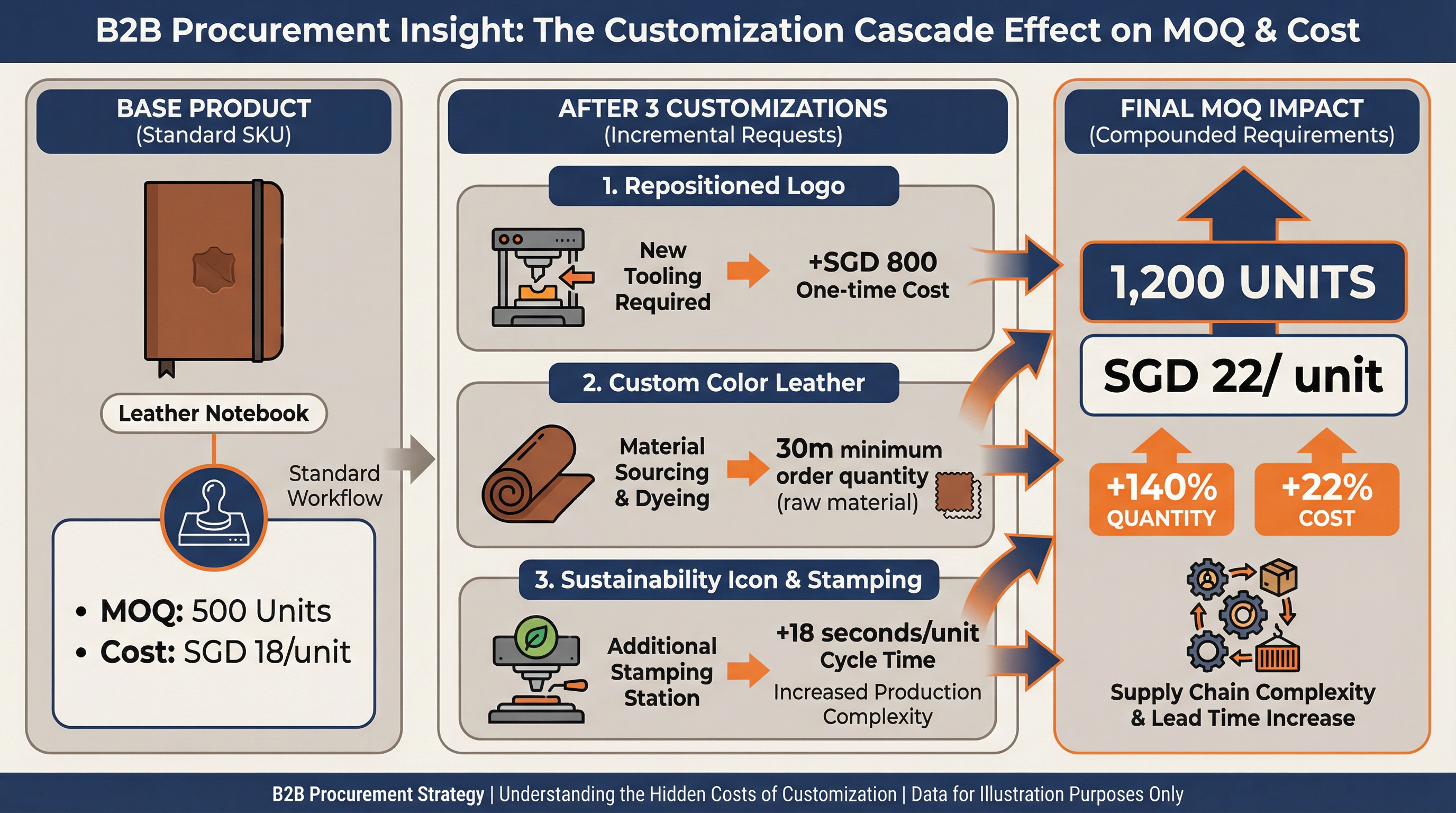
You receive the initial quote: 500 leather notebooks at SGD 18 per unit, MOQ 500. The supplier confirms they can deboss your company logo on the cover. Your team reviews the sample and requests three refinements: move the logo from center to bottom-right, change the leather from black to charcoal grey, and add a small "Sustainably Sourced" icon next to the logo. The supplier returns with a revised quote: MOQ 1,200 units at SGD 22 per unit.
Your procurement lead pushes back. These are minor adjustments. The original design already included a logo. The color change is minimal. The sustainability icon is smaller than a coin. How does this justify more than doubling the minimum order quantity and increasing the per-unit cost by 22%?
This is one of the most common misjudgments in corporate gift procurement. Buyers treat incremental customization requests as refinements to an existing design, assuming the MOQ calculation remains anchored to the base product. In practice, each customization—no matter how minor it appears—triggers a cascade of component sourcing requirements, setup cost multiplications, and production workflow changes that reset the MOQ calculation from the ground up. The final MOQ isn't the sum of individual requirements. It's a compounding function of how each change interacts with the supplier's material procurement structure, equipment setup protocols, and quality control workflows.
Six months later, you place the revised order at 1,200 units. The notebooks arrive with the logo in the correct position, the charcoal leather matches your brand guidelines, and the sustainability icon is crisp. Your finance team calculates the total cost: SGD 26,400 instead of the original SGD 9,000—a 193% increase. When you review the project retrospective, the procurement lead notes that the "minor design tweaks" were the primary cost driver, not the base product specifications.
This scenario repeats across corporate gift categories—stationery sets, drinkware, leather goods, packaging. The pattern is consistent: buyers request customizations incrementally during the sampling phase, suppliers recalculate MOQ with each change, and the final order quantity ends up 2-3x higher than the initial quote. The misjudgment isn't about negotiation tactics or supplier markup. It's about how buyers fundamentally misunderstand the mechanics of MOQ calculation when customizations are added mid-process rather than specified upfront.
The initial quote for 500 leather notebooks wasn't arbitrary. The supplier calculated it based on a specific production configuration: black leather from their primary tannery (which they order in 50-meter rolls), a single debossing plate for the centered logo (which costs SGD 800 to manufacture), and their standard packaging process (which handles 500 units per production run without retooling). The MOQ of 500 represents the minimum volume needed to absorb these fixed costs while maintaining their target profit margin.
When you request the logo repositioning, the supplier can't modify the existing debossing plate. Debossing plates are precision-machined metal dies. Changing the logo position requires manufacturing a completely new plate—another SGD 800. The supplier now has two setup costs to absorb: the original centered plate (which they already manufactured for sampling) and the new bottom-right plate. If they maintain the 500-unit MOQ, these dual setup costs increase the per-unit burden from SGD 1.60 to SGD 3.20, eroding their profit margin below viability.
The charcoal grey leather request compounds the problem. The supplier's primary tannery doesn't stock charcoal grey in their standard inventory. They can produce it as a custom dye batch, but their minimum order is 30 meters—enough leather for approximately 800 notebooks. The supplier now faces a material procurement constraint: they must order 30 meters of custom-dyed leather to fulfill your request, which means the MOQ must increase to at least 800 units to avoid excess inventory waste.
The sustainability icon adds a third layer of complexity. This isn't a simple addition to the existing debossing plate. Icons require separate tooling because they're applied in a different production step. The supplier needs to create a small stamping die (SGD 400) and integrate an additional stamping station into the assembly line. This adds labor time, quality control checkpoints, and production scheduling complexity. The supplier's production planner calculates that adding this step increases the per-unit processing time by 18 seconds, which reduces their daily output capacity from 500 units to 420 units. To maintain production efficiency, they need to batch at least 1,200 units to justify the line reconfiguration.
Each of your three "minor" customizations triggered a distinct MOQ driver: tooling multiplication (two debossing plates instead of one), component sourcing constraints (custom leather dye batch minimum), and production workflow changes (additional stamping station). These don't add linearly. They compound. The final MOQ of 1,200 isn't 500 + 300 + 400. It's the intersection point where all three constraints can be satisfied simultaneously while maintaining the supplier's minimum profitability threshold.
Buyers consistently underestimate customization impact because they evaluate changes from a design perspective rather than a production perspective. From a design standpoint, moving a logo three inches to the right is a minor adjustment—it's the same logo, the same size, the same technique. From a production standpoint, it's a complete tooling reset that doubles the setup cost and requires recalculating the minimum volume needed to amortize that cost.
This perception gap is particularly pronounced with color changes. Buyers see charcoal grey and black as adjacent shades—a subtle refinement that shouldn't materially affect production. They don't see the supplier's material procurement structure: standard colors are ordered in bulk from the tannery's standing inventory (low MOQ, immediate availability), while custom colors require dedicated dye batches (high MOQ, 4-6 week lead time). The "minor" color change transforms the leather from a commodity input with flexible sourcing to a custom component with rigid minimum order requirements.
The sustainability icon request illustrates another common misjudgment: buyers assume that adding a small element to an existing customization (the logo) is simpler than adding a large new element. In production terms, size is irrelevant. What matters is whether the addition requires new tooling, new process steps, or new quality control protocols. A small icon that requires a separate stamping die and an additional production station has the same MOQ impact as a large graphic that requires the same tooling and process integration.
Procurement teams often approach customization requests sequentially: get the base quote, review the sample, request refinements, review the revised sample, request final adjustments. This iterative approach makes sense from a design validation perspective—you want to see each change before committing to the next one. But it creates a compounding MOQ problem because each iteration triggers a new round of supplier calculations. The supplier can't simply "update" the MOQ. They have to recalculate it from scratch based on the new total configuration of tooling, materials, and production workflow.
The MOQ multiplication effect becomes more severe when customizations span multiple production stages. Corporate gift boxes typically involve three distinct manufacturing processes: the box itself (die-cutting, printing, assembly), the interior components (products, packaging materials, inserts), and the final packaging (outer boxes, protective materials, shipping prep). Each process has its own MOQ structure based on its specific setup costs and material requirements.
When you request a custom box color, you're affecting the printing stage. When you request custom tissue paper with your logo, you're affecting the packaging materials stage. When you request a custom product insert card, you're affecting the component stage. Each customization triggers an independent MOQ calculation within its respective production stage. The final MOQ for the complete gift box isn't determined by the highest individual stage MOQ—it's determined by the lowest common multiple that satisfies all three stages simultaneously.
A supplier quotes 300 units for a standard gift box with your logo printed on the lid. You request three changes: custom Pantone color for the box exterior (affects printing stage), custom tissue paper (affects packaging stage), and custom insert card (affects component stage). The printing stage MOQ increases to 500 units because custom Pantone colors require dedicated ink mixing and press calibration. The packaging stage MOQ increases to 400 units because custom tissue paper is ordered from a specialty supplier with a 400-sheet minimum. The component stage MOQ increases to 600 units because insert cards are printed in batches of 600 to optimize the digital press setup.
The supplier's final MOQ isn't 500 (the highest individual stage). It's 600—the minimum volume that allows all three stages to run efficiently without creating excess inventory at any stage. If they produced 500 units, they would have 100 unused insert cards. If they produced 400 units, they would have unused box exteriors and insert cards. The 600-unit MOQ is the first volume point where all three customizations can be integrated without waste.
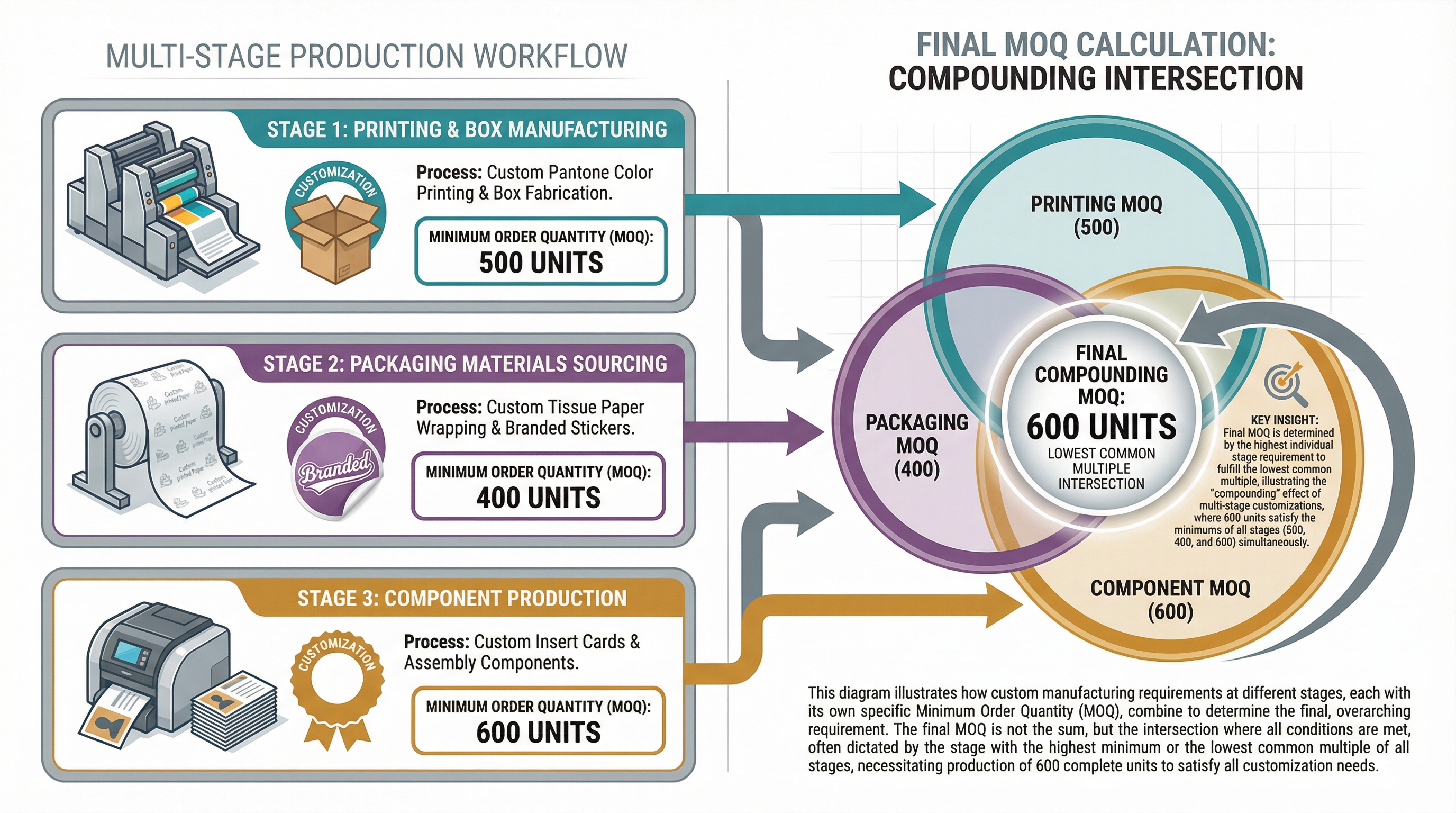
This multi-stage compounding effect explains why seemingly unrelated customizations can dramatically increase MOQ. Buyers see three separate, small changes. Suppliers see three interdependent production constraints that must be resolved simultaneously. The MOQ increase isn't about the size or complexity of each individual customization—it's about the mathematical intersection of multiple minimum requirements across different production stages.
The timing of customization requests significantly affects their MOQ impact. Customizations specified in the initial RFQ are incorporated into the base MOQ calculation. The supplier evaluates all requirements simultaneously, optimizes the production configuration, and quotes a single MOQ that reflects the complete specification. Customizations requested after the initial quote—during sampling, after sample approval, or even after purchase order issuance—force the supplier to recalculate MOQ based on a new configuration that wasn't optimized for cost efficiency.
A procurement team requests quotes for 500 leather portfolios with a debossed company logo. Three suppliers respond with MOQs of 500, 600, and 800 units respectively. The team selects the 500-unit supplier and proceeds to sampling. After receiving the sample, they request two changes: add a pen loop inside the portfolio and change the closure from magnetic to snap button. The supplier returns with a revised MOQ of 1,000 units.
The procurement lead is frustrated. These are functional improvements, not decorative additions. The pen loop is a simple strip of elastic. The snap button is a standard hardware component. How does this double the MOQ?
The original 500-unit MOQ was calculated for a specific product configuration: a leather portfolio with a debossed logo, magnetic closure, and no interior features. The supplier's production setup was optimized for this configuration—they ordered leather in quantities sufficient for 500 units, manufactured one debossing plate, and sourced magnetic closures from their standard hardware supplier (who has a 500-unit minimum for this particular closure type).
The pen loop addition requires integrating a sewing station into the assembly line. The supplier's leather goods facility has multiple production lines, but only two are equipped with the specialized sewing machines needed for elastic attachment. These lines are scheduled months in advance for other clients' orders. To accommodate your pen loop requirement, they need to either interrupt an existing production run (which incurs penalty costs from the displaced client) or wait for the next available slot (which delays your delivery by 8-10 weeks). The most cost-effective solution is to batch your order with another client's elastic-sewing run, but that requires a minimum of 1,000 units to justify the line reconfiguration.
The snap button change compounds the problem. The supplier's standard magnetic closure has a 500-unit MOQ from their hardware supplier. Snap buttons come from a different hardware supplier with a 1,000-unit MOQ. By changing the closure type, you've shifted the component sourcing from a low-MOQ supplier to a high-MOQ supplier. The supplier can't order 500 snap buttons—their supplier won't accept the order. They must order at least 1,000, which means your MOQ must increase to 1,000 to avoid inventory waste.
These mid-process customization requests are particularly costly because they disrupt the supplier's optimized production planning. When customizations are specified upfront, the supplier can negotiate with their component suppliers, optimize production scheduling, and potentially combine your order with other clients' orders that share similar specifications. When customizations are requested mid-process, the supplier has already committed to specific component orders, production schedules, and equipment configurations. Changing these commitments incurs penalty costs, expedite fees, and efficiency losses that must be recovered through higher MOQ or higher per-unit pricing.
The most effective way to minimize MOQ increases from customization is to specify all requirements in the initial RFQ, even if you're uncertain about final design details. Suppliers can provide conditional quotes—"If you choose custom color, MOQ increases to X; if you add interior features, MOQ increases to Y"—that allow you to understand the MOQ implications of different customization options before committing to sampling.
When mid-process changes are unavoidable, frame them as complete reconfigurations rather than incremental adjustments. Instead of requesting "add a pen loop to the existing design," request "quote for leather portfolio with debossed logo, magnetic closure, and pen loop." This signals to the supplier that you understand this is a new product configuration requiring fresh MOQ calculation, not a minor tweak to the existing quote.
For complex corporate gift projects with multiple customization possibilities, consider requesting a customization matrix from the supplier: a table showing how different combinations of customizations affect MOQ and per-unit pricing. This allows your team to evaluate trade-offs systematically rather than discovering MOQ increases reactively after each design iteration.
The compounding effect of incremental customizations extends beyond direct production costs. Each mid-process change disrupts the supplier\'s material procurement timeline, creating ripple effects that affect lead time, inventory planning, and production scheduling. When you request a custom leather color after the initial quote, the supplier must pause their standard material ordering process, contact their tannery to negotiate a custom dye batch, wait for dye lot approval, and then integrate this custom material into their production schedule. This procurement disruption adds 3-4 weeks to your lead time and forces the supplier to hold safety stock of the custom leather to prevent production delays—costs that must be recovered through higher MOQ or per-unit pricing.
Quality control protocols also multiply with each customization. A standard leather notebook with a centered logo requires two quality checkpoints: leather inspection upon receipt and final debossing inspection after production. Adding a repositioned logo, custom color, and sustainability icon increases this to six checkpoints: custom leather dye lot approval, leather inspection, first debossing plate inspection, second stamping die inspection, assembly verification (to ensure the icon and logo are correctly positioned relative to each other), and final product inspection. Each checkpoint adds labor cost, inspection time, and potential rejection risk that the supplier must account for in their MOQ calculation.
The most significant hidden cost of incremental customizations is the opportunity cost of production line disruption. Manufacturing facilities operate on tightly scheduled production runs optimized for efficiency. When a client requests mid-process changes, the supplier must either interrupt the current production schedule (displacing other clients\' orders and incurring penalty costs) or delay the order until the next available production slot (extending lead time by weeks or months). Both options reduce the supplier\'s overall production efficiency, which they recover by increasing MOQ to ensure each production run generates sufficient profit to offset the scheduling disruption.
Corporate gift procurement teams can minimize these compounding effects by adopting a front-loaded specification approach. Instead of requesting a base quote and iteratively refining the design through multiple sampling rounds, specify all potential customizations in the initial RFQ—even if you haven\'t finalized which options you\'ll ultimately select. Request conditional quotes that show MOQ and pricing for different customization combinations: \"Option A: centered logo only, MOQ 500 at SGD 18. Option B: repositioned logo plus custom color, MOQ 800 at SGD 20. Option C: repositioned logo, custom color, and sustainability icon, MOQ 1,200 at SGD 22.\" This approach allows you to evaluate the true cost implications of each customization before committing to sampling, rather than discovering MOQ increases reactively after each design iteration.
When mid-process changes are unavoidable due to stakeholder feedback or brand guideline updates, communicate them to the supplier as a complete reconfiguration rather than incremental adjustments. Frame the request as \"We need to revise our specifications to include repositioned logo, custom color, and sustainability icon—please provide a fresh quote for this new configuration\" rather than \"Can you add a sustainability icon to the existing design?\" This signals that you understand the production implications and expect a revised MOQ calculation, which facilitates more transparent supplier communication and reduces the likelihood of surprise cost increases.
For complex corporate gift projects involving multiple stakeholders with evolving design preferences, consider establishing a customization budget at the project outset. Allocate a specific number of \"customization credits\" that the team can spend on design refinements, with each credit representing a defined MOQ increase threshold. For example: \"We have budget for two customizations beyond the base design, each of which can increase MOQ by up to 200 units. Any additional customizations must be approved by finance.\" This framework helps teams prioritize which design elements are worth the MOQ impact and which should be deferred to future orders.
Understanding minimum order quantities for corporate gifts in Singapore requires recognizing that MOQ isn\'t a fixed number attached to a product—it\'s a dynamic calculation that reflects the total configuration of materials, tooling, and production processes required to manufacture your specific specification. Each customization changes this configuration, triggering a cascade of component sourcing adjustments, setup cost multiplications, and production workflow modifications that compound in ways most buyers don\'t anticipate during the design refinement process. The most effective procurement strategy isn\'t to avoid customizations—it\'s to specify them comprehensively at the outset, enabling suppliers to optimize their production configuration and quote accurate MOQs that reflect the true complexity of your requirements.