What Is the Minimum Order Quantity for Corporate Gift Boxes: Payment Timing Impact on Cash Flow
Procurement teams evaluating MOQ commitments often focus on total order value while systematically underestimating how payment term structures create cash flow pressure that can threaten business operations.
Your finance team approved the leather notebook order three weeks ago. The supplier quoted 500 units at $10 each with a 30% deposit requirement, and your procurement manager signed off because the total spend of $5,000 fit comfortably within the quarterly budget allocation. Production wrapped on schedule, the quality inspection passed without issues, and the 70% balance payment cleared two days before the container shipped from the port.
Then accounts payable flagged a problem. The $3,500 balance payment, combined with two other supplier invoices that came due the same week, pushed the operating account $8,200 below the safety threshold your CFO established for covering payroll and rent. The finance director had to pull funds from the marketing budget earmarked for the product launch campaign, which meant delaying the digital ads by six weeks. By the time the campaign finally ran, two competitors had already launched similar products into the same market segment.
The procurement manager insists the decision was sound because the MOQ analysis spreadsheet showed the 500-unit order would turn over in 90 days at the projected sell-through rate, generating a 35% gross margin. The finance director counters that the analysis completely ignored the timing of cash outflows relative to cash inflows, which is why the company now faces a choice between paying the landlord late or asking the bank to extend the credit line at a higher interest rate.
This situation repeats itself across corporate gift procurement teams every quarter, and the root cause is always the same. When evaluating minimum order quantity commitments from suppliers, buyers focus almost exclusively on the total order value and the per-unit cost, treating the decision as a simple inventory math problem. The payment terms, which determine exactly when cash leaves the company account, get relegated to a footnote in the purchase order rather than treated as a primary variable in the risk assessment.
The standard MOQ evaluation framework asks three questions. Can we sell this volume within a reasonable timeframe? Does the per-unit cost deliver acceptable margin? Do we have budget approval for this total spend? If all three answers come back affirmative, the order moves forward. What this framework systematically fails to capture is the fourth question that should precede all others: when does the supplier require payment, and does our cash position support that timing given everything else competing for funds in the same period? Understanding these order quantity thresholds requires looking beyond the headline numbers to examine the full financial cycle.
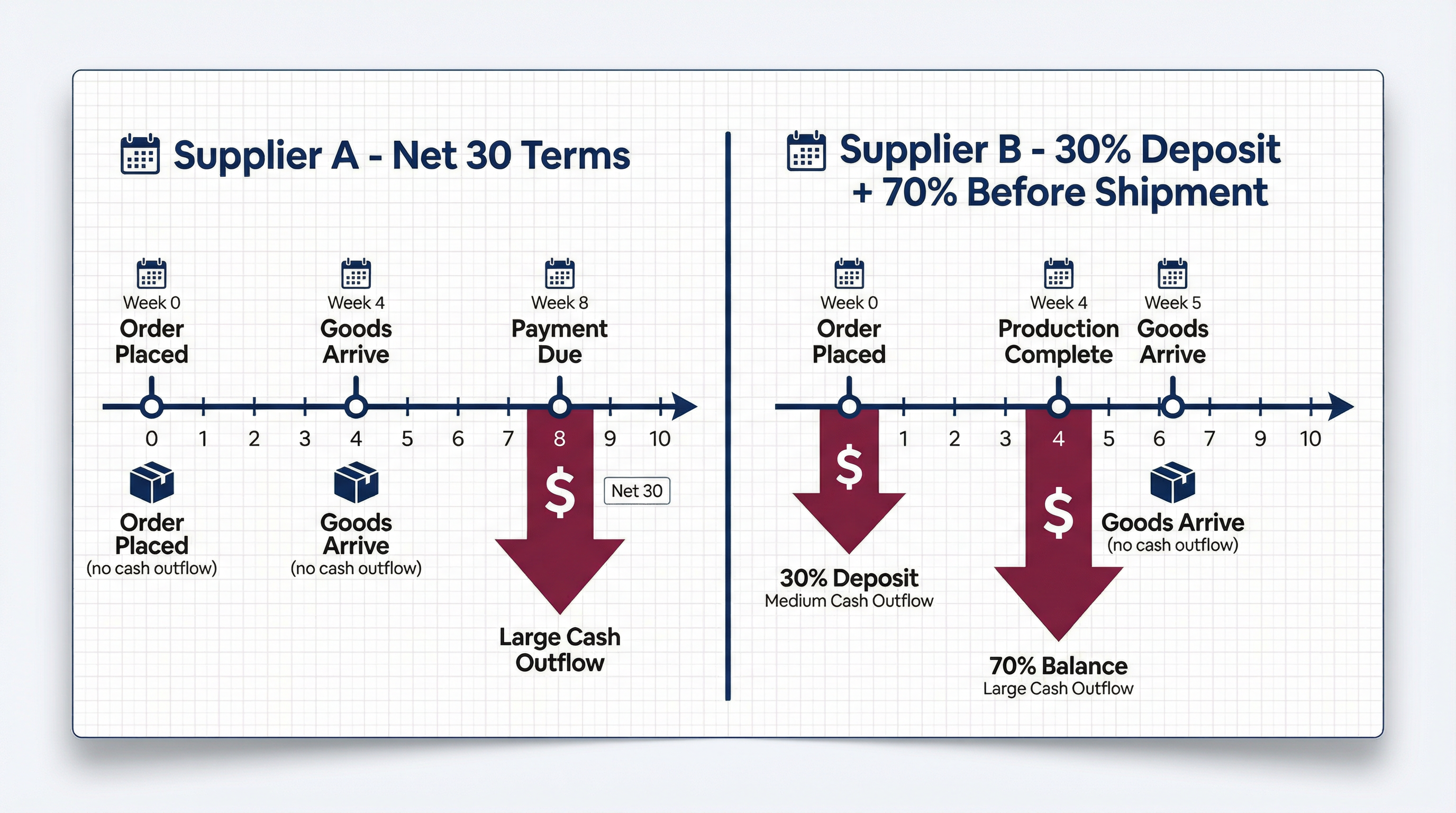
Consider how buyers typically compare supplier quotes for corporate gift boxes. Supplier A offers 1,000 units at $8 each with Net 30 terms, meaning payment is due 30 days after the goods ship. Supplier B offers 500 units at $10 each with a 30% deposit due at order placement and the remaining 70% due before shipment. The procurement analysis focuses on the headline numbers: Supplier A requires $8,000 total while Supplier B requires $5,000 total, and since the lower MOQ reduces inventory risk, Supplier B appears to be the more conservative choice.
This comparison completely misses the cash flow timeline. With Supplier A, the company places the order today but doesn't need to transfer any funds for at least four weeks, assuming standard production lead times. The goods arrive, get distributed to recipients, and the company has another 30 days before the invoice comes due. That's roughly eight weeks of buffer between order placement and cash outflow, during which the products might already be generating sales or fulfilling their intended purpose as client gifts that strengthen business relationships.
With Supplier B, the $1,500 deposit is due immediately upon order confirmation. Four weeks later, when production completes, the company must pay the $3,500 balance before the supplier releases the shipment. The total $5,000 has left the company account before the products even arrive at the warehouse, let alone reach the end customers. There is no buffer period, no opportunity to align the cash outflow with incoming revenue from other sources, and no flexibility if an unexpected expense emerges during the production window.
The financial impact extends beyond the immediate cash position. When a company commits $5,000 upfront for a corporate gift order, that capital becomes unavailable for other uses during the entire production and delivery cycle. If a key client suddenly requests a rush order of promotional items, or if a supplier offers a limited-time discount on another product line, the procurement team has $5,000 less flexibility to respond. The opportunity cost of that locked capital doesn't appear in the MOQ evaluation spreadsheet, but it represents real economic value that could have been deployed elsewhere.
Payment terms also interact with MOQ requirements in ways that amplify risk for buyers who don't model the full cash flow cycle. A supplier offering a lower MOQ often does so precisely because they need to protect their own cash position through deposits and prepayments. They're willing to accept smaller production runs, but only if the buyer shares the financial risk by committing cash before the goods are manufactured. The buyer interprets the lower MOQ as reduced risk, when in reality the risk has simply shifted from inventory exposure to cash flow exposure.
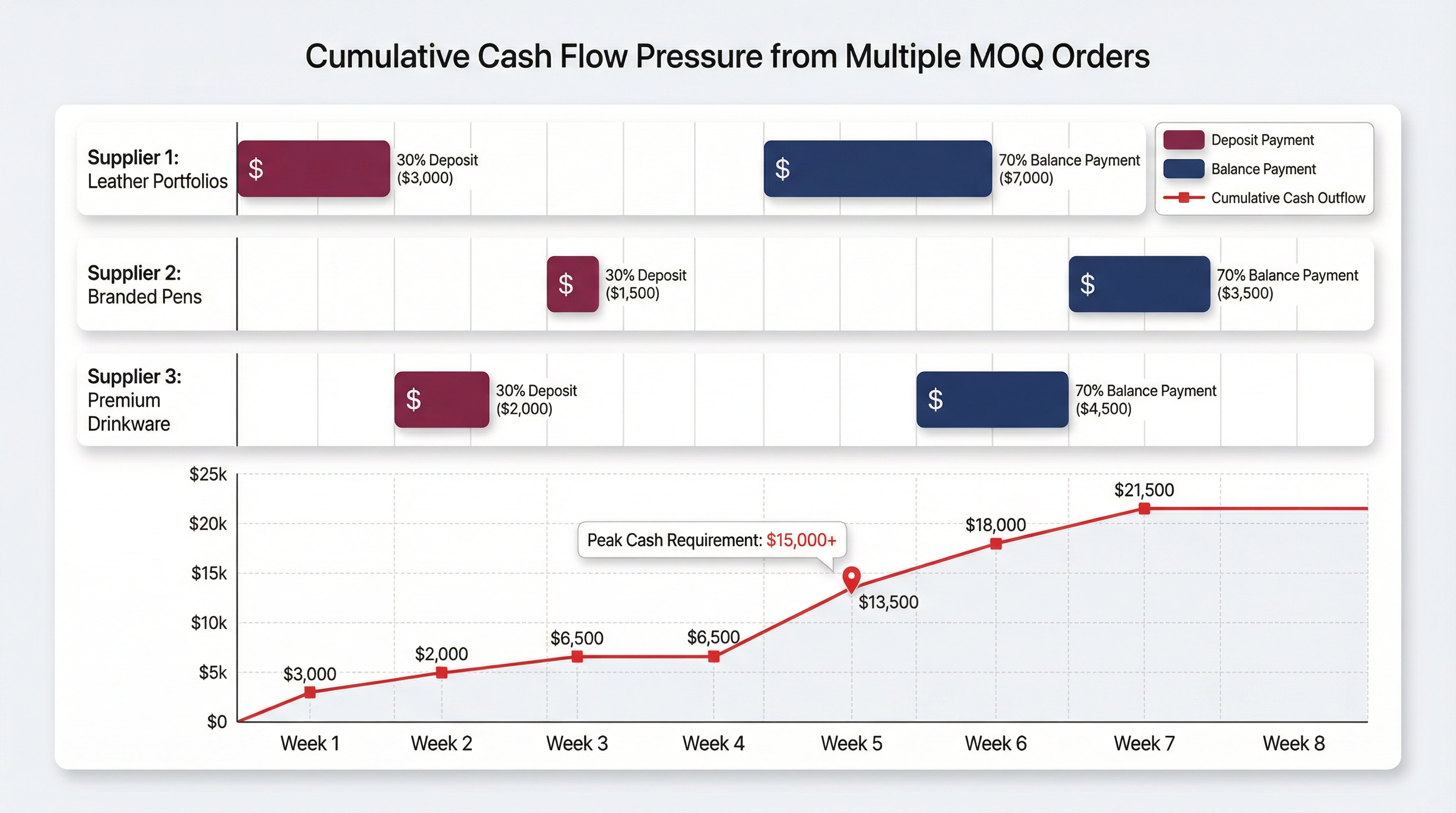
This dynamic becomes particularly problematic for companies managing multiple supplier relationships simultaneously. A procurement manager might negotiate favorable MOQ terms with three different suppliers for leather portfolios, branded pens, and premium drinkware, each requiring 30-40% deposits. Individually, each deposit seems manageable. But when all three orders happen to enter production during the same month, the cumulative deposit requirement can easily exceed $15,000, creating a cash crunch that wouldn't have occurred if the payment terms had been factored into the scheduling decisions.
!Cumulative Cash Flow Pressure
The situation intensifies during peak ordering seasons. In Singapore's corporate gifting market, the period from September through November sees concentrated demand as companies prepare year-end appreciation gifts and Chinese New Year corporate presents. Suppliers know their production capacity is constrained during these months, which gives them leverage to impose stricter payment terms. A supplier who might offer Net 30 terms during slower periods will shift to 50% deposit requirements during peak season, citing the need to secure raw materials and lock in production slots.
Buyers who evaluate MOQ decisions without accounting for seasonal payment term variations often find themselves in a bind. They commit to orders in August based on budget projections that assumed standard payment terms, only to discover in September that the actual cash requirement is 50% higher than anticipated because multiple suppliers have tightened their terms simultaneously. The company either has to delay some orders, which pushes delivery into January when the gifting window has closed, or scramble to secure short-term financing at unfavorable rates.
The payment timing issue also affects how buyers assess supplier reliability and relationship quality. When a supplier offers generous MOQ flexibility but requires full prepayment, buyers often interpret this as a sign of accommodation and partnership. In practice, the supplier is transferring execution risk entirely onto the buyer. If production delays occur, if quality issues emerge, or if the supplier's financial situation deteriorates mid-production, the buyer has already committed the full payment and has limited leverage to ensure satisfactory resolution.
Contrast this with a supplier who maintains higher MOQ requirements but offers Net 30 or Net 60 terms. The buyer retains payment leverage throughout the production cycle and for weeks after delivery. If problems arise, the buyer can withhold payment or negotiate adjustments before releasing funds. The higher MOQ might seem less flexible on the surface, but the payment terms actually provide more protection against operational and quality risks that commonly emerge during manufacturing.
This protection becomes especially valuable for first-time orders with a new supplier. Buyers naturally focus on minimizing inventory risk when testing a new relationship, which makes lower MOQ offers attractive. But accepting those lower MOQs in exchange for deposit requirements means committing significant capital before the supplier has demonstrated their ability to meet quality standards, adhere to timelines, or communicate effectively when issues arise. The buyer has optimized for the wrong risk variable.
The cash flow timing problem also interacts with the buyer's own sales cycle in ways that MOQ analysis typically ignores. Corporate gift procurement often happens in anticipation of specific events, client meetings, or seasonal campaigns. The buyer knows approximately when the products need to be in hand, but the timing of when those products will actually generate value or revenue can vary significantly based on factors outside the procurement team's control.
A company ordering branded leather notebooks for a trade show in October might place the order in August, pay a 30% deposit immediately, pay the 70% balance in September, and receive the goods in early October. If the trade show gets postponed to November, or if attendance is lower than expected and half the notebooks don't get distributed, the company has tied up $5,000 in cash for an extra month or longer without generating the intended business development value. The MOQ analysis that showed a 90-day inventory turn assumed the products would enter circulation immediately upon arrival, but payment term structures that require upfront cash don't accommodate these timing uncertainties.
The disconnect between MOQ evaluation and payment term analysis often stems from organizational structure. Procurement teams are measured on cost savings, supplier performance, and inventory management. Finance teams are measured on cash flow, working capital efficiency, and liquidity ratios. The procurement manager who negotiates a lower MOQ with favorable per-unit pricing gets credit for smart sourcing, while the finance team deals with the consequences of the deposit structure that made that lower MOQ possible. The two teams are optimizing for different objectives using different metrics, and the payment terms fall into the gap between their respective mandates.
Some companies attempt to bridge this gap by requiring finance approval for all purchase orders above a certain threshold, but this often becomes a rubber-stamp process focused on budget availability rather than cash flow timing. The finance team confirms that the total order value fits within the approved budget allocation, but they don't model out the specific payment schedule against the company's projected cash position for the relevant weeks. The approval process checks whether the company can afford the purchase in principle, not whether the company can afford the payment timing in practice.
Even when buyers do consider payment terms during MOQ evaluation, they often make the mistake of treating different payment structures as equivalent as long as the total amount is the same. A $5,000 order with 30% deposit plus 70% before shipment gets compared directly to a $5,000 order with Net 30 terms, and since both require the same total outflow, the buyer focuses on other factors like MOQ size or per-unit cost. This equivalence assumption ignores the time value of money and the optionality that deferred payment provides.
Having $5,000 available in the company account for an extra 30-60 days creates real economic value. That capital can earn interest in a money market account, can be deployed to take advantage of early payment discounts with other suppliers, or can simply provide buffer against unexpected expenses that would otherwise require expensive short-term borrowing. The difference between paying $5,000 today versus paying $5,000 in 60 days might represent $50-100 in direct financial benefit, plus the intangible value of maintaining financial flexibility during an uncertain period.
The payment term structure also affects how buyers should think about MOQ negotiations with suppliers. When a supplier offers to reduce the MOQ in exchange for a deposit requirement, the buyer needs to calculate not just whether the lower volume reduces inventory risk, but whether the deposit requirement increases cash flow risk by a greater amount. In many cases, the answer is yes. The inventory risk from ordering an extra 200-300 units might cost the company $2,000-3,000 in carrying costs over six months, but the cash flow risk from tying up $5,000 in deposits across multiple suppliers during the same period might cost $8,000-10,000 in lost opportunities or emergency financing charges.
This calculation becomes even more important for companies operating on thin margins or in capital-intensive industries. A corporate gift supplier serving the financial services sector might operate on 15-20% net margins, meaning every dollar of cash has to work efficiently to generate acceptable returns. Tying up $50,000 in supplier deposits for 6-8 weeks represents $50,000 that can't be used to fund other inventory purchases, pay down revolving credit lines, or invest in marketing campaigns. The opportunity cost of that capital drag can easily exceed the benefit of securing lower MOQ terms from suppliers.
The problem is particularly acute for growing companies that are scaling their corporate gift operations. Growth requires capital for inventory, marketing, hiring, and infrastructure, all of which compete for the same pool of available cash. A procurement strategy that prioritizes lower MOQs through deposit-heavy payment terms might look conservative from an inventory perspective, but it can actually constrain growth by locking up cash that would be better deployed elsewhere. The company ends up inventory-light but cash-poor, unable to respond quickly to new opportunities because their working capital is tied up in deposits with multiple suppliers.
Some buyers attempt to solve this problem by negotiating split payment terms with suppliers, such as 30% deposit, 30% at production midpoint, and 40% before shipment. This spreads the cash outflow over a longer period, which can help with cash flow management. However, it also increases administrative complexity and requires more frequent communication with suppliers to coordinate payment timing with production milestones. For orders below a certain size, typically under $10,000, suppliers often refuse split payment structures because the administrative burden outweighs the benefit of securing the order.
The payment term challenge also intersects with currency risk for companies sourcing corporate gifts from overseas suppliers. A Singapore-based company ordering leather goods from a Chinese manufacturer might negotiate favorable MOQ terms, but if the payment terms require a 50% deposit in USD or RMB, the company faces currency exposure for the entire production period. If the Singapore dollar weakens against the payment currency between deposit and final payment, the effective cost of the order increases, potentially eroding the margin advantage that justified the MOQ decision in the first place.
This currency dimension adds another layer of complexity that standard MOQ analysis doesn't capture. The buyer needs to consider not just when payment is due, but in what currency, and whether the company's treasury function has adequate hedging instruments in place to manage the exposure. For smaller companies without sophisticated treasury operations, accepting deposit requirements in foreign currencies can introduce significant financial risk that has nothing to do with the underlying product quality or inventory management.
The relationship between MOQ and payment terms also affects how buyers should structure their supplier portfolio. A procurement strategy that relies heavily on suppliers offering low MOQs with deposit requirements creates a portfolio with high cash flow volatility. When multiple orders enter production simultaneously, the cumulative deposit requirement spikes. When multiple orders complete production in the same week, the cumulative balance payment spikes. This creates a lumpy cash flow pattern that is harder to manage than the smoother pattern that emerges from working with suppliers who offer higher MOQs but more flexible payment terms.
A more resilient procurement strategy might intentionally include a mix of supplier payment term structures. Some suppliers with deposit requirements for flexibility on small orders, balanced by other suppliers with Net 30 or Net 60 terms for larger, more predictable orders. This diversification helps smooth out the cash flow impact across the portfolio, reducing the risk that multiple payment obligations will coincide in ways that strain the company's liquidity position.
The payment timing issue becomes especially critical during periods of economic uncertainty or tight credit conditions. When banks tighten lending standards or when the company's own financial performance comes under pressure, the ability to defer payment obligations becomes more valuable. A procurement strategy built around low MOQs with deposit requirements leaves the company with less financial flexibility precisely when flexibility is most needed. The inventory risk that the low MOQs were meant to mitigate becomes secondary to the cash flow risk that the deposit structure created.
This dynamic played out clearly during the supply chain disruptions of recent years. Companies that had optimized their procurement strategies around low MOQs with deposit requirements found themselves cash-constrained when multiple suppliers simultaneously demanded larger deposits to secure raw materials in tight markets. Companies that had maintained relationships with suppliers offering more flexible payment terms, even if those suppliers required higher MOQs, had more room to maneuver when conditions deteriorated.
The lesson from these experiences is that MOQ evaluation needs to incorporate payment term analysis as a primary risk factor, not an afterthought. The question isn't just "can we sell this volume?" but "can we afford the payment timing given our current cash position and upcoming obligations?" The answer to the second question should carry equal or greater weight in the final decision, because cash flow problems can threaten business viability in ways that excess inventory typically does not.
For procurement teams looking to improve their MOQ decision-making process, the starting point is to build payment term modeling into the standard evaluation framework. Every supplier quote should be analyzed not just for total cost and per-unit pricing, but for the specific cash outflow schedule it creates. A simple spreadsheet that maps supplier payment obligations against projected cash inflows over the next 90 days can reveal timing conflicts that wouldn't be apparent from looking at total order values alone.
This kind of cash flow modeling doesn't require sophisticated financial expertise. It simply requires procurement teams to ask finance for a projection of the company's cash position over the relevant period, and then overlay the payment obligations from pending supplier orders onto that projection. If the analysis shows that multiple deposit payments will coincide with a period of low cash inflows, the procurement team can adjust order timing, negotiate different payment terms, or prioritize suppliers who offer more flexibility.
The broader point is that minimum order quantity decisions are fundamentally financial decisions, not just inventory decisions. The size of the order matters, but the timing of the payment matters just as much, if not more. Buyers who treat MOQ evaluation as purely an inventory optimization problem will consistently underestimate the cash flow risks they're accepting, and will find themselves in situations where the "conservative" choice of a lower MOQ actually created more financial stress than the alternative of a higher MOQ with better payment terms.
In practice, this often means accepting higher MOQs from suppliers who offer Net 30 or Net 60 terms, rather than chasing the lowest possible MOQ from suppliers who require substantial deposits. The extra inventory might sit in the warehouse for a few additional weeks, but the company maintains cash flow flexibility and payment leverage throughout the production cycle. That flexibility has real economic value that should be factored into the MOQ decision with the same rigor that buyers apply to per-unit cost analysis.
The corporate gift procurement landscape is moving toward greater recognition of these cash flow dynamics, driven partly by the financing pressures that many companies have experienced in recent years. Buyers are starting to ask more pointed questions about payment terms during supplier negotiations, and are pushing back against deposit requirements that would have been accepted without much discussion in earlier periods. Suppliers, in turn, are becoming more willing to discuss payment term flexibility as a negotiating variable, recognizing that buyers who feel cash flow pressure are more likely to delay orders or switch suppliers entirely.
This evolution suggests that the traditional separation between MOQ evaluation and payment term analysis is breaking down, which should lead to better procurement decisions over time. But the change is happening slowly, and many buyers still default to the old framework that treats payment terms as a secondary consideration. For those buyers, the risk of cash flow disruption from seemingly conservative MOQ choices remains high, and will continue to create financial stress that could have been avoided with more integrated analysis upfront.
The path forward requires procurement teams to expand their definition of what constitutes a "good" supplier relationship. It's not just about getting the lowest MOQ or the best per-unit price. It's about finding suppliers whose payment term structures align with the company's cash flow reality, and who are willing to work collaboratively when timing conflicts arise. Those relationships, built on mutual understanding of financial constraints rather than just product specifications, tend to be more durable and more valuable over the long term than relationships focused solely on minimizing order quantities.