Quote Validity Expiration During MOQ Negotiations
Procurement teams systematically ignore supplier quote validity periods during MOQ negotiations, discovering too late that expired quotes transfer all leverage to suppliers who can reprice or refuse orders.
The procurement director's email arrived at 4:17 PM on a Wednesday, eight weeks into what had started as a straightforward MOQ negotiation for your company's year-end corporate gift boxes. The leather notebook supplier you'd been negotiating with—a manufacturer in Guangdong who had agreed to reduce their standard 1,500-unit minimum to 1,000 units after six weeks of discussions—was now informing you that their original quotation had expired three days ago. The price they quoted in early September, which your finance team had finally approved last week after extensive budget reviews, was no longer valid. The new quote, attached to the email, showed a 12% price increase and a return to their standard 1,500-unit MOQ. The supplier's explanation was polite but firm: raw material costs had shifted, and their production schedule for Q4 was now fully committed. If you wanted to proceed, you would need to accept the new terms by Friday.
Your procurement team insists this situation is unforeseeable. The supplier never mentioned that the quotation would expire during negotiations. The original quote included standard payment terms, delivery schedules, and product specifications, but the validity period—listed as "45 days from quote date"—seemed like administrative boilerplate, not a negotiation constraint. How could anyone have predicted that your internal approval process would take longer than the quote validity window? The supplier seemed genuinely interested in winning your business throughout the negotiation. Why would they suddenly change terms when you're ready to commit?
This scenario repeats itself in corporate gift procurement every quarter, and the root cause is always the same timing error. Buyers treat quote validity periods as administrative details rather than negotiation deadlines, conducting MOQ discussions without tracking the expiration date of the supplier's pricing commitment. The purchase order gets drafted, the budget gets approved, and only then does anyone notice that the quote has expired. By that point, the buyer has surrendered all negotiation leverage. The supplier has your timeline, your budget constraints are visible through your negotiation behavior, and your options have narrowed to accepting new terms or restarting the entire sourcing process while eating the sunk costs of eight weeks of negotiation time.
_Quote validity expiration during MOQ negotiations transforms what should be a straightforward procurement timeline into a leverage transfer mechanism that systematically disadvantages buyers who fail to synchronize negotiation pace with pricing commitment windows._
!Timeline mismatch between MOQ negotiation process and quote validity period
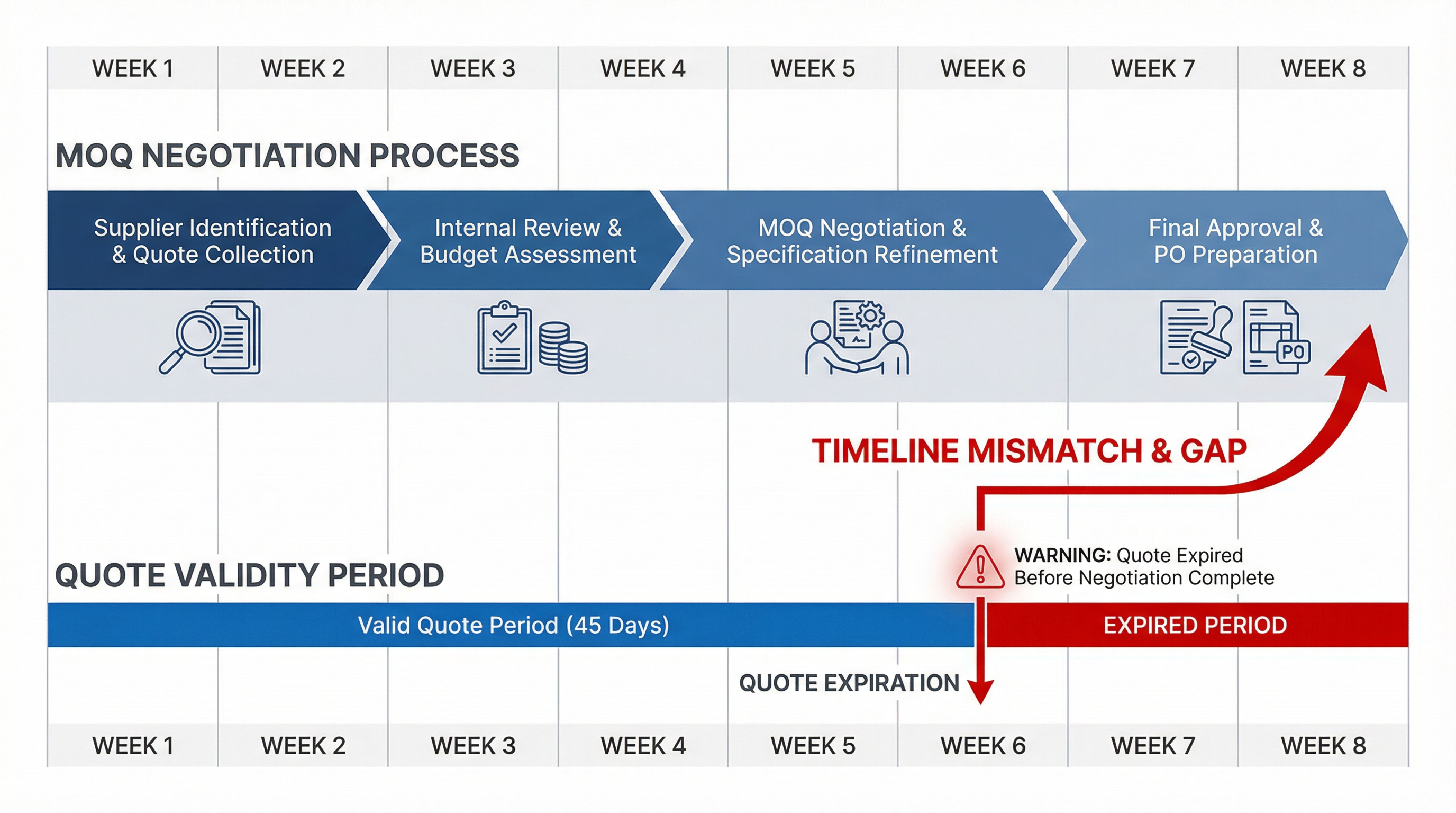
The standard procurement sequence treats quote validity as a supplier-side administrative requirement rather than a buyer-side negotiation constraint. The MOQ discussion focuses entirely on order quantity, unit price, customization options, and delivery schedules. Can the supplier accept 1,000 units instead of their standard 1,500? Will they maintain competitive pricing at the lower volume? Can they accommodate your logo embossing requirements? If these answers satisfy your procurement criteria, the negotiation advances through internal approval channels. Quote validity, if anyone notices it at all, gets filed alongside other contractual boilerplate like force majeure clauses and dispute resolution procedures. This categorization error transforms a time-sensitive pricing commitment into background noise that no one monitors until it's too late.
The disconnect stems from a fundamental misunderstanding about what quote validity actually controls. When a supplier issues a quotation valid for 45 days, buyers interpret this as a courtesy window—a reasonable period for the buyer to complete their internal processes without time pressure. The logic seems sound: suppliers understand that corporate procurement requires budget approvals, stakeholder reviews, and specification confirmations. Surely the validity period accounts for these normal business timelines. This assumption ignores the asymmetric information problem that defines quote validity. The supplier knows their production schedule, raw material cost trends, and capacity commitments. The buyer knows their internal approval complexity, budget cycle timing, and decision-making bottlenecks. Neither party fully understands the other's timeline constraints, and neither has incentive to make their constraints visible during early-stage negotiations.
For suppliers, quote validity serves multiple strategic functions that buyers systematically underestimate. The most obvious function is price protection—limiting exposure to raw material cost increases, currency fluctuations, or demand surges that could make the quoted price unprofitable. But quote validity also functions as a capacity management tool. A 45-day validity window allows the supplier to hold production slots for potential orders without indefinitely blocking capacity that could be allocated to other clients. When the validity period expires, the supplier can legitimately reallocate that capacity and adjust pricing to reflect current market conditions. This capacity reallocation happens invisibly to the buyer, who sees only a price increase or MOQ change without understanding the production scheduling dynamics that drove it.
The timing mismatch between MOQ negotiation cycles and quote validity windows creates systematic leverage problems that buyers discover only after losing their negotiating position. A typical corporate gift MOQ negotiation requires four to eight weeks from initial quote request to purchase order issuance. Week one involves supplier identification and quote collection. Week two covers internal stakeholder review and preliminary budget assessment. Weeks three through five encompass MOQ negotiation, specification refinement, and sample evaluation. Weeks six through eight involve final budget approval, legal review, and purchase order preparation. This timeline assumes no significant delays, no extended holiday periods, and no unexpected stakeholder objections. In practice, negotiations frequently extend beyond eight weeks when complications arise.
Meanwhile, supplier quote validity periods for corporate gift manufacturing typically range from 30 to 45 days, occasionally extending to 60 days for large-volume commitments or established customer relationships. These validity windows reflect the supplier's need to manage pricing risk and production capacity in markets where raw material costs can shift significantly within a quarter. Leather goods suppliers face volatile hide prices influenced by livestock cycles and tannery capacity. Metal gift suppliers contend with aluminum and steel price fluctuations driven by global commodity markets. Even suppliers of seemingly stable products like notebooks or drinkware must account for packaging material costs, labor rate changes, and shipping fee adjustments that can materially impact profitability on thin-margin corporate gift orders.
The mathematical reality is stark: a negotiation process that requires six to eight weeks cannot reliably complete within a 30 to 45-day quote validity window unless the buyer actively manages timeline compression from day one. Yet procurement teams rarely calculate this timeline mismatch at negotiation outset. The quote arrives with a validity date printed in the footer—"This quotation is valid until October 15, 2024"—and gets filed with the pricing details. No one creates a reverse timeline showing that if the quote expires October 15, and final approval requires two weeks, then all negotiation must conclude by October 1, meaning MOQ discussions must start no later than September 10 to allow three weeks for quantity and specification negotiations. This reverse timeline calculation happens in project management contexts but rarely in procurement negotiations, where the focus remains on price and quantity rather than process timing.
The attention allocation error that causes buyers to overlook quote validity stems from the way procurement teams structure their negotiation priorities. MOQ negotiations naturally center on the most visible and quantifiable variables: order quantity and unit price. These variables directly impact budget calculations and approval processes. A buyer negotiating to reduce MOQ from 1,500 to 1,000 units can immediately calculate the inventory carrying cost savings and cash flow benefits. A buyer securing a 5% price reduction can quantify the budget impact and demonstrate procurement value to management. These tangible outcomes drive negotiation focus and consume cognitive bandwidth.
Quote validity, by contrast, appears to be a constraint on the supplier rather than a variable the buyer can influence. The validity period is printed on the quotation as a fixed term, not presented as a negotiable element. Buyers assume that if they need more time, they can simply request an extension, much like requesting deadline extensions in other business contexts. This assumption treats quote validity as a soft deadline rather than a hard constraint, failing to recognize that validity extensions transfer negotiation leverage from buyer to supplier. When a buyer requests a validity extension, they signal that they have invested significant time in this supplier relationship, completed internal approvals based on the original pricing, and face substantial switching costs if they must restart the sourcing process. The supplier, receiving this signal, gains pricing power they did not have when the original quote was issued.
!Leverage transfer mechanism when quote validity expires during MOQ negotiations
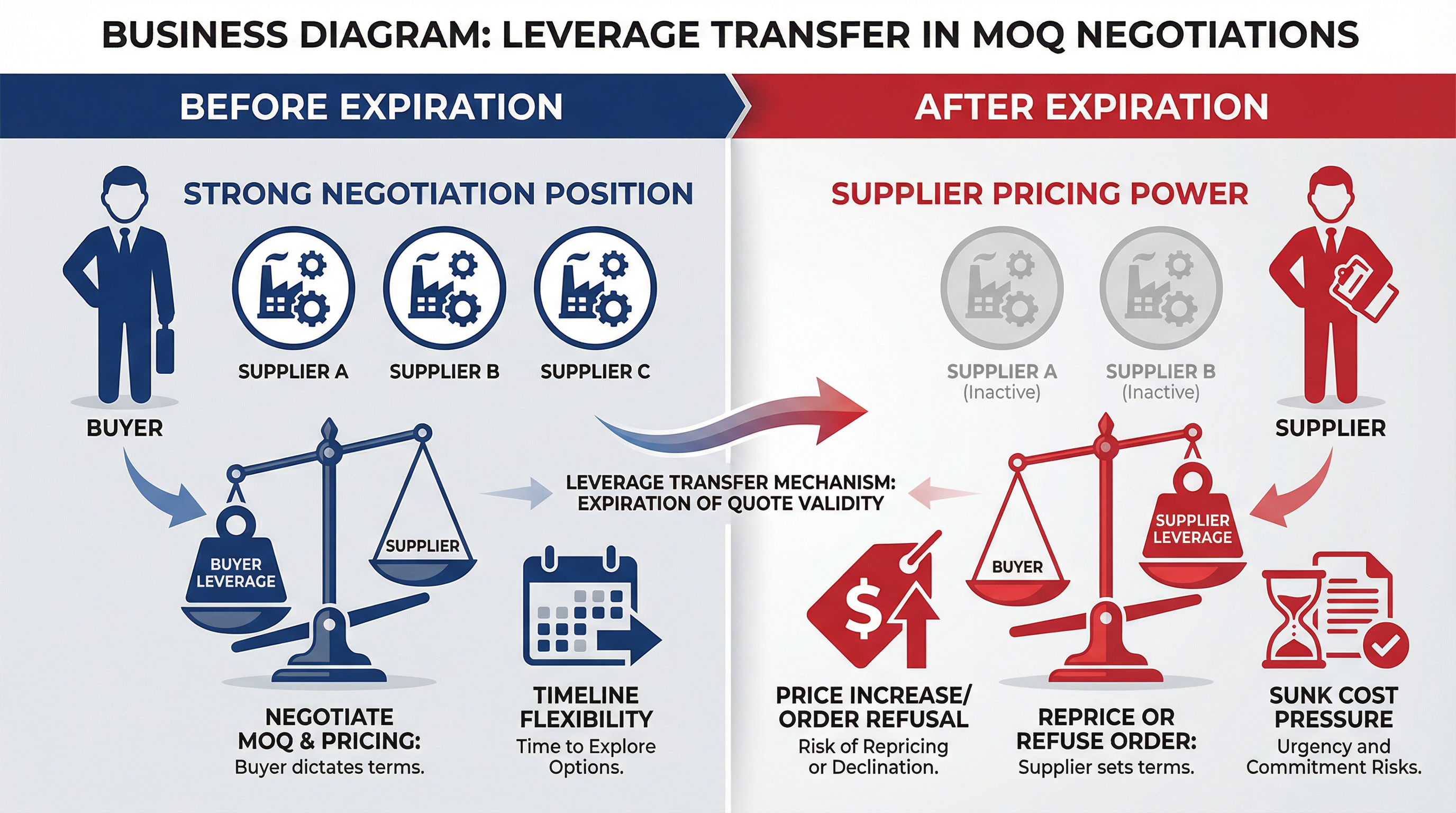
The leverage transfer mechanism that activates when quotes expire mid-negotiation operates through a combination of sunk cost psychology and time pressure dynamics. By the time a buyer realizes the quote has expired, they have typically invested four to six weeks in negotiation activities: specification discussions, sample evaluations, internal stakeholder alignment, budget approvals, and legal reviews. This invested time represents sunk costs that the buyer's organization has already absorbed. Restarting the sourcing process with a new supplier means repeating these activities, delaying the project timeline by another six to eight weeks, and potentially missing critical delivery windows for seasonal corporate gifts or event-specific distributions.
The supplier, aware of these buyer constraints, can credibly adjust pricing or MOQ terms when issuing an updated quotation. The adjustment might be framed as a response to changed market conditions—raw material cost increases, capacity constraints, or seasonal demand surges—but the timing is rarely coincidental. Suppliers track their quote validity periods and understand when buyers are approaching decision points. A buyer who requests a quote extension in week six of an eight-week approval process has revealed their timeline pressure and commitment to this supplier relationship. The supplier's updated quote reflects this shifted leverage, incorporating price increases or MOQ adjustments that would have been rejected if proposed during initial negotiations.
Consider the specific dynamics in corporate gift procurement, where quote validity expiration creates particularly acute leverage problems. Corporate gift orders are typically seasonal, concentrated in Q4 for year-end client appreciation or Q1 for Chinese New Year distributions. This seasonality means that procurement delays don't just push delivery dates back by a few weeks—they can push orders into the next year entirely, rendering them useless for their intended purpose. A buyer negotiating leather portfolios in September for December delivery who discovers in late October that their quote has expired faces a brutal choice: accept the supplier's new terms despite the price increase and MOQ change, or restart sourcing and accept that the gifts won't arrive until January, missing the year-end distribution window entirely.
The supplier understands this seasonal leverage and prices their quote extensions accordingly. The "market conditions" that justify a 12% price increase in late October might include genuine raw material cost changes, but they also reflect the supplier's knowledge that the buyer has limited alternatives at this point in the calendar. Other suppliers who might have offered competitive quotes in September are now fully committed to their own Q4 production schedules. The buyer's options have narrowed from "select among multiple qualified suppliers" to "accept this supplier's new terms or miss the delivery window." This option narrowing is precisely what quote validity periods are designed to create from the supplier's perspective—a mechanism to capture value from buyers who fail to manage their negotiation timelines effectively.
The extension request trap operates through a similar leverage transfer mechanism, but with additional complexity because buyers often don't realize they're entering a renegotiation when they request validity extensions. The request seems procedural: "We're still working through our internal approval process and would appreciate a two-week extension on your quote validity." The buyer frames this as a minor administrative adjustment, expecting the supplier to accommodate as a gesture of goodwill toward a potential customer. What the buyer fails to recognize is that the extension request is itself a negotiation move that reveals information and shifts leverage.
From the supplier's perspective, an extension request signals several valuable pieces of information. First, the buyer has progressed far enough in their internal process that they're committed to this supplier relationship rather than exploring alternatives. Second, the buyer's organization moves slowly enough that standard quote validity periods don't align with their decision cycles, suggesting future orders will face similar timeline challenges. Third, the buyer is approaching a decision point where they need pricing certainty to finalize approvals, meaning they're vulnerable to price adjustments that would have been rejected earlier. Armed with this information, the supplier can structure their extension response to capture value while maintaining the appearance of accommodation.
The supplier's extension response might take several forms, each designed to extract concessions while appearing reasonable. The most straightforward approach is conditional extension: "We can extend the quote validity for two weeks, but we'll need to adjust pricing to reflect current raw material costs, which have increased 8% since the original quote." This conditional extension forces the buyer to choose between accepting a price increase or restarting the sourcing process. The buyer, having invested six weeks in negotiations and facing timeline pressure, typically accepts the increase rather than absorbing the delay costs of finding a new supplier.
A more sophisticated extension response involves MOQ adjustment: "We can extend the quote validity, but our production schedule for Q4 is now fully committed. To accommodate your order, we'll need to return to our standard 1,500-unit minimum rather than the 1,000-unit exception we discussed." This MOQ increase forces the buyer to absorb additional inventory carrying costs or storage expenses they hadn't budgeted for, but the framing makes it seem like a capacity constraint rather than a negotiation tactic. The buyer, unable to verify the supplier's actual production schedule, must either accept the higher MOQ or restart sourcing, and the timeline pressure typically drives acceptance.
The most subtle extension response combines pricing and terms adjustments while offering apparent concessions: "We can extend the quote validity for three weeks and maintain the 1,000-unit MOQ, but we'll need to adjust the payment terms from 30 days net to 50% deposit with 50% on delivery, and the per-unit price will increase by 6% to reflect current market conditions." This bundled adjustment makes it difficult for the buyer to isolate and challenge individual changes. The extended validity period appears generous, the MOQ maintenance seems like a concession, but the payment terms shift and price increase extract significant value. The buyer, facing complexity and time pressure, often accepts the bundle rather than attempting to negotiate each element separately.
The procurement planning failure that allows quote validity expiration to occur stems from inadequate timeline mapping at negotiation outset. When a procurement team receives a supplier quotation, they should immediately create a reverse timeline that maps the quote expiration date backward through their internal approval process. If the quote expires November 15, and final purchase order issuance requires one week after approvals, then all approvals must complete by November 8. If budget approval requires two weeks and legal review requires one week, then these processes must start by October 25. If MOQ negotiation and specification refinement require three weeks, then these discussions must conclude by October 18. If sample evaluation requires two weeks, then samples must arrive by October 4. This reverse timeline calculation reveals whether the quote validity window is adequate for the buyer's actual decision process.
Most procurement teams never perform this calculation. The quote arrives, negotiations begin, and everyone assumes there's adequate time to complete the process. The quote validity date exists somewhere in the documentation, but no one treats it as a hard deadline that constrains the entire negotiation timeline. This planning failure is particularly problematic in organizations with complex approval hierarchies or seasonal budget cycles. A procurement team in a large corporation might require approvals from department managers, finance controllers, legal reviewers, and C-suite executives before issuing a purchase order. Each approval layer adds time, and unexpected delays at any layer can cascade through the entire timeline. Without explicit timeline mapping that accounts for these approval complexities, quote validity expiration becomes inevitable rather than exceptional.
The monitoring gap that prevents procurement teams from tracking quote validity during negotiations reflects broader organizational challenges in managing time-sensitive commitments. In well-functioning procurement operations, someone owns responsibility for tracking critical dates and alerting stakeholders when deadlines approach. This might be a procurement coordinator who maintains a master calendar of quote expiration dates, contract renewal deadlines, and delivery commitments. Or it might be a project manager who tracks all timeline-sensitive elements of a procurement initiative. In less mature procurement organizations, this monitoring responsibility falls into gaps between roles. The buyer focuses on negotiating price and quantity. The finance team focuses on budget approvals. The legal team focuses on contract terms. No one explicitly owns the responsibility for monitoring quote validity and ensuring negotiations complete before expiration.
This monitoring gap becomes particularly problematic when procurement teams manage multiple concurrent negotiations. A procurement manager handling year-end corporate gift sourcing might be negotiating with leather goods suppliers, drinkware manufacturers, and stationery vendors simultaneously, each with different quote validity periods and approval timelines. Without systematic tracking mechanisms, it's easy for individual quote expiration dates to slip through the cracks, discovered only when the buyer is ready to issue a purchase order and realizes the pricing is no longer valid. By that point, the leverage transfer has already occurred, and the buyer must either accept new terms or absorb delay costs.
The cultural factors that contribute to quote validity oversight reflect broader attitudes toward supplier relationships and negotiation dynamics. In procurement cultures that emphasize adversarial negotiation and aggressive price pressure, buyers may view quote validity periods as supplier-imposed constraints that can be ignored or challenged. The assumption is that suppliers need the buyer's business and will accommodate reasonable extension requests to avoid losing the order. This assumption works in buyer's markets where suppliers face excess capacity and limited alternatives, but it fails in seller's markets where suppliers have multiple customers competing for limited production capacity. Corporate gift manufacturing in Q4 typically operates as a seller's market, with suppliers fully committed and buyers competing for available slots. In this environment, quote validity periods function as real constraints rather than negotiable suggestions, but buyers accustomed to buyer's market dynamics may not adjust their behavior accordingly.
The information asymmetry between buyers and suppliers regarding production scheduling and market conditions amplifies the leverage transfer that occurs when quotes expire. The buyer cannot independently verify whether the supplier's claimed capacity constraints or raw material cost increases are genuine or negotiation tactics. The supplier's updated quotation might reflect real market changes—leather prices did increase 8% in October due to tannery capacity shortages—or it might reflect opportunistic repricing based on the buyer's revealed timeline pressure. The buyer, lacking direct access to commodity markets or supplier production schedules, must either accept the supplier's framing or invest additional time in market research to validate the claims. This validation time further compresses the negotiation timeline and increases pressure to accept terms.
The relationship dynamics between buyers and suppliers also influence how quote validity expiration plays out in practice. Established supplier relationships with multi-year history might handle validity extensions more flexibly than new supplier relationships where neither party has built trust or demonstrated reliability. A supplier who has successfully delivered corporate gift orders for three consecutive years might extend quote validity without price adjustments as an investment in relationship continuity. A new supplier competing for first-time business might take a harder line on validity extensions, viewing them as opportunities to test the buyer's price sensitivity and timeline flexibility. Buyers who fail to distinguish between these relationship contexts may be surprised when new suppliers refuse to accommodate extension requests that established suppliers would have granted routinely.
The strategic response to quote validity expiration risk requires procurement teams to fundamentally restructure how they approach MOQ negotiations and timeline management. The first essential change is treating quote validity as a primary negotiation constraint rather than administrative background detail. When a quotation arrives, the validity period should be highlighted, mapped against the organization's approval timeline, and monitored throughout the negotiation. If the standard validity period is inadequate for the organization's decision process, this should be addressed at negotiation outset rather than through extension requests later. A buyer might negotiate for a 60-day validity period instead of the supplier's standard 45 days, offering to provide faster decision-making or larger order volumes in exchange for the extended commitment window.
The second essential change is compressing internal approval timelines to align with market realities rather than expecting suppliers to accommodate organizational inefficiencies. If an organization's standard procurement approval process requires eight weeks, but supplier quote validity periods in the corporate gift market typically run 30 to 45 days, then either the approval process must be streamlined or procurement must begin earlier to create timeline buffer. This might mean initiating corporate gift sourcing in July for December delivery rather than waiting until September, or it might mean securing pre-approval for corporate gift budgets so that final purchase orders can be issued within two weeks of quote receipt rather than six weeks. Either approach requires organizational change, but both are more effective than repeatedly losing negotiation leverage to quote validity expiration.
The third essential change is explicit timeline communication with suppliers at negotiation outset. Rather than allowing suppliers to assume the buyer will complete decisions within standard validity periods, buyers should proactively communicate their actual timeline constraints and negotiate validity periods that accommodate these realities. This transparency might seem to weaken the buyer's negotiating position by revealing decision-making inefficiencies, but it actually strengthens the position by preventing the leverage transfer that occurs when quotes expire mid-negotiation. A supplier who agrees to a 75-day validity period at negotiation outset has committed to holding pricing and capacity for that duration. A supplier who issues a standard 45-day quote and then receives extension requests has opportunities to renegotiate terms with each extension.
The procurement team's ability to recognize when they're approaching quote validity expiration and take preemptive action can prevent leverage transfer even when timeline compression isn't possible. If a buyer realizes in week five of a six-week approval process that the quote will expire before approvals complete, they have several strategic options. They can request a validity extension immediately, before the quote expires, framing it as proactive timeline management rather than reactive crisis response. They can accelerate specific approval steps by escalating to senior management or requesting expedited reviews. They can secure conditional internal approvals that allow purchase order issuance contingent on final specification confirmation, compressing the timeline by parallelizing activities that would normally run sequentially. Each of these approaches requires active timeline monitoring and willingness to deviate from standard processes, but all are preferable to discovering quote expiration after the fact.
The leverage preservation that comes from completing negotiations within original quote validity periods extends beyond immediate price and MOQ protection. Buyers who consistently demonstrate ability to make decisions within supplier-specified timeframes build reputations as efficient customers worth prioritizing. Suppliers facing capacity constraints or competing orders will allocate available slots to customers who can commit quickly and reliably. Buyers who repeatedly request validity extensions or take months to finalize orders after receiving quotes signal that they're difficult customers whose orders carry execution risk. This reputation effect compounds over time, affecting not just pricing and MOQ terms but also delivery prioritization, quality attention, and willingness to accommodate special requests.
The organizational capability required to manage quote validity effectively as part of MOQ negotiations extends beyond individual procurement team skills. It requires systems for tracking critical dates, processes for compressing approval timelines, and cultural norms that treat supplier commitments as binding constraints rather than negotiable suggestions. Organizations that build these capabilities gain systematic advantages in procurement negotiations, consistently securing better terms and avoiding the leverage transfers that plague less disciplined buyers. Organizations that fail to build these capabilities pay recurring premiums through price increases, MOQ adjustments, and delivery delays that stem from quote validity expiration, often without recognizing the pattern or understanding its root cause.
Understanding order quantity thresholds means recognizing that quantity itself is only one variable in a complex procurement equation where timing constraints and commitment windows interact with pricing and capacity allocation. The MOQ negotiation that focuses exclusively on unit counts and per-unit prices while ignoring quote validity periods is optimizing one variable while allowing another to undermine the entire negotiation outcome. The procurement team that secures a favorable MOQ reduction but loses that advantage to quote validity expiration has failed to manage the negotiation holistically, achieving a tactical win that becomes a strategic loss when timing constraints force acceptance of worse overall terms.
The quote validity period, far from being administrative boilerplate, functions as a negotiation deadline that determines whether buyers maintain leverage to secure favorable terms or surrender that leverage through timeline mismanagement. The supplier who issues a 45-day quote isn't offering a courtesy window for buyer convenience—they're establishing a commitment boundary that protects their pricing and capacity allocation decisions. The buyer who treats this boundary as negotiable discovers, usually too late, that the boundary was real and that crossing it carries costs in the form of repricing, MOQ adjustments, or lost orders. The procurement team that learns to recognize quote validity as a primary negotiation constraint, maps it against their actual decision timelines, and manages their process to complete within the validity window gains systematic advantages that compound across every negotiation they conduct.