Singapore's Corporate Gifting Calendar: The Timing Mistakes That Cost You Client Relationships
A local business development manager's guide to navigating Singapore's multi-cultural gifting calendar—and the timing errors that signal cultural tone-deafness.
Singapore's Corporate Gifting Calendar: The Timing Mistakes That Cost You Client Relationships
Three years ago, I sent Hari Raya gift hampers to our Muslim clients—on the last day of Ramadan. The gesture was well-intentioned, the gifts were thoughtful, but the timing was catastrophically wrong. Hari Raya gifts should arrive before Ramadan ends, ideally 3-5 days prior, so recipients can share them during the festival. My late delivery signaled either ignorance of the cultural significance or, worse, that the relationship was an afterthought. Two of those clients quietly reduced their business with us over the following year.
That expensive lesson taught me what no corporate gifting guide explicitly states: in Singapore's multi-cultural business environment, when you give matters as much as what you give. The city-state's calendar includes Chinese New Year, Hari Raya Puasa, Deepavali, Christmas, and numerous corporate milestones—each with specific timing protocols that separate culturally competent businesses from those that inadvertently offend.
The Chinese New Year Window: Earlier Than You Think
Chinese New Year dominates Singapore's corporate gifting calendar, accounting for roughly 40-45% of annual corporate gift volume. But the gifting window is narrower and starts earlier than most foreign businesses realize.
!Singapore Corporate Gifting Calendar Cultural Protocol
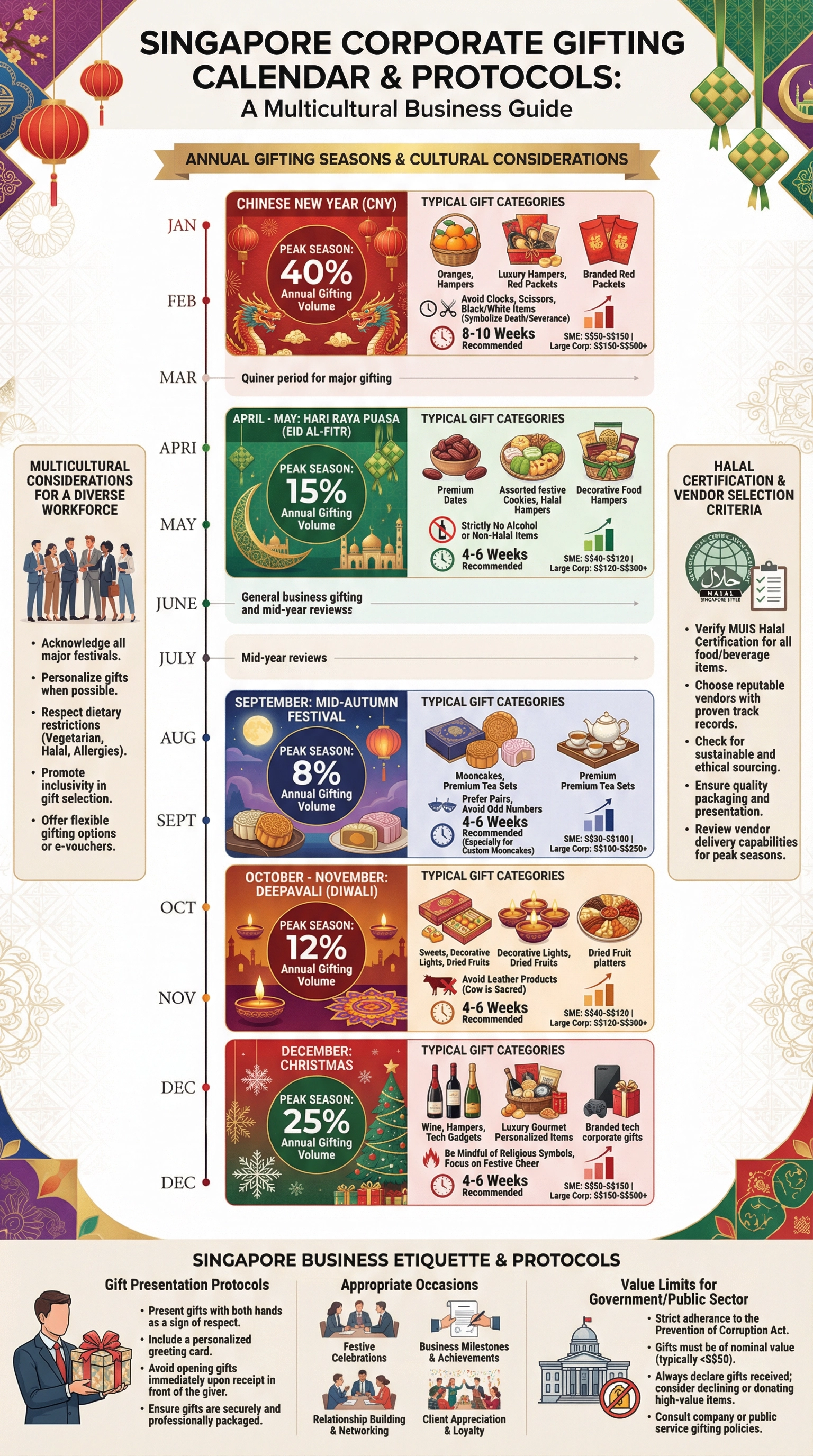
The cultural protocol: gifts should arrive no later than one week before Chinese New Year's Eve. Ideally, they arrive 2-3 weeks before. Why? Because the period immediately before CNY is when families gather, and gifts are shared and displayed. Gifts that arrive during the CNY holiday period (typically 3-4 days) sit unopened because recipients are with family, not checking office deliveries.
Last year, CNY fell on February 10. Our gifting window closed on February 3 (one week prior). But here's the complication: Chinese New Year dates shift each year based on the lunar calendar, falling anywhere between January 21 and February 20. You can't simply mark "mid-February" on your calendar and assume that works every year.
The procurement timeline I now follow:
October: Confirm next year's CNY date and calculate the gifting window
November: Finalize gift selection and place orders
December: Receive inventory and conduct quality checks
Mid-January: Begin distribution, completing all deliveries by 2-3 weeks before CNY
This timeline accounts for the December-January supplier capacity crunch. Every Singapore-based business is ordering CNY gifts simultaneously, and suppliers' lead times stretch from the usual 3-4 weeks to 6-8 weeks. Orders placed in December often don't deliver until mid-January—cutting it dangerously close to the gifting window.
The mistake I see foreign companies make repeatedly: they treat CNY like Christmas, assuming gifts can arrive anytime in the "holiday season." But CNY is fundamentally about family reunion and renewal. Gifts that arrive after the reunion period has started feel like an afterthought, no matter how expensive or thoughtful.
Hari Raya Puasa: The Pre-Ramadan Calculation
Hari Raya Puasa (Eid al-Fitr) marks the end of Ramadan, the Islamic holy month of fasting. The gifting protocol here is more nuanced than CNY because it involves both religious observance and cultural celebration.
The timing rule: gifts should arrive during the final week of Ramadan, but not so late that recipients can't incorporate them into their Hari Raya preparations. The ideal window is 5-7 days before Hari Raya.
Why this specific timing? During Ramadan, Muslims fast from dawn to sunset. The final week is when families prepare for Hari Raya celebrations—purchasing new clothes, preparing special foods, and arranging their homes. Corporate gifts that arrive during this preparation period become part of the celebration. Gifts that arrive after Hari Raya has started feel belated.
The complication: Ramadan dates shift approximately 10-11 days earlier each year because the Islamic calendar is lunar-based. Hari Raya Puasa in 2024 fell on April 10-11. In 2025, it will fall around March 30-31. By 2030, it will occur in mid-January. This moving target makes planning difficult.
My approach: I maintain a five-year rolling calendar of Islamic holidays and set procurement deadlines based on the earliest possible date range. For 2025 Hari Raya gifts, I placed orders in early February to ensure delivery by mid-March—well within the ideal window even if the exact date shifts slightly.
The cultural sensitivity point: Ramadan is a period of spiritual reflection and self-discipline. Gifts should acknowledge this significance. Avoid gifts that seem frivolous or focused on indulgence. Food hampers are traditional and appropriate, but they should include items suitable for breaking fast (dates, dried fruits, nuts) rather than purely luxury items.
Deepavali: The Festival of Lights Timing Protocol
Deepavali (Diwali) is the Hindu festival of lights, typically falling in October or November. The gifting protocol here is similar to CNY: gifts should arrive before the festival, ideally 1-2 weeks prior, so recipients can share them with family and guests during the five-day celebration period.
The timing window is more forgiving than CNY or Hari Raya because Deepavali doesn't involve the same concentrated family reunion period. Gifts that arrive a few days into the festival are still appreciated, though pre-festival delivery is preferred.
What makes Deepavali gifting complex in Singapore is the business context. October-November is a busy period for many industries, with year-end projects accelerating and Q4 targets looming. Corporate gifts can easily get deprioritized amid operational pressures. I've learned to set internal deadlines two weeks earlier than the actual gifting window to account for inevitable delays.
The cultural consideration: Deepavali celebrates the victory of light over darkness and knowledge over ignorance. Gifts that incorporate light (decorative lamps, candles) or sweets (traditional mithai) align with the festival's symbolism. Avoid gifts in black, which is associated with negativity in Hindu culture.
Christmas and Year-End: The Overlapping Obligations
December in Singapore involves overlapping gifting obligations: Christmas (for Christian clients and partners), year-end corporate appreciation (secular), and sometimes early CNY gifting (if CNY falls in late January). Managing these overlapping timelines without appearing to recycle the same gifts across different occasions requires careful planning.
The protocol I follow:
Christmas gifts: Deliver during the first two weeks of December. This timing ensures gifts arrive well before the holiday and don't get lost in the end-of-year chaos.
Year-end corporate appreciation: Deliver during the third week of December. These gifts acknowledge the business relationship and the year's collaboration, distinct from religious holiday gifts.
Early CNY gifts (if CNY is in late January): Hold these until early January to maintain clear separation from Christmas/year-end gifts.
The mistake I made early in my career: sending a single "holiday season" gift in mid-December and assuming it covered both Christmas and year-end appreciation. Some clients interpreted this as cutting corners—one gift doing double duty. Now I budget for distinct gifts for each occasion, even if they're modest. The gesture of recognizing each occasion separately matters more than the gift's monetary value.
The Corporate Milestone Calendar
Beyond cultural and religious festivals, Singapore's business calendar includes corporate milestones that warrant gifting: company anniversaries, project completions, contract renewals, and executive transitions. These don't follow fixed dates, but they do follow timing protocols.
Company anniversaries: Gifts should arrive on or within one week of the actual anniversary date. Late anniversary gifts signal that the relationship isn't important enough to track carefully.
Project completions: Gifts should arrive within 2-3 weeks of project delivery. Longer delays make the gift feel disconnected from the achievement it's meant to recognize.
Contract renewals: Gifts should arrive shortly after contract signing, not months later. The timing reinforces the message: "We value this renewed partnership."
Executive transitions: When a key contact leaves or joins a client organization, a thoughtful gift within the first month of the transition helps maintain relationship continuity.
I maintain a CRM-integrated calendar that flags these milestones 6-8 weeks in advance, giving me time to select appropriate gifts and ensure timely delivery. The investment in tracking pays off in relationship strength—clients notice when you remember and acknowledge their important dates.
The Supply Chain Reality Check
Understanding ideal gifting windows is one thing. Executing them amid Singapore's supply chain realities is another. The city-state's corporate gifting industry experiences extreme demand spikes around major festivals, and supplier capacity becomes the binding constraint.
The capacity crunch timeline:
November-January: Peak season for CNY gifts. Supplier lead times stretch to 6-8 weeks. Customization options become limited as suppliers prioritize high-volume orders.
March-April: Moderate demand for Hari Raya gifts. Lead times: 4-5 weeks.
September-October: Moderate demand for Deepavali gifts. Lead times: 4-5 weeks.
December: High demand for Christmas and year-end gifts. Lead times: 5-6 weeks.
February, May-August: Low season. Lead times: 3-4 weeks. This is when you have maximum flexibility and negotiating leverage.
The strategic implication: if your gifting calendar is predictable (same festivals each year), place orders during low-season months even if you don't need delivery for several months. You'll get better pricing, more customization options, and guaranteed delivery within your target window.
Last year, I placed our Deepavali gift order in July—three months before the October festival. The supplier offered 15% off the quoted price because they had excess capacity. We secured our preferred customization options (which were unavailable when we'd ordered closer to the festival in previous years). And we eliminated delivery risk entirely.
The Gifting Frequency Balance
In Singapore's relationship-oriented business culture, regular gifting strengthens partnerships. But there's a fine line between thoughtful consistency and excessive frequency that feels transactional or even burdensome (recipients may feel obligated to reciprocate).
The frequency framework I use:
Tier 1 clients (strategic partnerships, high revenue): 3-4 gifts annually
- CNY or Hari Raya or Deepavali (based on client's cultural background)
- Year-end appreciation
- Company anniversary or major project milestone
- One surprise "thinking of you" gift mid-year
Tier 2 clients (solid relationships, moderate revenue): 2 gifts annually
- CNY or Hari Raya or Deepavali
- Year-end appreciation
Tier 3 clients (newer relationships, lower revenue): 1 gift annually
- CNY or year-end appreciation (whichever aligns better with the relationship stage)
Prospects (not yet clients): 1 gift annually, typically year-end
- Avoids the appearance of trying to "buy" business with festival gifts
- Positions the gift as relationship-building rather than transactional
This tiered approach ensures gifting feels personal and relationship-appropriate rather than formulaic. The key is consistency within each tier—once you establish a gifting pattern with a client, maintaining it signals relationship stability.
The Cultural Sensitivity Audit
Singapore's multi-cultural environment means a single gifting approach doesn't work across your entire client base. What's appropriate for a Chinese-Singaporean client may be culturally tone-deaf for a Malay-Muslim client.
The cultural considerations I audit before finalizing gift selections:
Religious dietary restrictions: Avoid pork products for Muslim clients, beef products for Hindu clients. Alcohol is inappropriate for Muslim clients and some Hindu and Buddhist clients. When in doubt, choose vegetarian or universally acceptable food items.
Cultural symbolism: Certain numbers, colors, and symbols carry specific meanings. The number four (四) sounds like "death" in Chinese and should be avoided. White is associated with mourning in Chinese culture. Black has negative connotations in Hindu culture.
Festival alignment: Don't send Christmas gifts to non-Christian clients unless you're certain they celebrate the holiday secularly. Similarly, don't assume all Chinese clients celebrate CNY with the same level of importance—some Singaporean Chinese families are less traditional.
Language and messaging: Gift cards should be in the recipient's preferred language when possible. English is safe for business contexts, but including Mandarin, Malay, or Tamil (depending on the recipient's background) shows extra thoughtfulness.
I maintain a client database that tracks cultural background, religious observances, dietary restrictions, and past gift preferences. This seems like excessive detail, but it prevents costly mistakes. Last year, we almost sent a premium wine gift set to a Muslim client—caught only because our database flagged the religious consideration.
The Budget Allocation Strategy
With multiple gifting occasions throughout the year, budget allocation becomes strategic. Spending your entire annual gifting budget on CNY gifts leaves nothing for other important occasions.
My budget allocation framework (for a client with whom we exchange gifts 3 times annually):
Primary cultural festival (CNY, Hari Raya, or Deepavali): 40-45% of annual gifting budget
Year-end appreciation: 30-35% of annual gifting budget
Milestone or mid-year gift: 20-25% of annual gifting budget
This allocation ensures the most culturally significant gift (the primary festival) receives appropriate investment while maintaining meaningful gestures throughout the year.
For a Tier 1 client with an annual gifting budget of $500, this translates to:
- CNY gift: $200-225
- Year-end gift: $150-175
- Milestone gift: $100-125
The budget flexibility allows me to adjust based on relationship developments. If a major project succeeds mid-year, I can reallocate from the year-end budget to deliver a more substantial milestone gift.
The Delivery Logistics That Make or Break Timing
Perfect timing means nothing if your gifts sit in a delivery truck or warehouse. Singapore's compact geography makes same-day delivery feasible, but festival periods strain logistics networks.
The delivery strategies that ensure on-time arrival:
Direct delivery to offices: More reliable than home delivery, especially during festival periods when recipients may be traveling. Coordinate with the client's reception or admin team to confirm someone will be available to receive the gift.
Advance delivery with "open on [date]" instructions: For gifts that need to arrive before you're certain of the exact festival date, deliver early with clear instructions on when to open. This works well for CNY gifts when you want to ensure delivery but the exact date is still weeks away.
Hand delivery for VIP clients: For your most important relationships, hand-delivering gifts (or having a senior team member do so) adds a personal touch and eliminates delivery risk entirely. This is feasible in Singapore's compact geography.
Backup delivery windows: I always build in a 3-5 day buffer before the ideal delivery date. If the primary delivery attempt fails (recipient out of office, address issue, etc.), there's time for a second attempt without missing the gifting window.
Delivery confirmation and follow-up: Require signature confirmation for all corporate gifts. Follow up with a brief message (email or WhatsApp) confirming the gift has arrived and expressing your wishes for the festival or occasion.
Last year, a CNY gift delivery failed because the recipient's office had relocated. Without delivery confirmation, I wouldn't have known until after CNY—too late to resend. The signature requirement flagged the issue immediately, and we redirected the gift to the new address within 24 hours.
The Timing Mistakes That Signal Tone-Deafness
After a decade of corporate gifting in Singapore, I've identified the timing errors that most damage relationships:
Sending CNY gifts during or after the CNY holiday period: This signals you don't understand the cultural significance of the pre-festival reunion period.
Sending Hari Raya gifts after Ramadan ends: This suggests the relationship is an afterthought, not a priority.
Sending festival gifts to the wrong festival: Sending CNY gifts to a Malay-Muslim client or Hari Raya gifts to a Chinese-Buddhist client shows you haven't bothered to learn their cultural background.
Sending gifts so early they feel disconnected from the occasion: A CNY gift that arrives in November feels strange, like you're clearing inventory rather than honoring the festival.
Forgetting a gifting occasion after establishing a pattern: If you've sent CNY gifts for three consecutive years and then skip a year, clients notice and wonder if the relationship has changed.
Sending identical gifts for different occasions: If your CNY gift and year-end gift are obviously the same product with different wrapping, it feels lazy.
These mistakes are recoverable if caught quickly—a sincere apology and a properly timed replacement gift can repair the damage. But repeated timing errors create a pattern of cultural insensitivity that's harder to overcome.
The Calendar Integration That Prevents Mistakes
The single most effective change I made to our gifting program: integrating the multi-cultural calendar into our CRM and project management systems. Every team member with client-facing responsibilities sees upcoming gifting deadlines alongside project deadlines.
The system flags:
- Gifting occasions 12 weeks out (procurement deadline)
- Gifting occasions 8 weeks out (order placement deadline)
- Gifting occasions 4 weeks out (delivery coordination deadline)
- Gifting occasions 2 weeks out (final delivery window)
This automated flagging prevents the "oh no, CNY is next week and we haven't ordered anything" panic that used to plague our Q4-Q1 transition.
The calendar includes:
- Fixed-date occasions (Christmas, Singapore National Day)
- Variable-date religious festivals (CNY, Hari Raya, Deepavali) for the next three years
- Client-specific milestones (company anniversaries, contract renewal dates)
- Supplier capacity constraints (peak season periods when lead times extend)
The investment in calendar integration—roughly 20 hours of initial setup plus 2-3 hours of annual maintenance—has eliminated timing errors almost entirely. In the past two years, we've had zero late deliveries and zero culturally inappropriate timing mistakes.
The Relationship Payoff of Getting Timing Right
When you consistently deliver gifts at culturally appropriate times, clients notice. It signals that you understand and respect their cultural background, that the relationship matters enough to track important dates, and that you plan ahead rather than scrambling at the last minute.
Three months after I fixed our Hari Raya gifting timing (delivering 5-7 days before the festival instead of on the last day of Ramadan), one of our Muslim clients mentioned it during a business review: "You're one of the few non-Muslim partners who gets the timing right. It shows you care about understanding our culture, not just doing business with us."
That comment led to a deeper conversation about how we could better serve their needs, which ultimately led to a contract expansion worth $180,000 annually. I can't draw a direct line from proper gift timing to that revenue increase, but I'm certain the cultural competence signaled by correct timing contributed to their trust in our partnership.
The inverse is also true. When I delivered those late Hari Raya gifts three years ago, I damaged relationships that took months to repair. One client explicitly mentioned the timing error when explaining why they'd reduced their business with us: "It felt like you didn't really understand who we are or what matters to us."
In Singapore's competitive business environment, where multiple suppliers can deliver similar products and services, relationship strength often determines who wins the business. And relationship strength is built through countless small signals—including whether your corporate gifts arrive at the right time.
The corporate gifting calendar isn't just a logistics challenge. It's a cultural competence test that your clients are grading you on, whether or not they say so explicitly. Get the timing right, and you signal respect, understanding, and relationship investment. Get it wrong, and you signal the opposite—no matter how expensive or thoughtful the gift itself may be.