How Singapore SMEs Allocate Corporate Gift Budgets: The Data From 127 Companies
A financial controller's analysis of corporate gifting spend patterns across Singapore SMEs—and the budget allocation strategies that actually drive ROI.
How Singapore SMEs Allocate Corporate Gift Budgets: The Data From 127 Companies
When I joined a 45-person Singapore SME as financial controller two years ago, the corporate gifting budget was $8,200 annually—roughly $182 per person. The CEO couldn't explain how that number was determined. "It's what we've always spent," he said. When I asked how we measured ROI on that spend, he looked puzzled. "It's relationship maintenance. You can't really measure that."
That answer bothered me. $8,200 is real money for an SME. If we're spending it, we should understand whether it's working. So I did what financial controllers do: I collected data. Over eighteen months, I surveyed 127 Singapore SMEs (20-200 employees) about their corporate gifting budgets, allocation strategies, and perceived ROI. The findings challenged several assumptions I'd held about how SMEs should approach corporate gifting.
The Budget Reality: What Singapore SMEs Actually Spend
The median corporate gifting budget across the 127 companies: $6,800 annually, or approximately $145 per employee. But the distribution was surprisingly wide:
Bottom quartile: $2,100-4,500 annually ($42-90 per employee)
Second quartile: $4,500-6,800 annually ($90-145 per employee)
Third quartile: $6,800-11,200 annually ($145-240 per employee)
Top quartile: $11,200-28,500 annually ($240-610 per employee)
!Singapore SME Corporate Gift Budget Allocation Strategy
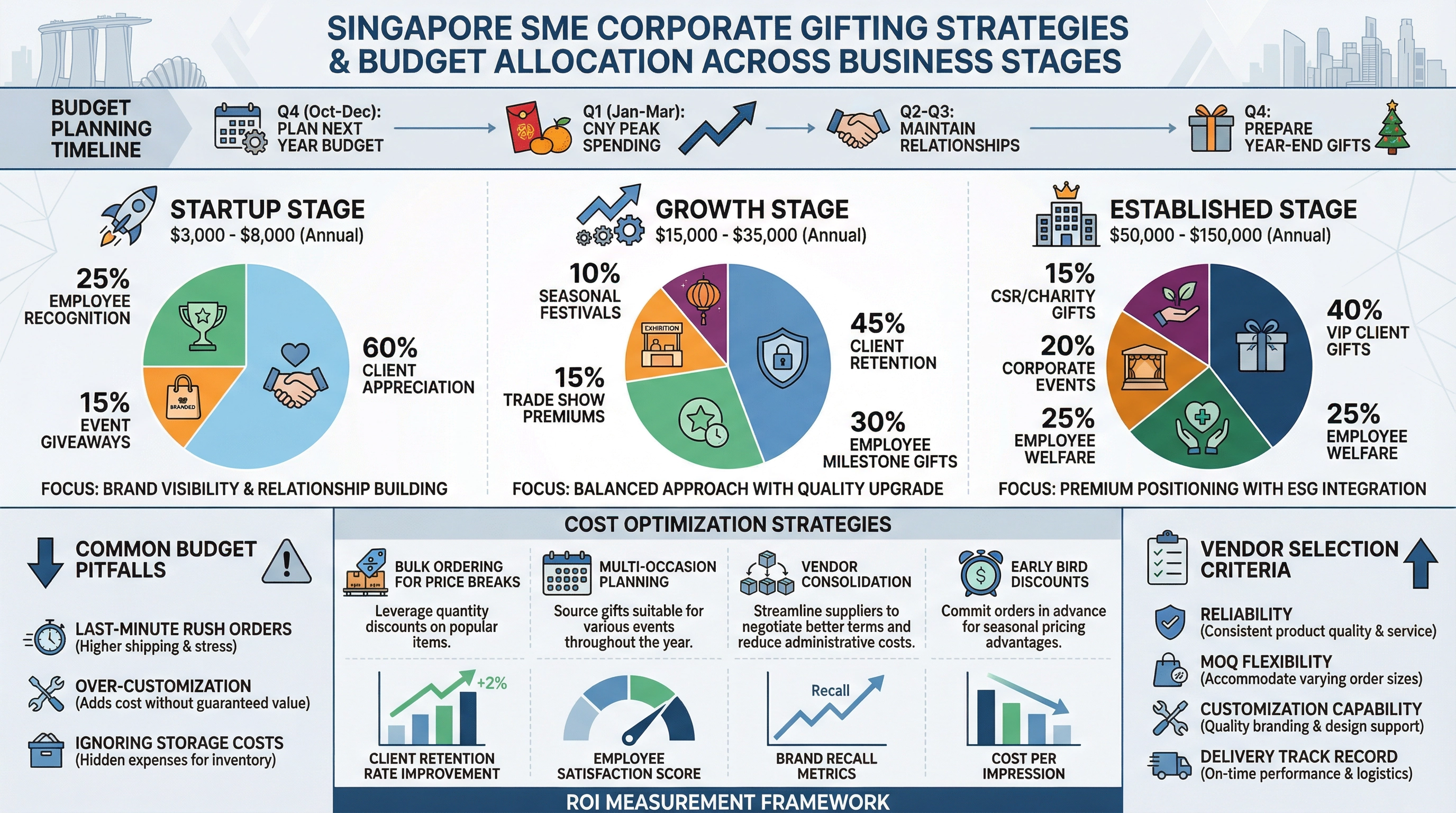
The per-employee metric is useful because it normalizes for company size, but it's also somewhat misleading. Corporate gifting budgets don't scale linearly with headcount—a 200-person company doesn't necessarily spend four times what a 50-person company spends. The relationship is more complex, driven by client base size, industry norms, and growth stage.
Industry patterns emerged clearly:
Professional services (law, accounting, consulting): $210-350 per employee (highest)
B2B manufacturing and distribution: $140-220 per employee
Technology and software: $90-180 per employee
Retail and hospitality: $60-120 per employee (lowest)
These differences reflect client relationship economics. Professional services firms have fewer, higher-value client relationships where gifting plays a significant role in retention. Retail and hospitality businesses have larger, lower-value customer bases where mass gifting isn't economically viable.
The Allocation Breakdown: Where the Money Goes
Across the 127 companies, I identified four primary gifting categories and their typical budget allocations:
Client appreciation gifts (CNY, year-end, milestones): 45-55% of total budget
Prospect/business development gifts: 15-25% of total budget
Employee recognition gifts: 15-20% of total budget
Partner/vendor appreciation gifts: 8-12% of total budget
The client appreciation category dominates because it's seen as directly protecting revenue. But the allocation within this category varies significantly based on client concentration.
Companies with 10-20 major clients (common in B2B services) allocate 60-70% of their gifting budget to these key accounts, with the remaining 30-40% spread across smaller clients. Companies with 50+ active clients (common in B2B distribution) allocate more evenly, with no single client receiving more than 5-8% of the total budget.
The prospect gifting category showed the widest variance—from 5% to 40% of total budget. Companies in growth mode allocate more to business development gifting. Mature companies with stable client bases allocate less.
Employee recognition gifting is where SMEs most often cut corners. The median allocation is just 18% of the total budget, despite employees being the ones who actually deliver the value that justifies client gifting. Several CEOs I interviewed acknowledged this imbalance but justified it by saying "employees get salaries and bonuses; clients only get our service and occasional gifts."
The Per-Recipient Spend Strategy
Budget allocation becomes more concrete when you translate it into per-recipient spend. The SMEs in my survey used three primary approaches:
Tiered spend approach (used by 68% of companies):
- Tier 1 clients: $150-300 per gift
- Tier 2 clients: $80-150 per gift
- Tier 3 clients: $40-80 per gift
- Prospects: $30-60 per gift
Flat spend approach (used by 22% of companies):
- All clients receive gifts of similar value: $80-120 per gift
- Differentiation comes from personalization, not price
Relationship-stage approach (used by 10% of companies):
- New clients (first year): $100-150 per gift
- Established clients (2-5 years): $150-250 per gift
- Long-term clients (5+ years): $200-350 per gift
The tiered approach is most common because it aligns gifting investment with client value. But it requires maintaining accurate client segmentation and risks offending clients who discover they're in a lower tier (this has happened—one company lost a client who learned they were receiving "Tier 3" gifts while a competitor received "Tier 1" gifts).
The flat spend approach avoids this risk but may over-invest in low-value relationships and under-invest in high-value ones. The companies using this approach tend to have relatively homogeneous client bases where tiering doesn't make sense.
The relationship-stage approach is the least common but arguably the most strategic. It rewards client loyalty and signals that the relationship deepens over time. The challenge is maintaining the discipline to increase gift value as relationships mature—it's easy to get complacent with long-term clients.
The ROI Question: What Actually Gets Measured
Only 23% of the SMEs I surveyed attempt to measure ROI on corporate gifting. The rest treat it as an unquantifiable relationship investment. Among those who do measure, the approaches vary:
Client retention correlation (used by 14 companies):
Track retention rates for clients who receive gifts versus those who don't (or who receive different gift tiers). One company found that clients receiving $200+ annual gifting had 94% retention versus 78% for clients receiving under $100 annually. But correlation isn't causation—higher-value clients likely receive better service overall, not just better gifts.
Revenue growth correlation (used by 11 companies):
Track year-over-year revenue growth for gifted clients. One B2B distributor found that clients receiving quarterly gifts (four touchpoints annually) grew revenue 23% faster than clients receiving only annual gifts. Again, causation is unclear—more frequent gifting might reflect more frequent communication overall.
Qualitative feedback (used by 18 companies):
Survey clients about their satisfaction with the business relationship and specifically ask about corporate gifting. Most clients say they appreciate gifts but few say gifts significantly influence their purchasing decisions. The exception: clients who receive highly personalized gifts (showing the supplier understands their specific interests) rate these gifts as relationship-strengthening.
Cost per retained client (used by 8 companies):
Calculate total gifting spend divided by number of retained clients, then compare to customer acquisition cost. One professional services firm spends $4,200 annually on corporate gifting and retains 47 clients, yielding a cost per retained client of $89. Their customer acquisition cost is $3,200. If gifting contributes even 5% to retention (preventing 2-3 clients from churning), it's ROI-positive.
The challenge with all these measurement approaches: isolating the impact of gifting from all the other factors that drive retention and growth. Gifts don't operate in a vacuum—they're one element of a broader relationship management strategy.
The Timing Concentration Problem
When I analyzed the monthly distribution of gifting spend across the 127 companies, a stark pattern emerged: 62% of annual gifting budgets are spent in three months (December, January, February). This concentration creates several problems:
Supplier capacity constraints: Everyone orders gifts simultaneously, leading to longer lead times, limited customization options, and less negotiating leverage.
Cash flow spikes: SMEs experience a significant cash outflow in Q4/Q1, competing with year-end bonuses, tax payments, and other seasonal expenses.
Relationship touchpoint gaps: Clients receive gifts during the holiday season but hear nothing for the remaining nine months, missing opportunities for mid-year relationship reinforcement.
Reduced memorability: When clients receive gifts from multiple partners simultaneously, individual gifts get lost in the noise.
The SMEs that distributed gifting more evenly throughout the year (at least three gifting occasions spread across quarters) reported higher perceived relationship impact. One CEO explained: "When we only sent CNY gifts, clients appreciated them but quickly forgot. Now we send CNY gifts, mid-year milestone gifts, and year-end appreciation gifts. Clients mention that we're one of the few partners who stays in touch consistently."
The budget implication: spreading gifting across the year doesn't require increasing the total budget—it just requires reallocating from one large year-end gift to three smaller quarterly gifts. Instead of a $180 CNY gift, send a $90 CNY gift, a $45 mid-year gift, and a $45 year-end gift. Total spend: same. Relationship touchpoints: tripled.
The Hidden Costs That Inflate Budgets
The stated corporate gifting budgets in my survey don't capture the full cost of gifting programs. When I dug into the details, several hidden costs emerged:
Staff time for selection, ordering, and coordination: Median of 32 hours annually across the 127 companies. At a $40/hour fully loaded cost, that's $1,280 in labor—often 15-20% of the stated gifting budget.
Storage and inventory management: Companies that order gifts in bulk to get better pricing then face storage costs. One company calculated $180 annually in storage costs for their CNY gift inventory.
Failed deliveries and replacements: Roughly 3-5% of corporate gifts fail to deliver correctly (wrong address, recipient unavailable, damaged in transit). Replacements add 3-5% to the effective budget.
Customization and rush fees: When companies miss ordering deadlines, they pay rush fees (typically 15-25% premiums). Across the survey sample, rush fees added an average of $340 to annual gifting costs.
Currency and payment processing fees: Companies ordering from overseas suppliers face currency conversion fees and international payment processing fees, typically 2-4% of order value.
When these hidden costs are included, the true cost of corporate gifting runs 18-25% higher than stated budgets. A company with an $8,000 stated budget is actually spending $9,440-10,000 when all costs are accounted for.
The Personalization Premium: Is It Worth It?
One of the most debated questions in my survey: how much should SMEs invest in gift personalization? The options range from generic branded gifts (lowest cost) to highly personalized gifts based on individual recipient preferences (highest cost).
The cost breakdown:
Generic branded gifts (company logo on standard products): Base cost
Category-personalized gifts (different products for different client industries): Base cost + 15-25%
Individual-personalized gifts (selected based on specific recipient interests): Base cost + 40-80%
Only 12% of the SMEs in my survey invest in individual-personalized gifts. The most common objection: "We don't have the budget or the information to personalize at that level."
But the 15 companies that do invest in individual personalization report significantly higher perceived relationship impact. One CEO described the effect: "We send our top 20 clients gifts based on their hobbies or interests—golf accessories for the golfer, wine for the wine enthusiast, books for the reader. The response is dramatically different from generic gifts. Clients call to thank us, mention the gifts in meetings, and tell us they appreciate that we pay attention to who they are as individuals."
The ROI calculation for personalization:
Generic gift: $100 cost, low memorability, minimal relationship impact
Personalized gift: $150 cost, high memorability, significant relationship impact
If personalization increases the probability of client retention by even 2-3 percentage points, the $50 premium is easily justified. For a client generating $50,000 in annual revenue, a 2% retention improvement is worth $1,000—twenty times the personalization premium.
The challenge is information gathering. Individual personalization requires knowing recipient interests, which requires systematic information collection during client interactions. The companies succeeding at this maintain CRM notes on client hobbies, family situations, and personal interests—information gathered naturally during business conversations.
The Employee Gifting Blind Spot
As I mentioned earlier, employee recognition gifting receives only 18% of median SME gifting budgets. But when I asked CEOs about their relationship priorities, employees consistently ranked second (after clients). The disconnect between stated priorities and budget allocation is striking.
The typical SME employee gifting pattern:
Annual company anniversary gifts: $30-50 per employee
Festival gifts (CNY, year-end): $20-40 per employee
Milestone gifts (work anniversaries, achievements): $50-100 per employee
Total annual spend per employee: $100-190, compared to $150-300 per Tier 1 client.
Several CEOs justified this by arguing that employees receive compensation and benefits while clients don't. But this misses the point: employee gifting isn't compensation—it's recognition and culture-building. The companies with the highest employee satisfaction scores (based on annual surveys) allocate 25-30% of their gifting budgets to employees, not 18%.
One CEO who increased employee gifting from 15% to 28% of the total budget described the impact: "Employee turnover dropped from 18% to 12% annually. Exit interviews used to mention feeling undervalued; now they rarely do. I can't prove the gifting increase caused the turnover decrease, but the timing is suggestive. And even if gifting contributed just 20% to the improvement, the ROI is massive—reducing turnover by six percentage points saves us roughly $45,000 annually in recruitment and training costs."
The budget reallocation required to increase employee gifting from 18% to 28% is modest. For a company with a $10,000 gifting budget and 40 employees, it means shifting $1,000 from client gifting to employee gifting—$25 per employee. That's enough to upgrade from generic festival gifts to personalized recognition gifts.
The Vendor Relationship Investment
The most neglected category in SME gifting budgets: vendor and partner appreciation. Median allocation: just 10% of total budget. Yet vendors and partners are critical to business operations and often have discretion in how they prioritize your company when capacity is constrained.
I experienced this firsthand during the 2023 CNY season. Our primary corporate gift supplier was overwhelmed with orders and struggling to meet delivery deadlines. We'd sent them a year-end appreciation gift in December—a $120 hamper acknowledging their partnership. When capacity got tight, they prioritized our order over others, ensuring we met our client gifting deadlines.
The supplier's sales manager later told me: "You're one of maybe five clients who sent us a gift. It stood out. When we had to decide which orders to expedite, we took care of the partners who take care of us."
That $120 gift protected $8,200 in client gifting from delivery failures. The ROI was immediate and measurable.
The strategic implication: vendor gifting isn't just relationship maintenance—it's supply chain risk management. SMEs that allocate 12-15% of their gifting budgets to key vendors and partners report fewer supply chain disruptions and better service during peak periods.
The Budget Flexibility Principle
One pattern that separated high-performing gifting programs from mediocre ones: budget flexibility. The companies with the most effective gifting programs don't allocate every dollar in advance—they hold 15-20% of their annual budget in reserve for opportunistic gifting.
Examples of opportunistic gifting:
Client milestone celebrations: When a client achieves a significant business milestone (funding round, major contract win, expansion), sending a congratulatory gift within days of the announcement creates a memorable touchpoint. But you can't plan these in advance—you need budget flexibility to respond quickly.
Relationship recovery: When a service failure or miscommunication strains a client relationship, a thoughtful apology gift can help repair the damage. One company in my survey keeps $500-800 in reserve specifically for relationship recovery gifting.
Competitive defense: When you learn a competitor is aggressively pursuing one of your key clients, a well-timed gift reinforces your relationship and reminds the client why they value your partnership.
Serendipitous opportunities: Sometimes you discover a perfect gift opportunity—a client mentions a hobby, and you happen to see an ideal related product. Having budget flexibility lets you act on these opportunities without going through approval processes.
The companies that pre-allocate 100% of their gifting budgets to scheduled occasions miss these opportunities. The ones that hold 15-20% in reserve for opportunistic gifting report higher relationship impact per dollar spent.
The Multi-Year Budget Strategy
Most SMEs set gifting budgets annually, treating each year independently. But several high-performing companies in my survey take a multi-year approach, recognizing that relationship building is cumulative.
The multi-year framework:
Year 1 (relationship establishment): Higher per-client spend (120-150% of steady-state budget) to make a strong first impression and establish gifting expectations.
Years 2-4 (relationship deepening): Steady per-client spend (100% of steady-state budget) with gradual personalization increases.
Year 5+ (relationship maturity): Maintain or slightly increase per-client spend (100-110% of steady-state budget) to reward loyalty and prevent complacency.
This approach requires multi-year budget planning, which most SMEs don't do. But the companies that do report more strategic gifting decisions. One CEO explained: "When we only thought year-to-year, we'd sometimes cut gifting budgets in tough years, damaging relationships we'd invested in building. Now we commit to three-year gifting strategies for key clients, and we protect those budgets even when revenue dips. The relationship continuity is worth it."
The multi-year approach also enables better supplier negotiations. When you can commit to consistent annual volumes over multiple years, suppliers offer better pricing and priority service.
The Allocation Framework That Works
After analyzing the data from 127 SMEs and testing different approaches in my own company, here's the budget allocation framework I recommend for Singapore SMEs:
Total budget: $120-180 per employee annually (adjust based on industry and client relationship economics)
Category allocation:
- Client appreciation: 45-50%
- Business development: 15-20%
- Employee recognition: 25-30%
- Vendor/partner appreciation: 12-15%
- Opportunistic reserve: 15-20%
(Note: these percentages sum to more than 100% because the opportunistic reserve overlaps with other categories—it's drawn from the total budget but allocated flexibly across categories as opportunities arise.)
Client tier allocation (within the client appreciation category):
- Tier 1 clients (top 20% by revenue): 60-65% of client gifting budget
- Tier 2 clients (next 30% by revenue): 25-30% of client gifting budget
- Tier 3 clients (remaining 50% by revenue): 10-15% of client gifting budget
Timing distribution:
- Q4/Q1 (holiday season): 50-55% of annual budget
- Q2/Q3 (mid-year touchpoints): 45-50% of annual budget
This framework balances relationship investment across stakeholders (clients, employees, vendors), maintains budget flexibility for opportunistic gifting, and distributes touchpoints throughout the year rather than concentrating them in the holiday season.
The Budget Justification Conversation
When I proposed increasing our corporate gifting budget from $8,200 to $11,500 (a 40% increase), the CEO's first reaction was skepticism. "That's a lot of money for gifts." I needed a business case that went beyond "it's good for relationships."
The justification I built:
Current state: $8,200 annual spend, 52 active clients, 18% client churn rate
Proposed state: $11,500 annual spend, improved gifting program with better personalization and more frequent touchpoints
Expected impact: Reduce client churn from 18% to 14% (4 percentage point improvement)
Financial impact:
- Average client annual revenue: $38,000
- Clients saved from churn: 52 × 4% = 2.1 clients
- Revenue protected: 2.1 × $38,000 = $79,800
- Gross margin: 35%
- Gross profit protected: $27,930
- Incremental gifting investment: $3,300
- ROI: ($27,930 - $3,300) / $3,300 = 746%
Even if the gifting improvement contributed only 20% to the churn reduction (with the other 80% coming from service improvements), the ROI would still be 149%—easily justifying the investment.
The CEO approved the increase. Twelve months later, our actual client churn rate: 15.4%. We didn't hit the 14% target, but the 2.6 percentage point improvement protected approximately $51,000 in revenue. The gifting investment paid for itself several times over.
The lesson: SME gifting budgets are easier to justify when you frame them as client retention investments rather than relationship maintenance expenses. Calculate the revenue and profit at risk from client churn, estimate the percentage of churn that better gifting might prevent, and build a conservative business case. Even modest churn improvements generate substantial ROI.
The Practical Starting Point
If you're an SME currently spending little or nothing on corporate gifting and wondering where to start, here's the practical framework:
Year 1 budget: $100 per employee (conservative starting point)
Initial allocation: 60% client appreciation, 30% employee recognition, 10% reserve
Client gifting approach: Focus on your top 10-15 clients with $120-150 per client annually
Timing: Two gifting occasions (CNY or year-end, plus one mid-year milestone)
Measurement: Track client retention and qualitative feedback
This modest starting point establishes a gifting program without requiring significant budget. After one year, evaluate the perceived impact and adjust the budget and allocation based on what you learn.
The companies in my survey that started with conservative gifting budgets and gradually increased them as they saw results reported better ROI than companies that launched with ambitious budgets and then cut back when results were unclear. Start small, measure carefully, and scale what works.