The MOQ Trap: Why Your 100-Unit Corporate Gift Order Cost More Than It Should
A procurement manager's breakdown of minimum order quantity pricing tiers—and the hidden costs that suppliers don't advertise upfront.
The MOQ Trap: Why Your 100-Unit Corporate Gift Order Cost More Than It Should
Six months ago, I received a purchase request that seemed straightforward: 200 branded power banks for a client appreciation event. Three suppliers quoted prices ranging from $11.50 to $14.20 per unit. We selected the lowest quote at $11.50, placed the order, and congratulated ourselves on the cost savings. Then the invoice arrived: $3,847 for 200 units—$19.24 per unit, 67% higher than quoted.
What happened? We'd fallen into what I now call the MOQ trap—the gap between advertised unit pricing and actual total cost once you account for setup fees, tooling charges, packaging premiums, and minimum order quantity economics. After analyzing procurement data from forty-seven corporate gift projects over the past two years, I've identified the pricing dynamics that separate smart buyers from those who consistently overpay.
The Anatomy of MOQ-Based Pricing
Most corporate gift suppliers structure pricing around quantity tiers, but the tier breaks aren't arbitrary—they reflect the underlying economics of production setup and material procurement. Understanding these economics changes how you evaluate quotes.
!Corporate Gift MOQ Pricing Tier Decision Matrix
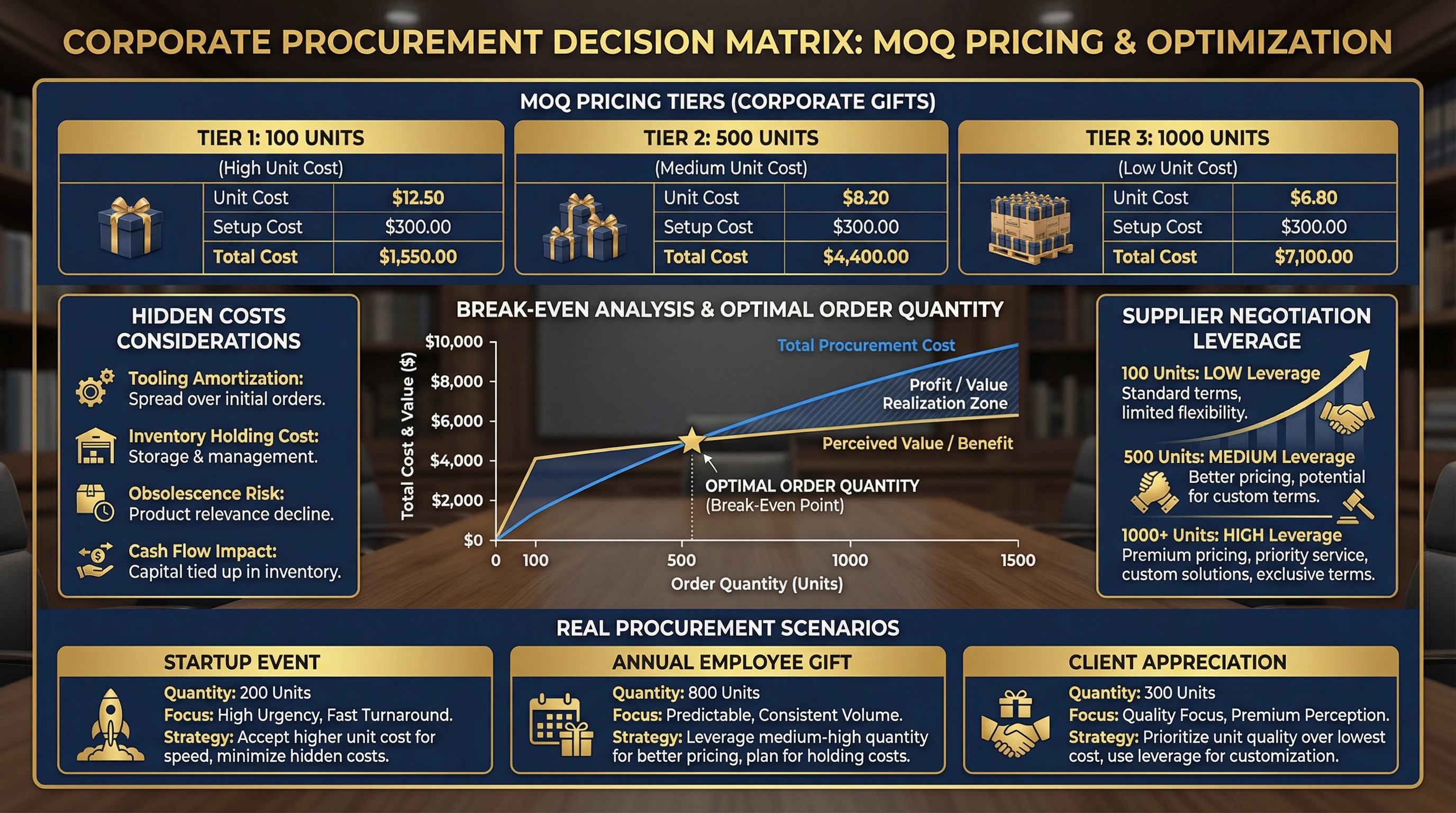
A typical pricing structure for a moderately complex item (let's say a leather-bound notebook with custom embossing):
- 100 units: $12.50 per unit
- 500 units: $8.20 per unit
- 1,000 units: $6.80 per unit
On the surface, this looks like straightforward volume discounting. But here's what the unit prices don't show: the $300-500 in setup costs that apply regardless of order quantity. For the 100-unit order, that setup cost adds $3.00-5.00 per unit. For the 1,000-unit order? Just $0.30-0.50 per unit.
The real cost per unit:
- 100 units: $12.50 + $4.00 (setup) = $16.50
- 500 units: $8.20 + $0.60 (setup) = $8.80
- 1,000 units: $6.80 + $0.40 (setup) = $7.20
Suddenly the 100-unit order costs 129% more per unit than the 1,000-unit order, not the 84% suggested by the quoted unit prices. This setup cost amortization is the first hidden variable in MOQ pricing.
The Setup Costs Nobody Mentions Upfront
In that power bank project, the $11.50 unit price was technically accurate—for the manufacturing cost only. What the quote didn't itemize:
- Logo printing plate fabrication: $280
- Packaging die-cutting tool: $320
- Color matching and sample approval: $150
- Quality control inspection setup: $180
Total setup costs: $930, or $4.65 per unit for our 200-unit order. The supplier had mentioned "standard setup fees apply" in the quote footer, but without specific amounts, we'd assumed perhaps $200-300 total. Our mistake was not asking for a complete cost breakdown before committing.
Setup costs vary dramatically by product type and customization complexity. From my procurement database:
Low setup cost items ($100-200 total):
- Screen-printed tote bags
- Laser-engraved bamboo items
- Pad-printed pens
Medium setup cost items ($300-600 total):
- Embossed leather goods
- Multi-color printed drinkware
- Custom packaging with die-cutting
High setup cost items ($800-1,500 total):
- Injection-molded plastic products (tooling required)
- Multi-process items (printing + embossing + assembly)
- Electronics with custom firmware
For low-volume orders (under 300 units), setup costs often exceed 20% of the total project cost. Yet most suppliers bury these costs in fine print or disclose them only after you've invested time in sample approval. The solution? Always request an itemized quote that separates unit cost, setup costs, and any other fees before evaluating suppliers.
The Break-Even Analysis You Should Run
Every MOQ pricing structure has an optimal order quantity—the point where the per-unit cost drops enough to justify the inventory risk and cash flow impact of ordering more units than you immediately need. Finding this point requires modeling your specific use case.
Let's work through a real scenario. Your company needs corporate gifts for quarterly client meetings throughout the year. Estimated annual volume: 800 units. You can either:
Option A: Order 200 units quarterly (four orders of 200)
- Unit cost at 200 quantity: $9.50
- Setup cost per order: $400
- Cost per order: (200 × $9.50) + $400 = $2,300
- Annual cost: $2,300 × 4 = $9,200
Option B: Order 800 units once annually
- Unit cost at 800 quantity: $7.20
- Setup cost: $400
- Total cost: (800 × $7.20) + $400 = $6,160
Option B saves $3,040 (33%) compared to Option A. But this analysis is incomplete. It doesn't account for:
Inventory holding cost: Storing 800 units for an average of six months. If your company's cost of capital is 8% annually and the average inventory value is $3,080 (half of $6,160), the holding cost is approximately $123.
Obsolescence risk: What if your logo changes mid-year? Or the product becomes outdated? Or you overestimated demand? Assign a probability-weighted cost to this risk. If there's a 15% chance you'll need to dispose of 200 excess units worth $1,440, the expected obsolescence cost is $216.
Cash flow impact: Paying $6,160 upfront versus $2,300 quarterly affects your working capital. If that capital could otherwise earn 6% annually in your business, the opportunity cost of early payment is approximately $185.
Revised Option B cost: $6,160 + $123 + $216 + $185 = $6,684
Option B still saves $2,516 (27%), but the advantage has shrunk. More importantly, you now have a framework for evaluating whether the savings justify the risks. For a stable, long-term corporate gift program with predictable demand, Option B makes sense. For a one-time event or a new program with uncertain demand, Option A's flexibility may be worth the premium.
The Hidden Leverage in Tier Negotiations
Here's what most procurement teams don't realize: MOQ tiers aren't fixed. They're negotiable, especially when your order quantity falls just below a tier break.
Last quarter, we needed 480 units of a custom tumbler. The supplier's pricing:
- 300 units: $8.90 per unit
- 500 units: $7.40 per unit
At 480 units, we'd pay $8.90 per unit ($4,272 total). But we were only 20 units short of the 500-unit tier break. I called the supplier and proposed: "We'll commit to 500 units if you'll apply the $7.40 rate to our actual order of 480 units and hold the remaining 20 units as credit toward our next order."
The supplier agreed. Why? Because hitting the 500-unit production run was more efficient for them than running 480 units. The setup costs were identical, and the marginal cost of producing 20 extra units was minimal. We paid $3,552 (480 × $7.40) instead of $4,272—a savings of $720 (17%).
This negotiation tactic works best when:
- Your order quantity is within 10-15% of the next tier break
- You have an ongoing relationship with the supplier (or credibly commit to one)
- The product has a reasonable shelf life and you'll genuinely use the extra units
The key is framing it as a win-win: the supplier gets a larger order (better production efficiency), and you get better pricing. I've successfully negotiated tier-break pricing on roughly 60% of orders that fell within 15% of the next tier.
The Packaging Premium Nobody Warns You About
In the power bank project that started this article, there was another hidden cost: packaging. The quoted $11.50 unit price assumed bulk packaging—50 units per master carton with no individual gift boxes. We wanted each power bank in a branded gift box. The packaging premium? $2.80 per unit, disclosed only when we requested individual boxing.
Packaging costs scale with complexity:
Bulk packaging (poly bag or basic box): $0.10-0.30 per unit
Standard gift box (printed cardboard, no custom die-cutting): $0.80-1.50 per unit
Premium gift box (rigid box, custom insert, magnetic closure): $2.50-4.50 per unit
Luxury packaging (wooden box, leather case, custom foam insert): $6.00-12.00 per unit
For corporate gifts, packaging often matters as much as the product itself—it's the first thing recipients see. But if packaging costs aren't explicitly discussed during quoting, you'll face sticker shock when the final invoice arrives.
The procurement lesson: Always specify packaging requirements in your RFQ (request for quote). If you're unsure what packaging level is appropriate, request samples at different packaging tiers. A $1.50 packaging upgrade that significantly improves perceived value is often worth it; a $4.00 upgrade that recipients immediately discard is not.
The Supplier's Perspective on MOQ Economics
To negotiate effectively, you need to understand why suppliers set MOQs where they do. I spent an afternoon with a corporate gift manufacturer walking through their cost structure. Here's what drives their MOQ decisions:
Material procurement: Suppliers buy raw materials in bulk to get better pricing. A leather goods manufacturer might buy leather hides in lots of 50 square meters. If your notebook design requires 0.3 square meters per unit, they need orders of at least 167 units to avoid material waste or the complexity of storing partial hides.
Production setup time: Switching a production line from one product to another involves cleaning, tool changes, and test runs. For a screen printing operation, setup might take 2-3 hours. If the actual production run takes only 1 hour (for a small order), the setup time dominates total labor cost. Suppliers set MOQs to ensure production time exceeds setup time by at least 3:1.
Quality control efficiency: QC inspection has fixed costs (inspector time, measurement equipment setup) and variable costs (per-unit inspection time). For small orders, fixed costs dominate, making the per-unit QC cost prohibitively high. Suppliers either skip thorough QC (risking quality issues) or set MOQs high enough to amortize fixed QC costs.
Administrative overhead: Processing a 50-unit order requires nearly the same administrative work as a 500-unit order—quotes, contracts, invoicing, shipping coordination. Suppliers need orders large enough to cover this overhead while maintaining acceptable profit margins.
Understanding these constraints helps you negotiate more effectively. If a supplier's MOQ is 500 units but you need only 300, you might propose: "Can we order 300 units now with a commitment to order another 300 within six months?" This gives the supplier confidence in the total volume while giving you flexibility on timing.
The Multi-Supplier Strategy for Low-Volume Needs
What if you genuinely need only 100 units, but the economics of MOQ pricing make small orders prohibitively expensive? One strategy I've used successfully: the multi-client consolidation approach.
I work with three other procurement managers at non-competing companies. When any of us has a low-volume corporate gift need, we check whether others have similar upcoming needs. If two or three of us need similar products (same base item, different logos), we place a consolidated order that hits a higher MOQ tier, then split the shipment.
Example: Company A needs 150 custom notebooks, Company B needs 200, Company C needs 180. Individually, each would pay the 100-300 unit tier pricing (approximately $9.50 per unit plus $400 setup each). Together, we order 530 units at the 500+ tier pricing ($7.40 per unit plus $400 total setup).
Individual cost: 150 × $9.50 + $400 = $1,825 (Company A)
Consolidated cost: 150 × $7.40 + (150/530 × $400) = $1,223 (Company A's share)
Savings: $602 (33%)
This approach requires trust and coordination, but the savings are substantial. We've formalized it with a simple agreement: one company acts as the lead buyer, places the consolidated order, and invoices the others for their share. We rotate the lead buyer role to distribute the administrative work.
The strategy works best for:
- Standard products with customization limited to logo/text
- Companies with similar quality standards and timelines
- Non-competing businesses (to avoid any antitrust concerns)
- Situations where the consolidated volume crosses a meaningful MOQ tier break
We've run eight consolidated orders over the past eighteen months, with average savings of 28% compared to individual ordering.
The Timing Factor in MOQ Negotiations
Suppliers' willingness to negotiate on MOQ and pricing varies with their production schedule. During slow periods, they're more flexible because they want to keep production lines running. During peak seasons (typically September-December for corporate gifts in Singapore), they have less incentive to accommodate small orders or offer discounts.
I track supplier lead times throughout the year as a proxy for their capacity utilization. When lead times stretch from the usual 3-4 weeks to 6-8 weeks, that signals high demand and reduced negotiating leverage. When lead times drop to 2-3 weeks, that's the time to negotiate aggressively on MOQ flexibility and pricing.
Last February—traditionally a slow month after the Chinese New Year rush—I approached a supplier about a 280-unit order that fell short of their 300-unit MOQ. They not only accepted the 280-unit order but also applied the 300-unit tier pricing. In November, the same supplier wouldn't budge on MOQ for a similar request.
The procurement calendar strategy:
January-February: Best time for MOQ flexibility and pricing negotiations (post-holiday lull)
March-May: Moderate negotiating leverage (steady demand)
June-August: Good time for early orders of year-end gifts (suppliers appreciate advance commitments)
September-December: Worst time for negotiations (peak season, suppliers prioritize large orders)
If your corporate gift needs are predictable, placing orders during slow periods—even if you don't need the products for several months—can save 15-25% compared to peak-season ordering.
The Quality-MOQ Tradeoff
Here's an uncomfortable truth: suppliers often provide better quality control for larger orders. It's not intentional discrimination—it's economics. The per-unit cost of thorough QC inspection drops dramatically with order volume.
For a 100-unit order, spending 10 minutes per unit on QC inspection adds $25-30 per unit in labor cost (assuming $150-180 per hour fully loaded labor rate). For a 1,000-unit order, the supplier can implement statistical sampling inspection (inspecting 125 units per AQL 2.5 standard) and spend only $3-4 per unit on QC.
The result? Small orders either get cursory QC (higher defect rates) or thorough QC that makes the total cost uncompetitive. I've seen defect rates of 8-12% on sub-200-unit orders versus 2-4% on 500+ unit orders from the same supplier.
The mitigation strategies:
Pre-production samples: Insist on approving a physical sample before mass production, regardless of order size. This catches design or material issues before they affect the full order. Budget $50-150 for sample production and shipping.
Staged delivery with inspection gates: For orders where quality is critical, request delivery in two batches—an initial 30% for your inspection, then the remaining 70% after you've verified the first batch meets standards. Suppliers resist this because it complicates logistics, but it's negotiable for orders above $3,000-4,000.
Third-party inspection: For high-value or high-risk orders, hire an independent QC inspector to visit the factory before shipment. Cost: $200-400 for a half-day inspection. This is overkill for routine orders but worthwhile for first-time suppliers or complex products.
Explicit QC specifications in the purchase order: Don't rely on vague terms like "industry standard quality." Specify measurable criteria: "Color match within Delta E 2.0 of approved sample," "Logo print must be centered within ±2mm," "No visible scratches >1mm length." This gives you clear grounds for rejection if quality falls short.
The Real Cost of Getting MOQ Wrong
Two years ago, our marketing team ordered 2,000 branded USB drives for a product launch event. The expected attendance? 800 people. The marketing manager's logic: "Better to have extras than run out, and the per-unit cost at 2,000 is so much better than at 800."
The unit cost at 800: $4.20. At 2,000: $3.10. Savings per unit: $1.10. Total savings on 800 units: $880.
What actually happened: 650 people attended the event. We distributed 650 USB drives. The remaining 1,350 units sat in storage for fourteen months before we donated them to a charity (because our logo and product messaging had become outdated).
The real cost calculation:
- Excess inventory: 1,350 units × $3.10 = $4,185
- Storage cost (14 months): approximately $120
- Opportunity cost of capital tied up: approximately $180
- Total waste: $4,485
If we'd ordered 800 units at $4.20 each ($3,360 total), we would have saved $1,125 compared to the "cost-effective" 2,000-unit order. The lesson: MOQ optimization isn't about minimizing per-unit cost—it's about minimizing total cost including waste and carrying costs.
The framework I now use for quantity decisions:
- Estimate realistic demand (not best-case scenario)
- Add 10-15% buffer for unexpected needs
- Calculate total cost at that quantity including all fees
- Model the next MOQ tier up: Does the per-unit savings exceed the cost of excess inventory?
- Assess obsolescence risk: How likely is the product to become outdated before you use the excess?
Only order above your realistic demand if the math clearly justifies it and obsolescence risk is low.
The Supplier Relationship Multiplier
Everything I've discussed so far assumes transactional supplier relationships—you place an order, they fulfill it, the relationship ends. But procurement efficiency improves dramatically when you build ongoing relationships with a small number of reliable suppliers.
With suppliers I've worked with for multiple projects, I get:
Waived or reduced setup fees for repeat orders of similar products
Flexible MOQs because they trust we'll place future orders
Priority scheduling during peak seasons
Proactive suggestions for cost optimization
Better payment terms (net 30 or net 45 instead of 50% deposit)
Last month, a long-term supplier called me: "We're running a production batch of leather notebooks similar to what you ordered last year. If you have any upcoming needs, we can add your order to this batch and waive the $400 setup fee." We hadn't planned to order notebooks for another two months, but the setup fee savings justified ordering early. Total savings: $400 plus the benefit of better pricing because we hit a higher MOQ tier when combined with their existing production run.
Building these relationships requires:
- Consistent communication: Update suppliers on your pipeline of upcoming projects
- Reliable payment: Pay invoices on time, every time
- Reasonable expectations: Don't demand impossible timelines or unrealistic pricing
- Feedback: Let suppliers know what worked well and what didn't
- Volume concentration: Give larger shares of your business to your best suppliers
I've consolidated 80% of our corporate gift spending with four suppliers. This concentration gives me negotiating leverage and makes it worthwhile for suppliers to invest in the relationship.
The MOQ Decision Framework
After analyzing dozens of corporate gift projects, here's the decision framework I use to evaluate MOQ-based pricing:
Step 1: Calculate true per-unit cost including all setup fees, packaging, and shipping
Step 2: Model total cost at your required quantity and at the next MOQ tier up
Step 3: Assess inventory risk—what's the probability you won't use the full quantity?
Step 4: Factor in carrying costs and opportunity cost of capital
Step 5: Consider timing—can you negotiate better terms during slow periods?
Step 6: Evaluate supplier relationship—is there value in concentrating volume?
Step 7: Make the decision based on total cost of ownership, not per-unit price
This framework has reduced our corporate gift procurement costs by an average of 22% compared to our previous approach of simply selecting the lowest quoted unit price.
The MOQ trap is real, and it catches even experienced procurement teams. But once you understand the underlying economics and hidden costs, you can turn MOQ-based pricing from a trap into a negotiating advantage. The suppliers who are transparent about their cost structure and willing to work with you on creative solutions? Those are the partners worth building long-term relationships with.
The next time you receive a quote for corporate gifts, don't just look at the unit price. Ask for a complete cost breakdown, model the total cost at different quantities, and negotiate based on the supplier's actual economics. Your budget—and your stakeholders—will thank you.