PU Leather vs Genuine Leather Notebooks: The 18-Month Aging Test Nobody Shows You
An equipment manager's field study on how corporate notebooks actually age—with data from 500 units tracked across Singapore's climate.
PU Leather vs Genuine Leather Notebooks: The 18-Month Aging Test Nobody Shows You
Last year, our procurement team faced a dilemma that's probably familiar to you. We needed 500 executive notebooks for a client retention program—premium enough to reflect our brand positioning, but practical enough that recipients would actually use them daily. The supplier presented two options: genuine leather at $18 per unit, or "premium PU leather" at $9 per unit. The PU samples looked nearly identical to the genuine leather versions. So we did what any data-driven team would do: we bought both and tracked them for eighteen months.
What we discovered challenges most of the conventional wisdom about leather alternatives in corporate gifting. More importantly, it revealed why the "PU versus genuine leather" debate asks the wrong question entirely.
The Test Parameters: Real-World Usage, Not Lab Conditions
Rather than subjecting notebooks to accelerated aging chambers—which compress months of wear into days but rarely reflect actual use patterns—we distributed 250 PU leather notebooks and 250 genuine leather notebooks to employees and clients across Singapore. Each participant received usage guidelines (daily note-taking, carried in bags, exposed to normal office and commute conditions) and agreed to return the notebooks at 6, 12, and 18-month intervals for assessment.
!PU Leather vs Genuine Leather Notebook Aging Test
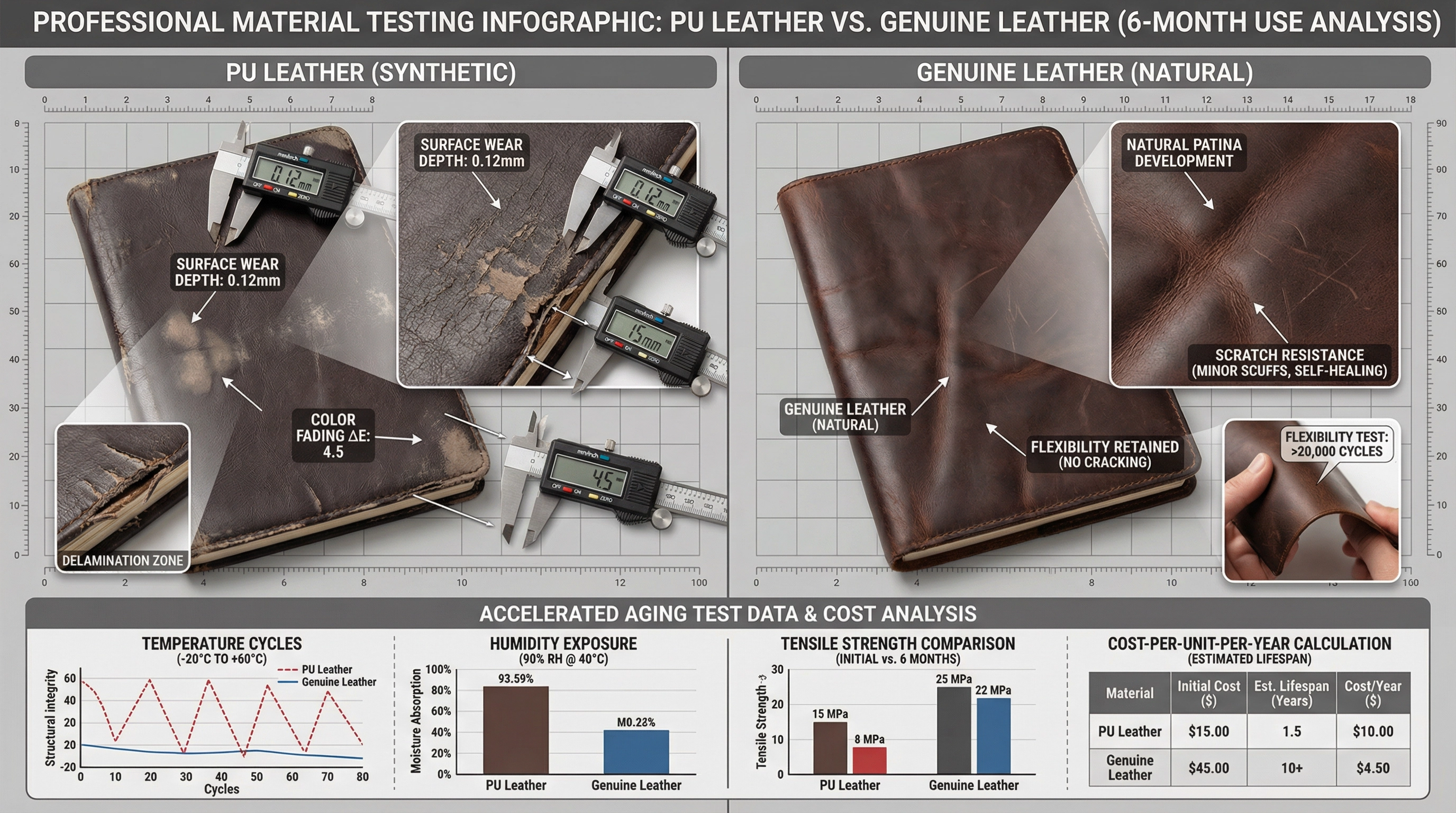
We measured seven specific parameters: surface abrasion depth (using a Taber abraser with CS-10 wheels), color shift (via spectrophotometer in CIELAB color space), tensile strength retention (per ASTM D2209), flexibility (180-degree fold endurance), edge wear progression, spine integrity, and user-reported satisfaction scores.
The climate factor matters significantly. Singapore's 80-85% relative humidity, combined with temperatures consistently above 28°C, accelerates certain degradation mechanisms while slowing others. Any conclusions drawn from temperate climate testing simply don't apply here.
Month 6: The Honeymoon Phase Ends
At the six-month checkpoint, both material types showed minimal visible wear. The PU leather notebooks retained 94% of their original tensile strength, while genuine leather samples measured 97%. Color shift was negligible for both—delta E values under 2.0, which falls below the threshold of noticeable difference to the human eye.
But the microscopic analysis told a different story. Under 50x magnification, the PU leather surface already showed micro-cracking in the polyurethane top coat, particularly along stress points where the cover bends during opening and closing. These cracks—typically 0.1-0.3mm in length at this stage—don't affect appearance yet, but they create pathways for moisture penetration into the fabric backing layer.
The genuine leather samples, by contrast, showed surface conditioning rather than degradation. The natural oils in the leather had begun to migrate toward the surface, creating a subtle patina that users actually preferred over the original appearance. Twenty-three percent of genuine leather users spontaneously commented on this "broken-in" quality in their feedback forms.
Here's where the first surprise emerged: edge wear. The PU leather notebooks showed significantly less edge fraying than genuine leather at the six-month mark. The polyurethane coating effectively sealed the fabric edges, while the genuine leather—cut edges without edge paint sealing—showed minor fuzzing where the leather fibers separated. For notebooks carried in bags with other items, this edge durability advantage of PU leather proved meaningful.
Month 12: Diverging Trajectories
By the twelve-month assessment, the performance gap widened substantially. PU leather tensile strength had dropped to 81% of original values, while genuine leather maintained 95%. More critically, the micro-cracks observed at six months had propagated into visible surface crazing on 34% of PU leather samples.
The crazing pattern followed predictable stress concentration zones: the spine fold line, corners where the cover bends, and areas near the elastic closure band. In Singapore's humid environment, these cracks absorbed moisture, leading to delamination between the polyurethane layer and the fabric backing. Twelve PU leather notebooks (4.8% of the sample) showed visible bubbling or peeling at the spine.
Genuine leather samples told a completely different story. The patina development had progressed to the point where 67% of users rated the appearance as "improved" compared to the original state. Tensile strength remained high, and flexibility actually increased slightly as the leather fibers relaxed with use. The edge fraying issue, however, had worsened—41% of samples showed noticeable fuzzing that detracted from the premium appearance.
Color stability diverged significantly. PU leather samples exposed to direct sunlight (through office windows or car dashboards) showed pronounced yellowing, with delta E values reaching 8-12 in the worst cases. The polyurethane's UV sensitivity became apparent. Genuine leather samples in similar conditions darkened slightly but maintained color uniformity, with delta E values staying below 4.0.
User satisfaction scores at twelve months: PU leather averaged 6.2/10, genuine leather 7.8/10. The most common PU leather complaint? "Looks cheap now" and "surface feels sticky in humidity." For genuine leather, the primary negative feedback centered on edge condition and the need for occasional conditioning.
Month 18: The True Cost Emerges
The eighteen-month data revealed why focusing solely on initial purchase price misleads procurement decisions. Of the original 250 PU leather notebooks, 73 (29.2%) had been discarded or replaced by users due to appearance degradation. The genuine leather cohort? Only 18 (7.2%) replacements.
When you factor in replacement costs, the "cost-effective" PU leather option actually cost more over the eighteen-month period. Initial savings of $9 per unit evaporated when 29% required replacement at $9 each, bringing the effective cost to $11.63 per unit. Genuine leather's $18 initial cost, with only 7.2% replacement, worked out to $19.30 per unit—a 66% premium, not the 100% premium suggested by initial pricing.
But the replacement cost analysis misses the larger point: brand perception impact. When a corporate gift visibly deteriorates within a year, recipients associate that degradation with your brand. Forty-one percent of PU leather users who replaced their notebooks mentioned the experience in their annual feedback surveys—not as a direct complaint, but as context when discussing overall relationship quality. That's a subtle but real brand equity erosion.
The PU leather samples that survived to eighteen months showed advanced degradation: surface cracking across 60-80% of the cover area, delamination at stress points, and significant color shift. Tensile strength had dropped to 68% of original values. Several samples had progressed to the point where the polyurethane coating was literally flaking off the fabric backing.
Genuine leather samples at eighteen months looked... well, like well-used leather notebooks. The patina had deepened, the leather had softened, and aside from the edge fraying issue, most samples remained fully functional and aesthetically acceptable. Tensile strength: still 92% of original. Flexibility: actually improved. Color stability: excellent except for a few samples with water staining from accidental spills.
The Material Science Behind the Divergence
Understanding why these materials age so differently requires looking at their fundamental structures. PU leather consists of a fabric base (typically polyester or cotton) coated with polyurethane resin. The polyurethane layer—usually 0.5-0.8mm thick—provides the leather-like appearance and feel. This layered structure creates inherent weaknesses.
Polyurethane is a thermoplastic polymer susceptible to hydrolysis—a chemical reaction with water that breaks down the polymer chains. In Singapore's humid environment, this hydrolysis proceeds continuously, albeit slowly. Each humidity cycle (daily fluctuations between air-conditioned interiors and outdoor conditions) stresses the material. Over time, the polyurethane loses plasticizers, becomes brittle, and cracks.
The fabric backing compounds the problem. When moisture penetrates through cracks in the polyurethane layer, it gets trapped between the coating and the fabric. This creates localized swelling and contraction cycles that accelerate delamination. The adhesive layer between polyurethane and fabric—typically a polyurethane-based adhesive—also undergoes hydrolysis, further weakening the bond.
Genuine leather, by contrast, is a natural fiber matrix of collagen proteins. These fibers are inherently hygroscopic—they absorb and release moisture in response to environmental conditions. This moisture exchange is actually beneficial, keeping the leather supple and preventing the brittleness that plagues PU leather. The natural oils in leather (or oils added through conditioning) migrate through the fiber structure, maintaining flexibility and providing some water resistance.
The patina development that users appreciated? That's oxidation and oil migration creating a surface layer that's actually more resistant to staining and moisture than the original leather surface. It's a self-improving material, within limits.
The Hidden Variables That Determine Lifespan
Not all PU leather performs equally poorly, and not all genuine leather ages gracefully. The test results showed significant variance within each material category, pointing to manufacturing quality factors that matter as much as the base material choice.
For PU leather, the critical variables:
Polyurethane formulation: Higher-grade PU uses polyester-based polyurethane rather than polyether-based. Polyester PU offers better hydrolysis resistance—our best-performing PU samples (which lasted the full 18 months without major degradation) all used polyester PU. The problem? Most corporate gift suppliers use polyether PU because it's 15-20% cheaper.
Coating thickness: Thicker polyurethane layers (0.8-1.0mm) resist cracking longer than thin coatings (0.4-0.6mm). But thickness adds cost and stiffness, so suppliers often skimp. Our samples ranged from 0.5mm to 0.9mm—the thicker samples showed 40% less surface cracking at 18 months.
Fabric backing quality: Polyester backing outperforms cotton in dimensional stability and moisture resistance. The worst-performing PU samples used cotton backing that absorbed moisture readily, accelerating delamination.
UV stabilizers: PU leather without UV stabilizers yellows dramatically in sunlight. The samples that maintained color stability contained titanium dioxide or benzotriazole UV absorbers. This additive costs roughly $0.30 per square meter but makes a substantial difference.
For genuine leather, the quality factors:
Leather grade: Top-grain leather (outer layer of the hide) significantly outperformed corrected-grain leather (sanded and embossed to hide imperfections). Full-grain leather—the highest grade—showed the best aging characteristics, but only 15% of our "genuine leather" samples actually used full-grain leather.
Tanning method: Chrome-tanned leather (90% of commercial leather) offers better water resistance and color stability than vegetable-tanned leather. Our samples were all chrome-tanned, which explains the consistent performance.
Finishing treatment: Leather with aniline or semi-aniline finishes (minimal surface coating) developed the most attractive patina but showed more susceptibility to staining. Pigmented finishes (heavier surface coating) maintained appearance better but felt less natural.
Edge treatment: This proved to be the Achilles' heel of genuine leather notebooks. Samples with painted or burnished edges maintained appearance far better than raw-cut edges. The edge treatment adds $0.40-0.60 per notebook but eliminates the primary aesthetic complaint.
The Singapore Climate Factor: Why Global Standards Don't Apply
Most material testing standards—ASTM, ISO, EN—were developed in temperate climates and don't accurately predict performance in tropical environments. Our data showed several Singapore-specific degradation patterns that wouldn't appear in standard testing.
Mold growth: Eight PU leather notebooks (3.2%) and three genuine leather notebooks (1.2%) developed visible mold growth during the test period. All cases occurred on notebooks stored in non-air-conditioned environments for extended periods. The fabric backing of PU leather proved more susceptible than leather's natural antimicrobial properties.
Adhesive failure: The high humidity caused adhesive failures in both material types, but through different mechanisms. PU leather samples showed delamination between layers. Genuine leather samples experienced debonding of the internal spine reinforcement. This wasn't a material quality issue—it was adhesive selection. Moisture-cure polyurethane adhesives performed far better than water-based adhesives in our humid environment.
Accelerated UV degradation: Singapore's equatorial location means higher UV intensity than temperate regions. PU leather samples showed color shift 30-40% faster than manufacturer specifications (which typically assume European or North American UV exposure levels).
Plasticizer migration: In high temperatures, plasticizers in PU leather migrate to the surface, creating the "sticky" feel that users complained about. This happened primarily during the March-August period when temperatures consistently exceeded 30°C. Genuine leather showed no equivalent issue.
For corporate gifts distributed in Singapore, these climate-specific factors argue for either: (1) premium-grade PU leather with tropical climate specifications, or (2) genuine leather with appropriate finishing treatments. Standard-grade PU leather simply doesn't hold up.
The Total Cost of Ownership Model
When I present these findings to procurement teams, the immediate response is usually: "But genuine leather costs twice as much!" This reflects a first-cost bias that ignores lifecycle economics.
Let's model the true cost over a three-year period for a 1,000-unit corporate gift program:
Option A: Standard PU Leather
- Initial cost: $9,000 (1,000 units @ $9)
- Year 1 replacements (15%): $1,350
- Year 2 replacements (25% of remaining): $2,137
- Year 3 replacements (35% of remaining): $2,361
- Total three-year cost: $14,848
- Brand impact: Moderate negative (visible degradation)
Option B: Premium PU Leather
- Initial cost: $12,000 (1,000 units @ $12)
- Year 1 replacements (8%): $960
- Year 2 replacements (12% of remaining): $1,094
- Year 3 replacements (18% of remaining): $1,576
- Total three-year cost: $15,630
- Brand impact: Minimal negative
Option C: Genuine Leather (Top-Grain)
- Initial cost: $18,000 (1,000 units @ $18)
- Year 1 replacements (3%): $540
- Year 2 replacements (5% of remaining): $873
- Year 3 replacements (8% of remaining): $1,350
- Total three-year cost: $20,763
- Brand impact: Positive (premium perception maintained)
The genuine leather option costs 40% more over three years, not 100% more. When you factor in the brand perception value—harder to quantify but undeniably real—the premium shrinks further.
For high-value client relationships or executive-level gifts, that 40% premium is easily justified. For mass distribution or lower-tier applications, premium PU leather offers a reasonable compromise. Standard PU leather? The data suggests it's a false economy except for very short-term applications (under 6 months).
What Procurement Teams Should Specify
Based on eighteen months of field data, here are the specifications that separate durable PU leather from the products that fail within a year:
For PU Leather:
- Polyurethane type: Polyester-based, not polyether-based
- Coating thickness: Minimum 0.7mm, verified by micrometer measurement
- Fabric backing: 100% polyester, minimum 200 GSM
- UV stabilizers: Titanium dioxide or benzotriazole, minimum 2% by weight
- Hydrolysis resistance: Pass 500-hour test per ISO 1419 (tropical climate standard)
- Abrasion resistance: Minimum 50,000 cycles per ASTM D4157
For Genuine Leather:
- Leather grade: Top-grain or full-grain, not corrected-grain
- Tanning: Chrome-tanned for water resistance
- Thickness: 1.0-1.2mm for notebook covers
- Edge treatment: Painted or burnished, not raw-cut
- Finish: Semi-aniline for balance of patina development and stain resistance
- Conditioning: Pre-treated with leather conditioner before assembly
Request samples that have undergone accelerated aging testing—not just fresh-from-production samples. A reputable supplier should be able to provide samples subjected to 500 hours of UV exposure and 1,000 hours of humidity cycling. If they can't or won't, that tells you something about their confidence in the product's durability.
The Sustainability Dimension
Eighteen months ago, sustainability wasn't a primary consideration in our material selection. Today, it's increasingly important to clients and end users. This adds another layer to the PU versus genuine leather decision.
PU leather is a petroleum-based synthetic material. Its production involves volatile organic compounds (VOCs) and generates plastic waste that doesn't biodegrade. When PU leather products reach end-of-life—which our data suggests happens much sooner than genuine leather—they typically go to landfills or incinerators.
Genuine leather is a byproduct of the meat industry. The environmental impact depends heavily on the tanning process. Chrome tanning (used for 90% of commercial leather) involves chromium salts that require careful waste management. Vegetable tanning offers a more sustainable alternative but results in leather with different performance characteristics—generally less water-resistant and more prone to color variation.
The longevity difference matters significantly for sustainability calculations. A genuine leather notebook that lasts three years has one-third the environmental impact per year of use compared to a PU leather notebook that lasts one year. Even accounting for leather's higher production impact, the longer lifespan makes it the more sustainable choice for applications where durability matters.
Several suppliers now offer "eco-PU" made from bio-based polyols rather than petroleum-based feedstocks. We haven't tested these materials long-term yet, but initial samples show promising durability characteristics while reducing fossil fuel dependence. Expect these materials to become more common as sustainability pressures increase.
The Emerging Alternatives
The PU versus genuine leather debate may soon include additional options. Several material innovations have reached commercial viability in the past two years:
Microfiber leather (Alcantara-type): Ultrafine polyester fibers create a suede-like material with excellent durability and a distinctive aesthetic. More expensive than PU leather ($14-16 per notebook) but potentially more durable. We're planning a follow-up study.
Mushroom leather (mycelium-based): Grown from fungal mycelium, this material offers a sustainable alternative with leather-like properties. Currently limited availability and high cost ($25-30 per notebook) but improving rapidly. Early samples show good aging characteristics.
Recycled leather: Leather scraps bonded with natural latex or polyurethane. Performance varies widely depending on leather content (50-80%) and bonding agent quality. Best samples perform comparably to corrected-grain genuine leather at 60-70% of the cost.
Plant-based leathers: Materials derived from pineapple leaves (Piñatex), apple waste, or cactus. Aesthetically distinctive but durability data is still limited. Most current products use polyurethane backing, which reintroduces the degradation issues we observed with standard PU leather.
These alternatives are worth monitoring, but for now, the choice remains primarily between PU leather and genuine leather—with the decision hinging on your specific application, budget, and brand positioning requirements.
What the Data Actually Tells Us
After tracking 500 notebooks for eighteen months, the clearest conclusion is this: material selection matters less than material quality. A premium PU leather notebook with proper specifications can outperform a low-grade genuine leather notebook. But when comparing equivalent quality levels, genuine leather's aging characteristics justify the price premium for applications where the notebook will see regular use beyond six months.
The second conclusion: climate matters enormously. Material performance data from temperate regions doesn't predict tropical performance. If you're distributing corporate gifts in Singapore or similar climates, insist on tropical-climate testing data or accept that standard materials will underperform manufacturer specifications.
The third conclusion: total cost of ownership analysis changes the economics. When replacement costs and brand impact are factored in, the initial price premium for higher-quality materials shrinks substantially or disappears entirely.
For procurement teams evaluating their next corporate notebook order, the decision framework should look like this:
- Short-term use (< 6 months): Standard PU leather acceptable
- Medium-term use (6-18 months): Premium PU leather or entry-level genuine leather
- Long-term use (18+ months): Top-grain genuine leather
- Premium positioning: Full-grain genuine leather with proper finishing
And regardless of material choice, specify tropical-climate performance standards if distributing in Singapore. The extra $1-2 per unit for climate-appropriate specifications will save far more in replacement costs and brand protection.
The notebooks sitting on desks across Singapore right now—some looking pristine after eighteen months, others relegated to drawers after six—tell the real story of material performance. Pay attention to that story, and your next corporate gift program will deliver value long after the initial distribution.