Approval Process Delays Eroding Production Lead Time for Corporate Gift Boxes
Procurement teams systematically exclude internal approval workflows from lead time calculations, creating a dangerous illusion that production can begin immediately after purchase orders are issued. This blind spot compresses quality control windows and forces factories into operational compromises.
When procurement teams calculate production timelines for corporate gift boxes, they typically focus on the manufacturing duration quoted by suppliers. A supplier might promise "15 working days for production," and that number becomes the anchor for all downstream planning. What gets systematically overlooked is the time consumed by internal approval workflows—design sign-off, sample confirmation, packaging validation, and final artwork clearance. These approval stages are mentally categorized as "internal processes" rather than components of the total lead time, creating a dangerous illusion that production can begin immediately after the purchase order is issued.
From a factory project manager's perspective, this misunderstanding represents one of the most predictable yet preventable causes of delivery failures in the corporate gifting supply chain. The approval process does not pause the clock on production lead time; it actively erodes the buffer time that was supposed to protect against unforeseen complications. By the time all approvals are secured, the factory is often left with a fraction of the originally planned production window, forcing compromises in quality control, material sourcing, or production sequencing that would have been unnecessary had the approval timeline been factored into the initial lead time calculation.
This pattern repeats across industries and company sizes, yet it remains largely invisible to procurement teams who measure their performance by how quickly they issue purchase orders rather than how effectively they manage the end-to-end timeline from concept to delivery. Understanding why approval delays are systematically excluded from lead time planning—and what that exclusion costs in operational reality—is essential for anyone responsible for corporate gift procurement in environments where delivery precision directly impacts brand reputation and stakeholder relationships.
Why Approval Time Gets Excluded From Lead Time Calculations
The mental model most procurement professionals use when planning corporate gift box orders treats "lead time" as synonymous with "supplier production time." This framing is reinforced by supplier quotations, which typically state production duration in isolation: "12-15 working days after artwork approval" or "3 weeks from sample confirmation." The conditional phrasing—"after approval"—implicitly positions the approval process as a prerequisite that exists outside the production timeline rather than as an integral component of it.
This separation is not accidental. Suppliers structure their quotes this way to protect themselves from delays caused by client-side decision-making, which they cannot control. From the supplier's operational standpoint, production lead time begins when they receive final, approved specifications and ends when finished goods are ready for shipment. Everything that happens before that starting point—design iterations, sample reviews, stakeholder consultations—is the client's responsibility and therefore the client's timeline risk.
Procurement teams, in turn, internalize this framing without questioning its implications. When building a project timeline, they allocate discrete blocks for "supplier production" and "shipping," but approval stages are either omitted entirely or represented as vague placeholders like "internal review" without specific duration estimates. The assumption is that approvals will happen quickly because they involve internal stakeholders who are presumably aligned on project goals and motivated to move fast. In practice, approval workflows are subject to competing priorities, limited availability, and organizational inertia that can stretch a "quick review" into days or weeks of back-and-forth communication.
The result is a systematic underestimation of total lead time. A project that appears to have a comfortable 6-week runway from order placement to delivery date may actually have only 3-4 weeks of usable production time once approval delays are accounted for. This compression happens gradually and invisibly, making it difficult for procurement teams to recognize the problem until it manifests as a crisis in the final stages of production.
The Cumulative Effect of Multi-Stage Approval Workflows
!Cumulative approval delay accumulation in corporate gift production workflow
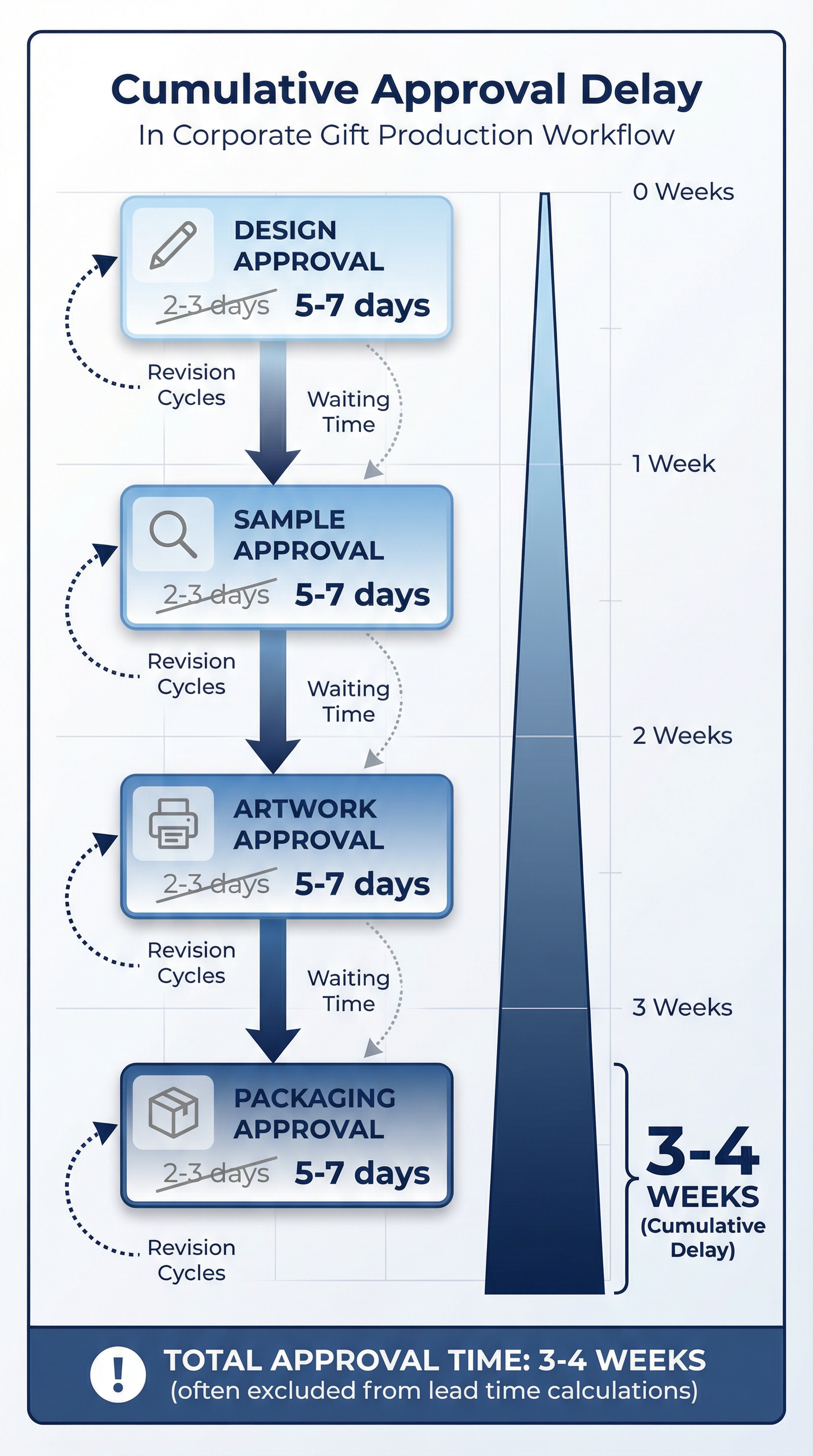
Corporate gift box projects typically require approval at multiple decision points: initial design concept, sample prototype, final artwork, packaging layout, and sometimes additional sign-offs for compliance or branding consistency. Each approval stage appears manageable in isolation—"we just need 2-3 days for the marketing team to review the design"—but the cumulative duration of sequential approvals can easily consume 2-3 weeks of calendar time, especially when decision-makers are not immediately available or when feedback triggers additional revision cycles.
The waiting time embedded in approval workflows is systematically underestimated because it is not visible as "work" in the traditional sense. When a procurement manager sends a sample photo to stakeholders for approval, the task feels complete from their perspective. The fact that the sample sits in someone's inbox for four days before being reviewed, then requires a follow-up meeting to discuss minor adjustments, then goes back to the supplier for revisions, then returns for re-approval—all of this elapsed time is perceived as incidental rather than structural. Yet from the factory's perspective, those four days of inbox delay are four days of lost production capacity that cannot be recovered without compressing downstream activities.
Revision cycles amplify this effect. A single round of feedback that requests "small changes" to a design can trigger a 5-7 day loop: 1 day for the supplier to implement changes, 1-2 days for file transfer and internal coordination, 2-3 days for stakeholder review, and another day for final confirmation. If the revised version still does not meet expectations, the loop repeats. Two revision cycles can consume nearly two weeks of calendar time, during which the factory's production schedule continues to advance and the window for starting the actual manufacturing process continues to shrink.
What makes this particularly insidious is that each individual approval delay feels justifiable. Marketing wants to ensure the design aligns with brand guidelines. Finance needs to confirm the budget. Compliance wants to verify that the gift meets regulatory requirements. No single stakeholder is being unreasonable, yet the aggregate effect of their sequential reviews creates a timeline bottleneck that was never accounted for in the original lead time estimate. By the time all approvals are secured, the project is already behind schedule, even though no one perceives themselves as having caused a delay.
How Approval Delays Compress Quality Control Windows
!Timeline erosion showing how approval delays compress production time
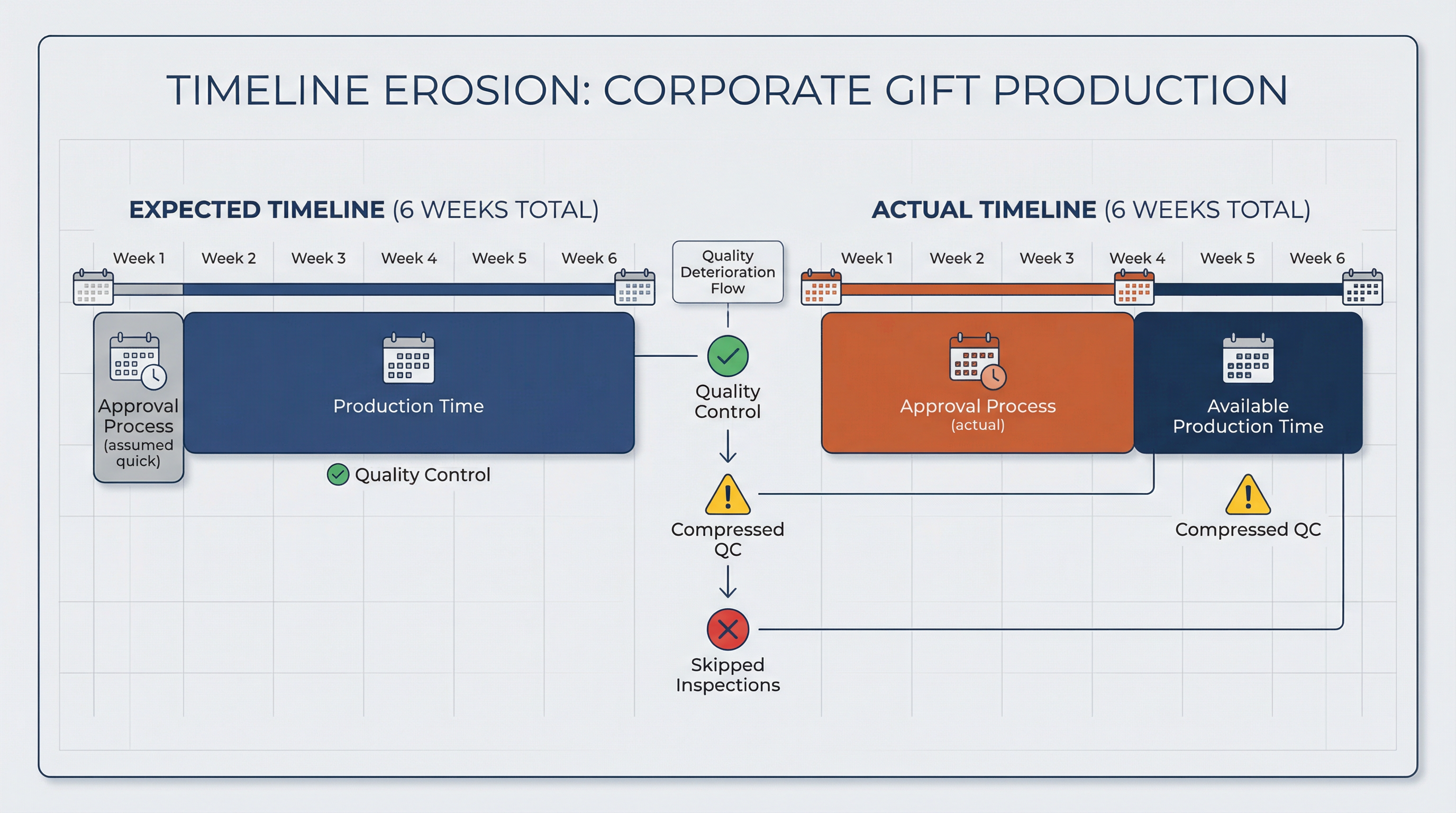
When approval processes consume more time than originally anticipated, the immediate consequence is a reduction in the time available for actual production. Factories respond to this compression by prioritizing activities that are visible and contractually required—manufacturing the units, applying customization, assembling packaging—while quietly reducing the time allocated to activities that are less visible but equally important, such as quality control inspections, material curing periods, and pre-shipment testing.
This trade-off is rarely communicated explicitly to the client. A factory project manager who receives final artwork approval two weeks later than expected will not typically send an email saying, "Due to the approval delay, we will be skipping the mid-production inspection to stay on schedule." Instead, they will internally adjust the production plan to compress or eliminate quality checkpoints that would normally catch defects before they reach the client. The factory's priority is to meet the delivery deadline, and in the absence of clear communication about the risks introduced by timeline compression, they will make whatever operational adjustments are necessary to hit that date.
From the procurement team's perspective, this compression is invisible. They see that the factory confirmed the delivery date and assume that production is proceeding according to the original plan. Only when the shipment arrives and quality issues are discovered—misaligned logos, inconsistent colors, packaging defects—does it become apparent that something went wrong. At that point, the root cause is often misdiagnosed as "poor supplier quality" rather than "insufficient production time caused by approval delays."
The relationship between approval delays and quality compromises is not always linear or obvious. A three-day delay in sample approval might not directly cause a quality defect, but it might force the factory to source materials from a secondary supplier with shorter lead times and less stringent quality standards. A one-week delay in final artwork approval might not seem catastrophic, but it might eliminate the buffer time that would have allowed the factory to conduct a full pre-production run to test color consistency across different printing batches. These second-order effects are difficult to trace back to their source, which is why approval delays continue to be treated as "internal process issues" rather than as direct contributors to production risk.
In high-stakes corporate gifting scenarios—such as gifts tied to specific events, product launches, or executive meetings—the cost of quality failures is disproportionately high. A gift box with a misaligned logo or incorrect branding does not just represent a financial loss; it represents a reputational risk that can damage relationships with clients, employees, or partners. Yet the procurement decisions that increase the likelihood of these failures—specifically, the failure to account for approval time in lead time planning—are made weeks or months earlier, at a stage when the consequences feel abstract and distant.
The Disconnect Between Approval Timelines and Factory Production Scheduling
Factory production schedules are planned in advance based on confirmed orders, expected material arrivals, and equipment availability. When a procurement team places an order with an expected approval completion date, the factory allocates a production slot based on that timeline. If approvals are delayed, the factory does not simply hold that slot open indefinitely; they fill it with other orders to maintain operational efficiency and revenue flow. When the delayed approval finally arrives, the factory must either squeeze the project into an already-full schedule or push it to the next available slot, which may be days or weeks later than originally planned.
This dynamic is poorly understood by procurement teams, who often assume that as long as they approve everything before the contractual delivery date, the factory will be able to accommodate the timeline. The implicit belief is that production capacity is fungible—that the factory can start production whenever the client is ready, as long as sufficient time remains before the deadline. In reality, production capacity is highly structured and time-sensitive. A factory that produces corporate gift boxes alongside other product lines cannot simply pause one order to accommodate a late approval on another without incurring costs in the form of setup time, material waste, or lost revenue from other clients.
When approval delays cause a project to miss its originally allocated production slot, the factory faces a difficult choice. They can attempt to expedite production by running overtime shifts, which increases labor costs and may compromise quality due to worker fatigue. They can re-sequence production to fit the delayed project into gaps in the schedule, which may require using different equipment or materials than originally planned. Or they can inform the client that the delivery date is no longer achievable, which risks damaging the supplier relationship and may trigger penalty clauses or lost future business.
In most cases, factories choose the first or second option—expedite or re-sequence—because maintaining client relationships and avoiding contractual penalties is more valuable than the incremental cost of accommodating the delay. However, this accommodation is not free. The costs are absorbed by the factory in the short term and passed back to the client in the form of higher future pricing, reduced willingness to offer favorable terms, or diminished trust that makes future collaboration more transactional and less flexible.
From a procurement perspective, the lesson here is that approval delays do not just consume time; they consume goodwill and operational flexibility. A supplier who consistently receives late approvals will eventually build that risk into their pricing or become less responsive to urgent requests, because they have learned that the client's internal processes are unreliable. Over time, this erodes the quality of the supplier relationship and reduces the procurement team's ability to negotiate favorable terms or secure priority treatment during peak seasons.
Why Procurement Teams Fail to Recognize Approval Time as a Lead Time Component
The persistence of this blind spot—treating approval time as separate from production lead time—can be traced to several structural factors in how corporate procurement is organized and measured. First, procurement performance metrics typically focus on cost savings, supplier compliance, and order processing speed rather than on end-to-end timeline management. A procurement manager who secures a 10% price reduction or processes a purchase order within 48 hours is recognized as high-performing, even if their project ultimately misses its delivery deadline due to approval delays that were never tracked or managed.
Second, approval workflows are often distributed across multiple departments—marketing, finance, compliance, legal—each with its own priorities and timelines. No single person owns the end-to-end approval process, which means no one is accountable for the cumulative delay caused by sequential handoffs. When a project misses its deadline, the blame is diffused across multiple stakeholders, making it difficult to identify a clear point of failure or to implement corrective measures for future projects.
Third, approval delays are often framed as exceptions rather than as predictable patterns. When a sample approval takes longer than expected, it is attributed to a specific circumstance—"the CMO was traveling" or "we had to wait for legal review"—rather than recognized as a symptom of a systemic problem in how approval timelines are estimated and managed. This framing prevents organizations from building approval time into their baseline lead time calculations, because each delay is treated as a one-off event that will not recur in future projects.
Finally, there is a psychological dimension to this blind spot. Procurement teams are trained to focus on supplier performance as the primary variable they can control. Supplier lead times, quality standards, and pricing are all areas where procurement can exert influence through negotiation, contract terms, and supplier selection. Internal approval processes, by contrast, feel outside the procurement team's sphere of control. Acknowledging that approval delays are a major contributor to timeline failures would require procurement to confront organizational dynamics—stakeholder availability, decision-making speed, internal alignment—that are politically sensitive and difficult to change. It is easier to blame the supplier for "not meeting the deadline" than to acknowledge that the deadline was unrealistic given the time consumed by internal approvals.
What This Means for Corporate Gift Box Procurement in Practice
For procurement professionals responsible for corporate gift box orders, the practical implication of this analysis is straightforward: approval time must be treated as a first-class component of total lead time, not as an afterthought or internal process that exists outside the production timeline. This requires a shift in how timelines are planned, communicated, and monitored throughout the project lifecycle.
The first step is to map out the approval workflow in detail before placing an order. Identify every decision point that requires stakeholder sign-off—design concept, sample prototype, final artwork, packaging layout, compliance review—and estimate the realistic duration for each stage, including waiting time and potential revision cycles. A realistic estimate for a single approval stage might be 5-7 days rather than the optimistic 2-3 days that procurement teams often assume. Multiply that across four or five approval stages, and the total approval time can easily reach 3-4 weeks, which must be added to the supplier's quoted production lead time to arrive at a realistic total timeline.
The second step is to communicate this timeline to all stakeholders upfront, making it clear that delays in any approval stage will directly impact the final delivery date. This is not about assigning blame; it is about creating shared accountability for timeline management. When stakeholders understand that their approval delay will compress production time and increase quality risk, they are more likely to prioritize timely reviews and avoid unnecessary revision cycles.
The third step is to build buffer time into the timeline specifically to absorb approval delays. If the supplier quotes 15 working days for production and the approval workflow is estimated at 3 weeks, the total timeline should be calculated as 6-7 weeks rather than 4-5 weeks, to account for the inevitable slippage that occurs in real-world approval processes. This buffer time is not wasted; it is insurance against the operational risks introduced by timeline compression.
The fourth step is to monitor approval progress actively throughout the project, treating approval milestones with the same rigor as production milestones. If a sample approval is delayed by three days, that delay should trigger an immediate reassessment of the overall timeline and a conversation with the supplier about whether the original delivery date is still achievable. Waiting until all approvals are complete to check in with the supplier is too late; by that point, the damage has already been done.
Finally, procurement teams should work with suppliers to understand how approval delays impact production scheduling and what flexibility exists to accommodate late approvals without compromising quality. Some suppliers may be able to hold a production slot open for a few extra days if they are given advance notice of a potential delay. Others may require a formal timeline extension and a revised delivery date. Having these conversations early—before delays occur—creates a foundation of trust and transparency that makes it easier to navigate timeline challenges when they inevitably arise.
The broader point here is that understanding how production timelines are structured requires looking beyond the supplier's quoted lead time to consider all the activities—both internal and external—that must occur before a finished product can be delivered. Approval workflows are not peripheral to this process; they are central to it. Treating them as such is not just a matter of better project management; it is a matter of operational realism that directly impacts delivery reliability, quality outcomes, and supplier relationships.
The Hidden Cost of Treating Approval Time as "Free"
When approval time is excluded from lead time calculations, the implicit assumption is that approval processes consume zero resources and impose zero constraints on production. This assumption is false. Approval delays consume calendar time, which is a finite and non-renewable resource in any project with a fixed delivery date. They consume stakeholder attention, which is a scarce resource in organizations where decision-makers are juggling multiple priorities. And they consume supplier goodwill, which is a strategic asset that determines how much flexibility and priority a procurement team can expect from their manufacturing partners.
The cost of this assumption becomes visible only when projects fail—when gifts arrive late, when quality defects force expensive rework, when supplier relationships deteriorate due to repeated last-minute rushes. At that point, the root cause is often obscured by the complexity of the supply chain and the difficulty of tracing timeline failures back to their source. Procurement teams may conclude that they need to find a "better supplier" or negotiate "shorter lead times," when the real problem is that their internal approval processes are consuming time that was never accounted for in the original timeline.
From a factory project manager's perspective, the most frustrating aspect of this dynamic is that it is entirely preventable. Approval delays are not random events; they are predictable patterns that can be measured, managed, and mitigated with relatively simple changes to how timelines are planned and communicated. The fact that these changes are not widely adopted suggests that the problem is not a lack of solutions but a lack of recognition that the problem exists in the first place.
Changing this requires a shift in how procurement teams think about their role. Instead of seeing themselves as intermediaries who place orders and manage supplier relationships, they need to see themselves as timeline orchestrators who are responsible for coordinating all the activities—internal and external—that must occur to deliver a finished product on time. This includes managing approval workflows with the same rigor and accountability that they apply to supplier performance. It includes building realistic timelines that account for the messiness of real-world decision-making processes. And it includes having difficult conversations with stakeholders about the trade-offs between timeline flexibility and quality risk.
The alternative—continuing to treat approval time as an invisible, unmanaged component of the supply chain—is to accept that a significant percentage of corporate gift box projects will experience avoidable delays, quality compromises, and supplier friction. For organizations where corporate gifting is a strategic tool for building relationships and reinforcing brand identity, that is a cost that cannot be justified by the convenience of ignoring approval timelines in lead time planning.