Cross-Timezone Asynchronous Approval Cycles in Corporate Gift Box Production
Cross-Timezone Asynchronous Approval Cycles in Corporate Gift Box Production
Cross-timezone sample approval cycles in corporate gift box production operate under a fundamental misunderstanding that procurement teams rarely articulate but consistently act upon: the belief that email communication functions as a real-time medium. This assumption, embedded in how lead time estimates are constructed, treats the approval process as if both parties exist in the same temporal space. When a procurement manager sends sample feedback at four in the afternoon and expects a revised sample by the following morning, the timeline reflects this synchronous expectation. The supplier, however, receives that feedback at midnight their time, begins work eight hours later, and sends revisions at the end of their working day—which arrives in the procurement manager's inbox the next morning, not as a next-day response but as a two-day cycle.
!Asynchronous communication cycle in cross-timezone sample approval process
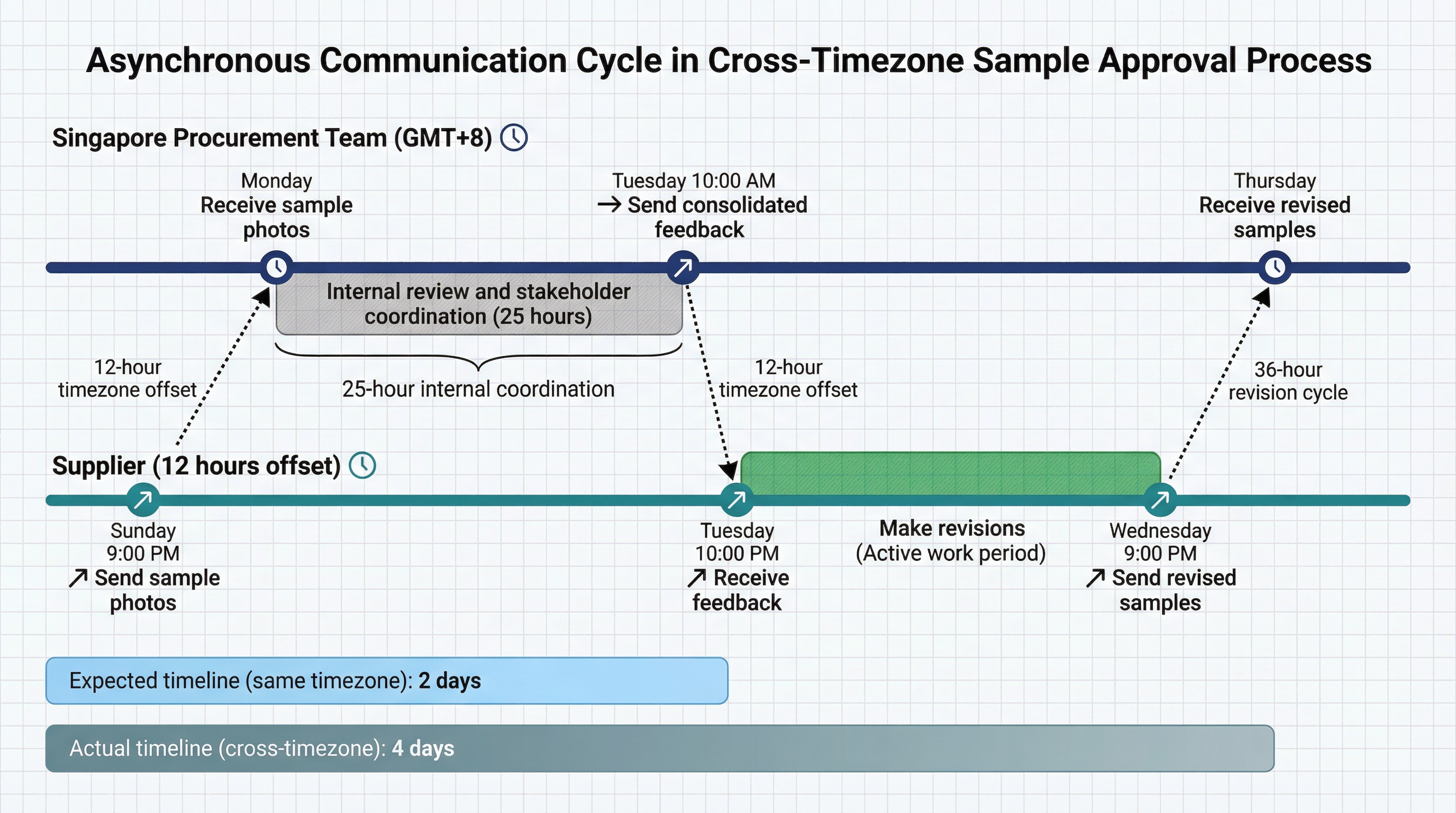
*Asynchronous communication cycle showing how 12-hour timezone offset extends a 2-day approval round to 4 days. Internal coordination and communication latency compound to create systematic lead time underestimation.*
The mechanics of this misalignment are straightforward but their implications for understanding how production scheduling and coordination dynamics affect delivery timelines for corporate gift box production are systematically underestimated. A typical sample approval round, when both parties operate in the same timezone, follows a predictable rhythm: supplier sends sample photos in the morning, procurement reviews by afternoon, feedback returns by end of day, supplier makes adjustments overnight, revised sample appears the next morning. This twenty-four to thirty-six hour cycle becomes the mental model that procurement teams apply to all supplier relationships, regardless of geographic distance. When the supplier operates twelve hours ahead or behind, this model breaks down, but the procurement team's timeline expectations often do not adjust accordingly.
Consider the actual sequence when a Singapore-based procurement team works with a supplier operating in a timezone twelve hours removed. The procurement team receives initial sample photos at nine in the morning on Monday. These photos were sent by the supplier at nine in the evening their time, at the end of their working day. The procurement team reviews the samples, but because corporate gift box specifications typically require input from multiple stakeholders—brand managers who need to verify logo placement, marketing teams who assess color accuracy against brand guidelines, legal departments who check compliance markings—the internal review process extends beyond a few hours. By the time consolidated feedback is compiled and sent, it is Tuesday morning in Singapore, which means Tuesday evening for the supplier. The supplier begins work on revisions Wednesday morning their time, completes adjustments by end of day Wednesday, and sends revised photos Wednesday evening. These photos arrive in the procurement team's inbox Thursday morning Singapore time.
From the procurement perspective, they sent feedback on Tuesday and received revisions on Thursday—a two-day turnaround that seems reasonable. From the supplier's perspective, they received feedback Tuesday evening, worked on revisions Wednesday, and delivered Thursday morning their time—also a reasonable turnaround. Neither party is being inefficient, yet the approval cycle consumed three calendar days instead of the one day that same-timezone coordination would require. When this pattern repeats across three or four approval rounds, the cumulative delay extends the pre-production phase by eight to twelve days beyond what the procurement team's timeline anticipated.
The problem intensifies when procurement teams conflate their internal processing time with supplier response time. In practice, the sequence of events during a sample approval round involves distinct phases that each consume time but are not always visible to the other party. The procurement team receives sample photos, which triggers an internal coordination process: the procurement manager forwards images to the design team, who may take several hours to review and provide feedback; this feedback then goes to the marketing team for brand consistency verification, which may not happen until the following day if the initial review occurs late in the afternoon; legal or compliance teams may need to verify regulatory markings, adding another review layer; finally, the procurement manager consolidates all feedback into a coherent response to send to the supplier. This internal coordination, which can easily span twenty-four to forty-eight hours, is often invisible to the supplier, who only sees the gap between when they sent samples and when they received feedback.
When time zones separate these parties by twelve hours, the internal coordination delay compounds with the communication delay. If the procurement team receives samples Monday morning and takes until Tuesday afternoon to complete internal reviews, their feedback sent Tuesday afternoon arrives at the supplier Wednesday morning. The supplier makes revisions Wednesday, sends updated samples Wednesday evening, and these arrive Thursday morning procurement time. What the procurement team perceives as a two-day supplier turnaround actually includes a full day of their own internal coordination time that they did not account for in their original timeline estimate. Across four approval rounds, this invisible time accumulates to four additional days that were never budgeted in the lead time calculation.
The asynchronous nature of cross-timezone communication also affects how quickly issues can be resolved when clarification is needed. In same-timezone relationships, when a supplier has a question about feedback, they can send a message in the morning and receive clarification by afternoon, allowing them to proceed with revisions the same day. When twelve hours separate the parties, a clarification question sent in the morning arrives at the procurement team's end of day, the response comes the next morning, and the supplier receives it at their end of day, meaning revisions cannot begin until the following day. A simple clarification that would cost four hours in a same-timezone relationship costs thirty-six hours in a cross-timezone relationship. When sample specifications for corporate gift boxes involve precise details—pantone color matching, embossing depth, magnetic closure strength, interior compartment dimensions—the likelihood of requiring clarification during the revision process is high, and each clarification request extends the timeline by a full day.
Procurement teams often attempt to mitigate these delays by requesting that suppliers "work overnight" or "prioritize urgent revisions," but these requests reflect a misunderstanding of how production scheduling functions. A supplier managing multiple client orders operates on a production schedule where each project is allocated specific time slots. When a procurement team sends feedback at the end of their working day, expecting revisions by the next morning, they are effectively asking the supplier to interrupt their planned schedule, pull workers from other projects, and complete unscheduled work during hours that may fall outside normal production shifts. Some suppliers can accommodate occasional urgent requests, but when this becomes the standard expectation—as it often does when procurement teams do not account for timezone delays in their planning—it creates operational strain that eventually manifests as longer lead times, higher costs, or quality issues as workers rush through revisions.
The cumulative effect of these asynchronous approval cycles becomes particularly visible when comparing quoted lead times to actual delivery timelines. A procurement team planning a corporate gift box order might allocate two weeks for sample approval, based on an assumption of four approval rounds at two to three days each. This assumption works in a same-timezone context where each round genuinely takes two days. In a cross-timezone context where each round takes three to four days due to communication delays, the actual sample approval phase extends to three or even four weeks. The procurement team, not recognizing that their timeline assumption was built on synchronous communication expectations, interprets this as supplier inefficiency rather than as a structural consequence of asynchronous coordination.
This misunderstanding has downstream implications for how procurement teams evaluate supplier performance and make decisions about lead time buffers. When a supplier consistently takes longer than expected to complete sample approvals, procurement may conclude that the supplier is slow or unresponsive, leading them to either switch suppliers or demand faster turnarounds. If they switch to a supplier in a closer timezone, they may indeed see faster approval cycles, but they attribute this improvement to supplier quality rather than to reduced communication latency. If they demand faster turnarounds from the existing supplier, they may receive rushed work that compromises quality, or they may find that the supplier begins padding their lead time quotes to account for the unrealistic expectations, resulting in longer overall timelines.
The challenge in addressing this blind spot is that the delays are distributed across both parties and across multiple phases of the approval process, making them difficult to identify and quantify. Neither the procurement team nor the supplier is individually responsible for the extended timeline; rather, the delay emerges from the interaction between internal coordination processes, communication latency, and timezone offset. Procurement teams that recognize this dynamic can adjust their planning by adding a timezone coordination buffer to their lead time estimates—typically one additional day per approval round when working with suppliers twelve hours offset, or half a day per round when working with suppliers six to eight hours offset. This adjustment, while seemingly small, can mean the difference between a sample approval phase that completes in two weeks versus one that extends to four weeks, with corresponding implications for the overall production timeline and delivery date.
!Multi-stakeholder cross-timezone approval delays
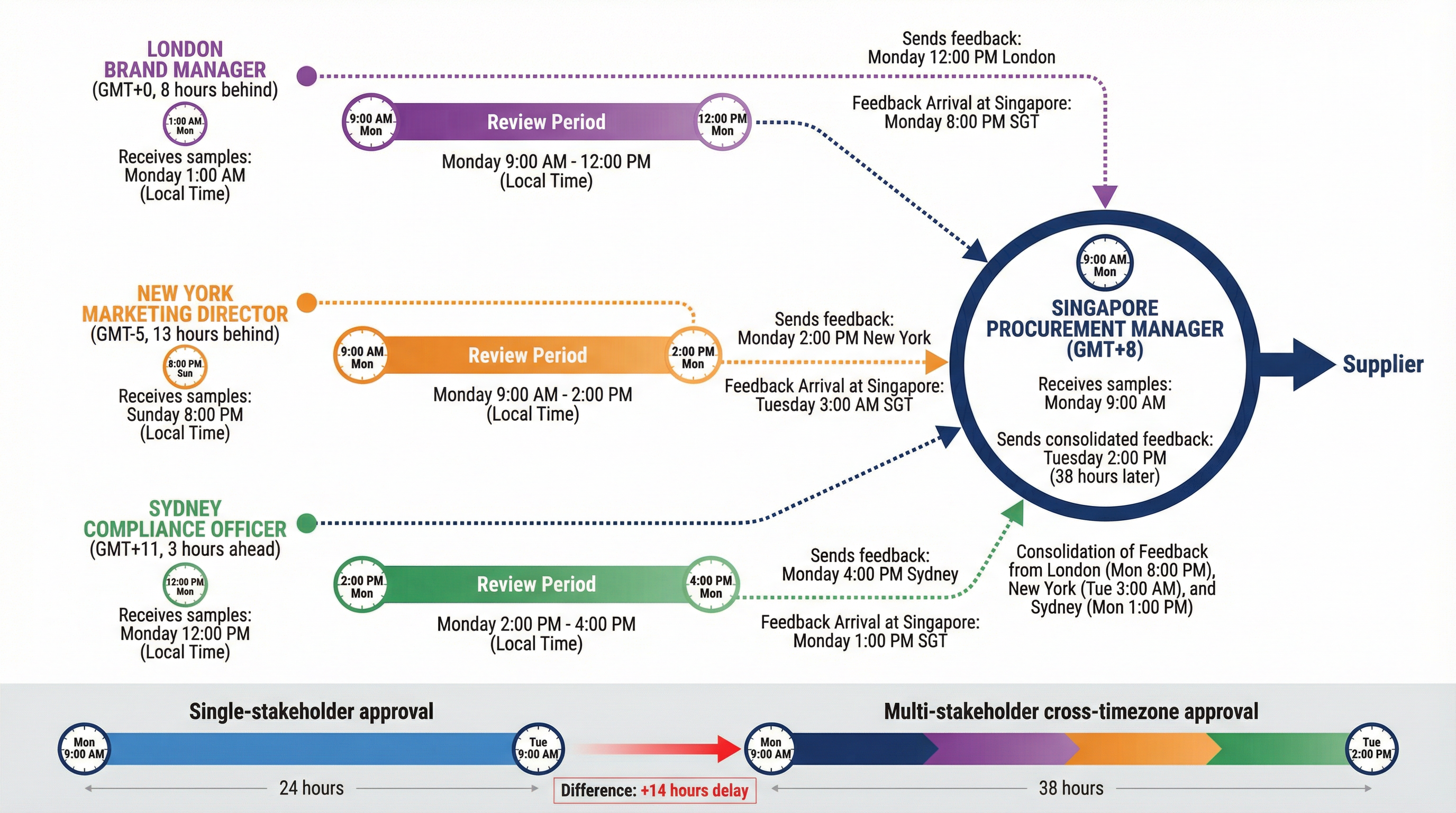
*Multi-stakeholder cross-timezone approval process showing how feedback from London, New York, and Sydney stakeholders arrives at different times, extending single-stakeholder 24-hour approval to 38-hour multi-stakeholder approval cycle.*
Understanding the relationship between communication patterns and lead time accuracy requires procurement teams to think beyond the mechanics of production and consider the temporal structure of coordination itself. The question of how long it takes to produce corporate gift boxes cannot be answered solely by examining production capacity, material lead times, or quality control processes. It must also account for the rhythm of information exchange between parties, the internal coordination processes that occur before feedback is sent, and the structural delays introduced when those parties operate in different temporal zones. Procurement teams that build their timeline estimates on the assumption of synchronous communication will consistently underestimate lead times when working with geographically distant suppliers, not because those suppliers are inefficient, but because the timeline model itself does not reflect the asynchronous reality of cross-timezone coordination.
The practical implication is that lead time estimates for corporate gift box production should explicitly account for communication latency as a distinct component, separate from production time. A procurement team working with a supplier twelve hours offset should expect each sample approval round to take three to four days rather than two days, and should plan accordingly. This adjustment does not require changes to production processes or supplier capabilities; it simply requires recognizing that the temporal structure of coordination differs when parties operate in different timezones, and that this difference has measurable effects on how long the overall process takes. Procurement teams that make this adjustment will find that their lead time estimates become more accurate, their supplier relationships become less strained, and their ability to deliver corporate gift boxes on schedule improves, not because anything about the production process has changed, but because their planning now reflects the actual dynamics of cross-timezone collaboration.
The phenomenon becomes more complex when multiple approval stakeholders are distributed across different locations and timezones. In many corporate procurement structures, the decision to approve a corporate gift box sample does not rest with a single individual but requires sign-off from regional managers, brand custodians, and compliance officers who may be located in different countries. A procurement manager in Singapore might coordinate feedback from a brand manager in London, a marketing director in New York, and a compliance officer in Sydney. Each of these stakeholders operates in a different timezone, and the procurement manager must collect and consolidate their input before sending unified feedback to the supplier. This multi-stakeholder coordination introduces additional asynchronous delays that are rarely accounted for in lead time planning.
When the Singapore procurement manager receives sample photos at nine in the morning Monday, they immediately forward them to the London brand manager, for whom it is one in the morning. The brand manager reviews the samples when they begin work Monday morning London time, which is already Monday afternoon in Singapore. Their feedback arrives in the procurement manager's inbox Monday evening Singapore time. Meanwhile, the New York marketing director, who is thirteen hours behind Singapore, receives the sample photos Monday morning their time, which is already Monday night in Singapore. Their feedback arrives Tuesday morning Singapore time. The Sydney compliance officer, only two hours ahead of Singapore, provides feedback Monday afternoon. The procurement manager now has feedback from three stakeholders arriving at different times across a twenty-four hour period, and must wait until all feedback is received before consolidating and sending it to the supplier. By the time consolidated feedback is sent, it is Tuesday afternoon Singapore time, which means Tuesday evening or Wednesday morning supplier time, depending on their location.
This multi-stakeholder asynchronous coordination can extend a single approval round from the expected two days to four or even five days, and procurement teams often do not recognize this extension as a structural consequence of distributed decision-making. Instead, they may perceive the delay as individual stakeholders being slow to respond, when in reality each stakeholder is responding within a reasonable timeframe given their timezone and workload. The delay emerges from the sequential nature of the coordination process and the timezone offsets between stakeholders, not from any individual inefficiency.
The situation becomes particularly problematic when revisions require multiple iterations of clarification between stakeholders and the supplier. Suppose the London brand manager requests a specific adjustment to logo placement, but the supplier is uncertain about the exact positioning and needs clarification. The supplier sends a clarification question Tuesday evening their time, which arrives Wednesday morning Singapore time. The procurement manager forwards the question to London, where it is late Tuesday night, so the brand manager does not see it until Wednesday morning London time. The brand manager responds Wednesday afternoon London time, which is Wednesday evening Singapore time. The procurement manager forwards this clarification to the supplier Wednesday evening, which arrives Thursday morning supplier time. The supplier makes the adjustment Thursday and sends revised samples Thursday evening, arriving Friday morning Singapore time. A single clarification cycle has consumed three calendar days, and if the brand manager's clarification itself requires further discussion—perhaps they need to consult with the creative director—the cycle extends even further.
Procurement teams working with these distributed approval structures often attempt to accelerate the process by setting tight deadlines for stakeholder feedback, but this approach frequently backfires. When stakeholders feel pressured to provide rapid feedback, they may approve samples without thorough review, leading to issues that only become apparent during bulk production. Alternatively, they may provide incomplete feedback that requires follow-up clarification, ultimately extending the approval process rather than shortening it. The more effective approach is to recognize that distributed multi-stakeholder approval inherently requires longer timelines than single-stakeholder approval, and to build this additional time into the lead time estimate from the outset.
Another dimension of the asynchronous approval challenge involves the rhythm of work across different organizational cultures and business practices. Some suppliers operate on a six-day work week, while procurement teams may work five days. This difference means that when a procurement team sends feedback Friday afternoon, expecting a response by Monday, the supplier may be working Saturday and Sunday and could potentially deliver revisions by Sunday evening, which arrives Monday morning procurement time. However, if the procurement team assumes a five-day work week on both sides, they might not check for responses until Monday morning, missing the opportunity to provide rapid follow-up feedback if needed. Conversely, when a supplier sends samples Friday evening their time, arriving Friday morning procurement time, and the procurement team takes the weekend to coordinate internal feedback, the supplier may be working Saturday and Sunday without receiving the feedback they need to proceed, resulting in idle time that could have been used productively if the communication rhythm had been better coordinated.
These work rhythm misalignments add variability to the approval timeline that makes it difficult for procurement teams to predict with confidence how long the sample approval phase will take. In some weeks, the alignment of work schedules and timezone offsets may result in efficient two-day approval rounds. In other weeks, when feedback requests fall on weekends or public holidays in one location but not the other, the same approval round may extend to four or five days. This variability makes it challenging to provide accurate delivery date commitments to internal stakeholders or end clients, and procurement teams may find themselves either building excessive buffer time into their estimates—resulting in longer quoted lead times that make them less competitive—or building insufficient buffer time and consistently missing deadlines.
The compounding effect of these asynchronous delays across the entire pre-production phase means that a corporate gift box order requiring four sample approval rounds, two material approval rounds, and one pre-production sample approval can see its pre-production timeline extend from an expected four weeks to six or seven weeks solely due to communication latency and timezone coordination challenges. This two to three week extension represents a significant portion of the total lead time, yet it is often invisible in how procurement teams analyze and discuss lead time performance. When a supplier quotes six weeks for sample approval and the procurement team's internal model expects four weeks, the procurement team may view the supplier's quote as padded or inefficient, when in reality the supplier is simply accounting for the structural delays that the procurement team has not recognized.
Addressing this blind spot requires procurement teams to map out the actual communication flows and approval sequences in their sample approval process, identifying where timezone offsets and multi-stakeholder coordination introduce delays. This mapping exercise often reveals that the approval process involves more asynchronous handoffs than the procurement team realized, and that each handoff introduces a potential twelve to twenty-four hour delay when parties operate in different timezones. By quantifying these delays and incorporating them into lead time estimates, procurement teams can develop more accurate timelines that reflect the reality of cross-timezone collaboration rather than the idealized model of synchronous communication.
The question of how long it takes to produce corporate gift boxes, when examined through the lens of cross-timezone sample approval dynamics, reveals that a substantial portion of the lead time is determined not by production capacity or material availability, but by the temporal structure of information exchange and decision-making. Procurement teams that recognize this reality and adjust their planning accordingly will find that their lead time estimates become more reliable, their supplier relationships become more productive, and their ability to deliver on schedule improves. The adjustment required is not a change in production processes or supplier capabilities, but rather a shift in how procurement teams model the timeline of coordination itself, acknowledging that asynchronous communication across timezones introduces structural delays that must be accounted for in any realistic lead time estimate.