Sample Revision Iteration Creep in Corporate Gift Box Production
Procurement teams treat each sample revision as an isolated 2-3 day delay without realizing the fixed 7-10 day cycle time per round. Four rounds consume 28-40 days before production even starts, compressing quality control windows and pushing orders into lower-priority production queues.
When a procurement manager initiates a corporate gift box project in early July targeting October delivery, the timeline appears comfortable. The supplier quotes six weeks for production, leaving ample buffer time for sample approval. Three months should be more than enough. By mid-September, however, the same procurement team discovers they are entering their fourth round of sample revisions, production has not yet started, and the delivery deadline is now at serious risk.
This pattern repeats across procurement teams with remarkable consistency. The misjudgment does not stem from unreasonable quality standards or supplier incompetence. It emerges from a systematic underestimation of how sample revision cycles accumulate. Procurement teams treat each revision request as an isolated two-to-three-day delay. They focus on the supplier's turnaround time—the visible portion of the cycle—while overlooking their own internal review processes, stakeholder coordination, and communication lag. What appears to be "just one more small tweak" resets an entire seven-to-ten-day cycle, and by the fourth iteration, six to eight weeks have disappeared before production even begins.
The arithmetic seems straightforward when procurement teams plan their timelines. A supplier confirms they can revise a sample in two to three business days. The procurement team assumes this means they can request a change on Monday and review the updated sample by Thursday. If another adjustment is needed, they will lose perhaps another three days. Four rounds of revisions, in this mental model, should consume no more than twelve to fifteen days total. This calculation, however, omits half of the actual cycle time.
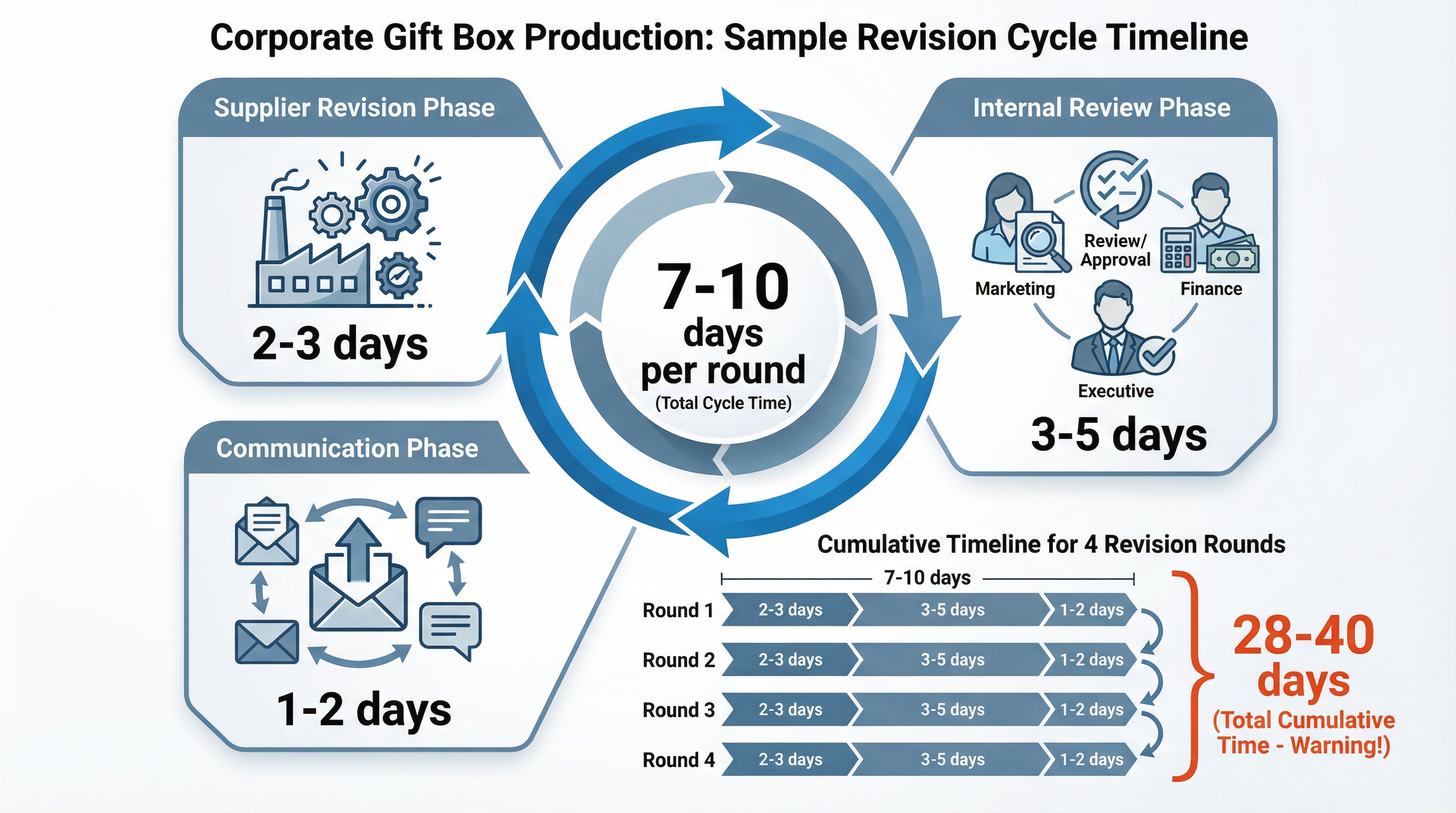
Sample revision cycles do not consist solely of supplier execution time. Each cycle includes three distinct phases that must occur sequentially. The supplier receives feedback, revises the sample, and ships it back—this is the two-to-three-day window procurement teams focus on. The sample then enters the procurement organization's internal review process. Depending on the stakeholders involved, this review can require three to five business days. Marketing needs to verify brand consistency. Finance may need to confirm the customization stays within budget parameters. The end client—HR or the executive team commissioning the gifts—must provide final approval. Coordinating these approvals, especially when stakeholders are in different time zones or managing competing priorities, extends the review window.
After internal review concludes, the procurement team consolidates feedback and communicates it back to the supplier. This communication phase, often dismissed as negligible, adds another one to two days. Feedback may need to be translated if the supplier operates in a different region. Technical specifications must be clarified to avoid misinterpretation. If the feedback arrives late in the supplier's business day or over a weekend, the next revision cycle does not begin until the following business day. These communication lags, individually minor, compound across multiple iterations.
When these three phases are combined, a single sample revision cycle requires seven to ten business days from the moment feedback is sent until the next revised sample arrives for review. Procurement teams requesting four rounds of revisions are not adding twelve days to their timeline. They are consuming twenty-eight to forty days—more than half of the three-month buffer they believed they had when the project began.
!Sample Revision Cycle Timeline
The decision to request another revision round rarely feels consequential in the moment. A procurement manager reviews a sample and notices the logo placement is slightly off-center. The color shade is close but not an exact match to the brand guidelines. The interior lining material feels acceptable but not quite premium enough for the intended recipients. Each of these observations, in isolation, represents a legitimate quality concern. The procurement manager reasons that addressing the issue now, before production begins, is far more cost-effective than discovering the problem in the finished goods. This reasoning is correct. The misjudgment lies not in the decision to request revisions but in the failure to account for the cumulative time cost of iteration.
Procurement teams also underestimate how sample revision delays affect their position in the supplier's production queue. When a project enters the sampling phase, the supplier allocates a tentative production slot based on the anticipated sample approval date. If the procurement team approves the sample by late July, the supplier schedules production to begin in early August, ensuring the six-week production timeline concludes in mid-September with two weeks of buffer before the October delivery deadline. This production slot, however, is not held indefinitely.
Each time the procurement team requests another sample revision, the production start date shifts backward. The supplier cannot hold the original production slot open while waiting for sample approval because other confirmed orders need to be scheduled. By the time the procurement team approves the sample in their fourth round—now in mid-September—the original early-August production slot has been filled by other clients who finalized their samples on schedule. The procurement team's order is now positioned in a later queue slot, and the six-week production timeline that was quoted in July no longer fits within the remaining window before the October deadline.
!Production Window Compression Effect
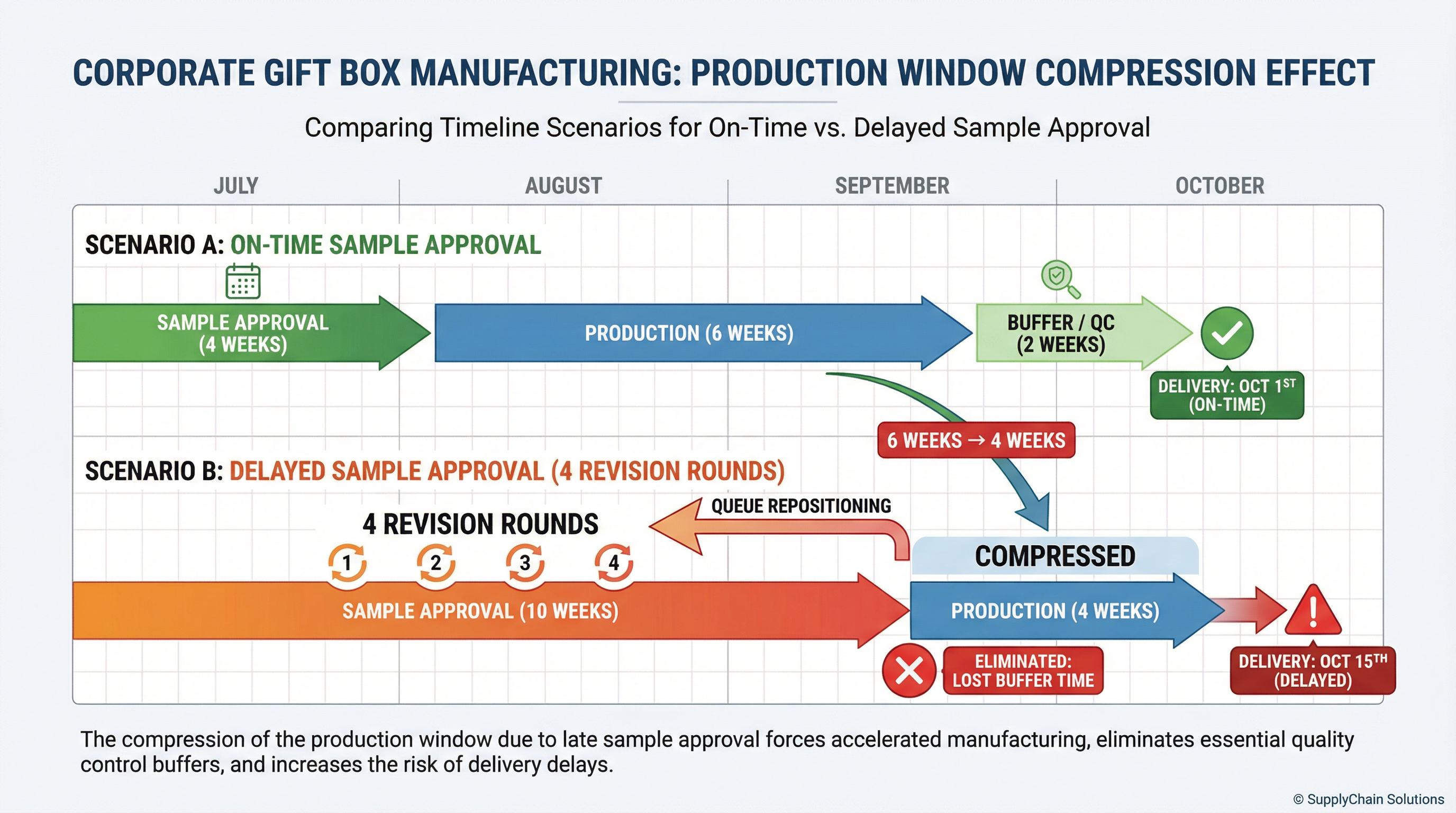
Suppliers do not always communicate this queue repositioning explicitly. From the supplier's perspective, the production timeline remains six weeks—they have not changed their estimate. What has changed is when production can begin, but this shift may not be highlighted in routine status updates. The procurement team, focused on finalizing the sample, may not realize until late September that their order is now scheduled to begin production in early October, making the original October delivery deadline impossible to meet.
The compression of the production window creates secondary risks that extend beyond the delivery date. When production finally begins with a shortened timeline, the supplier faces pressure to compress quality control checkpoints. A six-week production timeline typically includes multiple quality verification stages: raw material inspection, in-process checks during printing or assembly, and final inspection before packaging. When that timeline is reduced to four weeks due to late sample approval, some of these checkpoints must be shortened or combined. The supplier may still meet the technical specifications, but the margin for catching defects or making corrections narrows significantly.
Procurement teams sometimes attempt to compensate for late sample approval by requesting expedited production. Suppliers can often accommodate expedited timelines, but this comes with trade-offs. Expedited production may require overtime shifts, which increases labor costs. It may necessitate prioritizing the order over other clients, which strains supplier relationships and reduces the likelihood of favorable terms on future orders. In some cases, expedited production limits the range of customization options available, as certain techniques—such as multi-layer embossing or specialty coatings—require curing time that cannot be compressed without compromising quality.
The financial impact of sample revision delays extends beyond expedited production fees. When a procurement team realizes in late September that their October delivery deadline is at risk, they face a constrained set of options. They can accept a delayed delivery, which may disrupt the event or distribution plan the gifts were intended for. They can switch to a simpler product that requires less production time, sacrificing the customization or quality level they originally specified. They can split the order across multiple suppliers to parallelize production, but this introduces inconsistencies in the final product and increases coordination overhead. Each of these options carries costs—either direct financial costs or indirect costs in the form of compromised outcomes.
The pattern of iteration creep is not unique to inexperienced procurement teams. Even seasoned buyers fall into this cycle because the feedback loop is fragmented. The person requesting a sample revision in round two may not be the same person who requested the revision in round one. Marketing may request a logo adjustment in one round, while the executive team requests a material change in the next round. Each stakeholder views their feedback in isolation, unaware of how many previous rounds have already occurred or how much cumulative time has been consumed. Without a centralized view of the iteration count and elapsed time, the procurement team lacks the information needed to make informed trade-offs between incremental quality improvements and timeline risk.
Some procurement teams attempt to avoid iteration creep by conducting more thorough upfront planning. They invest additional time in the initial brief, providing detailed specifications for materials, colors, dimensions, and branding elements. They request digital mockups before physical samples to catch obvious issues early. These practices reduce the likelihood of major revisions, but they do not eliminate iteration entirely. Corporate gift boxes, particularly those with custom packaging and premium finishes, involve variables that cannot be fully evaluated until a physical sample is produced. The way a metallic foil catches light, the tactile feel of an embossed logo, the structural integrity of a magnetic closure—these elements require physical evaluation, and discrepancies between the digital mockup and the physical sample often emerge only after the first sample is produced.
The challenge is compounded when the corporate gift box project involves multiple components. A gift box may include a rigid outer box, an interior tray, a printed insert card, and the gift items themselves. Each component may be sourced from a different supplier or produced in a different facility. Sample approval for the complete assembly requires that all components arrive simultaneously, and any delay in one component pushes back the approval timeline for the entire project. Procurement teams sometimes attempt to parallelize sample approvals by reviewing components independently, but this introduces the risk that components approved separately do not integrate seamlessly when assembled together.
The decision to approve a sample after multiple revision rounds is rarely clear-cut. By the fourth round, the sample may still not be perfect, but the procurement team recognizes that further revisions will jeopardize the delivery deadline. They face a trade-off: approve a sample that is ninety percent aligned with their vision and proceed to production, or request one more revision to achieve ninety-five percent alignment and accept the risk of a delayed delivery. This trade-off is difficult to evaluate without visibility into the supplier's production queue and the exact number of days remaining before the deadline. Procurement teams often default to approving the sample, reasoning that minor imperfections are preferable to missing the delivery window entirely.
The supplier's perspective on sample revisions differs from the procurement team's perspective in ways that are not always transparent. Suppliers understand that sample approval is a critical gate in the project timeline, but they also operate within constraints that limit how much flexibility they can offer. A supplier managing dozens of concurrent projects cannot afford to hold production slots open indefinitely for clients who are still iterating on samples. The supplier's production schedule is optimized for throughput, and empty slots represent lost revenue. When a procurement team takes longer than anticipated to approve a sample, the supplier reallocates that production capacity to other clients, and the delayed project is rescheduled based on the next available slot.
Suppliers also face pressure to maintain quality standards across all clients, which means they cannot compress production timelines arbitrarily to accommodate late sample approvals. A supplier who agrees to an unrealistic expedited timeline risks delivering substandard products, which damages their reputation and leads to costly rework or refunds. Experienced suppliers will communicate these constraints to procurement teams, but the conversation often occurs late in the process—after the procurement team has already committed to a delivery deadline and is reluctant to renegotiate with their internal stakeholders.
The most effective mitigation strategy for sample revision iteration creep is not to eliminate revisions entirely but to establish a revision budget at the outset of the project. A revision budget defines the maximum number of sample revision rounds the procurement team will request before approving the sample and proceeding to production. This budget is communicated to all stakeholders involved in the approval process, creating a shared understanding that each revision round consumes a fixed amount of time and that the cumulative impact of multiple rounds can jeopardize the delivery timeline.
A revision budget does not prevent procurement teams from requesting changes. It forces them to prioritize which changes are critical and which are acceptable compromises. If the revision budget is set at two rounds, the procurement team knows they must consolidate all feedback carefully in each round, rather than addressing issues incrementally. This discipline reduces the likelihood of iteration creep and ensures that the most important quality concerns are addressed first.
Establishing a revision budget requires procurement teams to have realistic expectations about what can be achieved within the available timeline. If the delivery deadline is fixed and non-negotiable, the revision budget must be set conservatively to preserve buffer time for production. If the procurement team anticipates that multiple stakeholders will need to review and approve the sample, the revision budget must account for the coordination time required to gather and consolidate feedback. The revision budget is not a constraint imposed by the supplier—it is a planning tool that helps procurement teams manage their own internal processes more effectively.
Another mitigation strategy involves front-loading the sample approval process by requesting samples earlier in the project timeline. If a procurement team initiates sampling in May for an October delivery, they create more room for iteration without jeopardizing the production window. Early sampling also allows procurement teams to identify potential issues—such as material availability or technical feasibility—before they become urgent problems. Suppliers are often more willing to accommodate multiple revision rounds when the project timeline is not compressed, as they have more flexibility to adjust their production schedule.
Front-loading the sample approval process requires procurement teams to finalize their design specifications earlier, which can be challenging when the end client—such as an HR team or executive leadership—has not yet confirmed all details. Procurement teams sometimes delay sampling until all specifications are locked in, reasoning that premature sampling will lead to wasted effort if the requirements change. This reasoning, while logical, underestimates the value of early feedback. Even if the initial sample is based on preliminary specifications, it provides tangible information about material quality, production feasibility, and lead times that cannot be obtained from digital mockups or supplier quotes alone.
The relationship between sample approval timelines and corporate gift box production timelines is not always linear. A procurement team that completes sample approval one week earlier does not necessarily gain one week of buffer time in the production phase. Production schedules are built around batch runs and machine availability, and a one-week shift in sample approval may not translate into an earlier production start date if the supplier's next available slot is two weeks later. This non-linearity makes it difficult for procurement teams to predict the exact impact of sample approval delays, reinforcing the importance of maintaining conservative timelines and avoiding iteration creep.
The consequences of sample revision iteration creep extend beyond the immediate project. When a procurement team experiences a near-miss or actual delivery delay due to prolonged sample approval, it erodes trust with internal stakeholders and complicates future projects. The HR team or executive leadership that commissioned the corporate gifts may lose confidence in the procurement team's ability to manage timelines, leading to increased scrutiny or reduced autonomy on subsequent projects. The supplier relationship may also be strained if the procurement team requests expedited production or last-minute changes to compensate for late sample approval, reducing the supplier's willingness to offer favorable terms or prioritize the client's orders in the future.
Procurement teams that successfully manage sample revision cycles do so by treating sample approval as a project phase with its own timeline, milestones, and accountability. They assign a single point of contact to coordinate feedback from all stakeholders, ensuring that revisions are consolidated and communicated efficiently. They track the number of revision rounds and the elapsed time for each round, maintaining visibility into how much of the timeline buffer has been consumed. They communicate proactively with suppliers about the expected sample approval date and any changes to that date, allowing suppliers to adjust production schedules in advance rather than reacting to last-minute shifts.
The decision to approve a sample and proceed to production is ultimately a judgment call that balances quality, timeline, and cost. Procurement teams that understand the true cycle time of sample revisions—seven to ten days per round, not two to three—are better equipped to make that judgment call before iteration creep consumes their timeline buffer. The goal is not to achieve perfection in the sample but to achieve sufficient alignment with specifications that production can proceed with confidence, knowing that the final product will meet the quality standards required for the intended use.
Sample revision iteration creep is a predictable failure mode in corporate gift box procurement, but it is also a manageable one. The solution does not require procurement teams to lower their quality standards or accept subpar products. It requires them to recognize that each sample revision round has a fixed cycle time, that multiple rounds accumulate into weeks of delay, and that late sample approval compresses the production window in ways that introduce secondary risks. With this understanding, procurement teams can establish revision budgets, front-load the sample approval process, and maintain the timeline discipline needed to deliver high-quality corporate gifts on schedule.