Capacity Reservation Timing Assumption in Corporate Gift Box Production Lead Time Quotes
Procurement teams often treat lead time quotes as guaranteed timelines that remain valid until order placement. In reality, quotes reflect current capacity availability and degrade as other customers confirm orders during your internal approval period. A three-week approval delay typically extends an eight-week quote to thirteen weeks—not because suppliers change terms, but because the original capacity window has been filled by faster-moving customers.
When procurement teams receive an eight-week lead time quote for corporate gift box production, they typically interpret this as a guaranteed timeline that remains valid until they decide to place the order. The assumption feels reasonable—after all, the supplier provided a written quote with a specific delivery window, and nothing in the documentation suggests that this timeline might change if the order is delayed by a few weeks. In practice, this is precisely where lead time decisions start to be misjudged, because the quote reflects the supplier's production capacity at the moment of inquiry, not a reserved slot that waits indefinitely for confirmation.
The misjudgment stems from a fundamental misunderstanding of how manufacturing capacity allocation actually works. Suppliers do not hold production slots for potential orders. When a factory provides a lead time estimate, they are assessing their current production queue and identifying the next available window where your order could be scheduled. This assessment is time-sensitive. If you receive a quote on Monday stating "eight weeks from order confirmation," that eight-week timeline assumes you will confirm the order within a reasonable period—typically within the same week or, at most, within ten days. The supplier is not reserving Week 10 on their production calendar for your order. They are simply informing you that, based on current capacity, Week 10 is when they could start your production if you confirm now.
!Capacity Reservation Timing Assumption Diagram
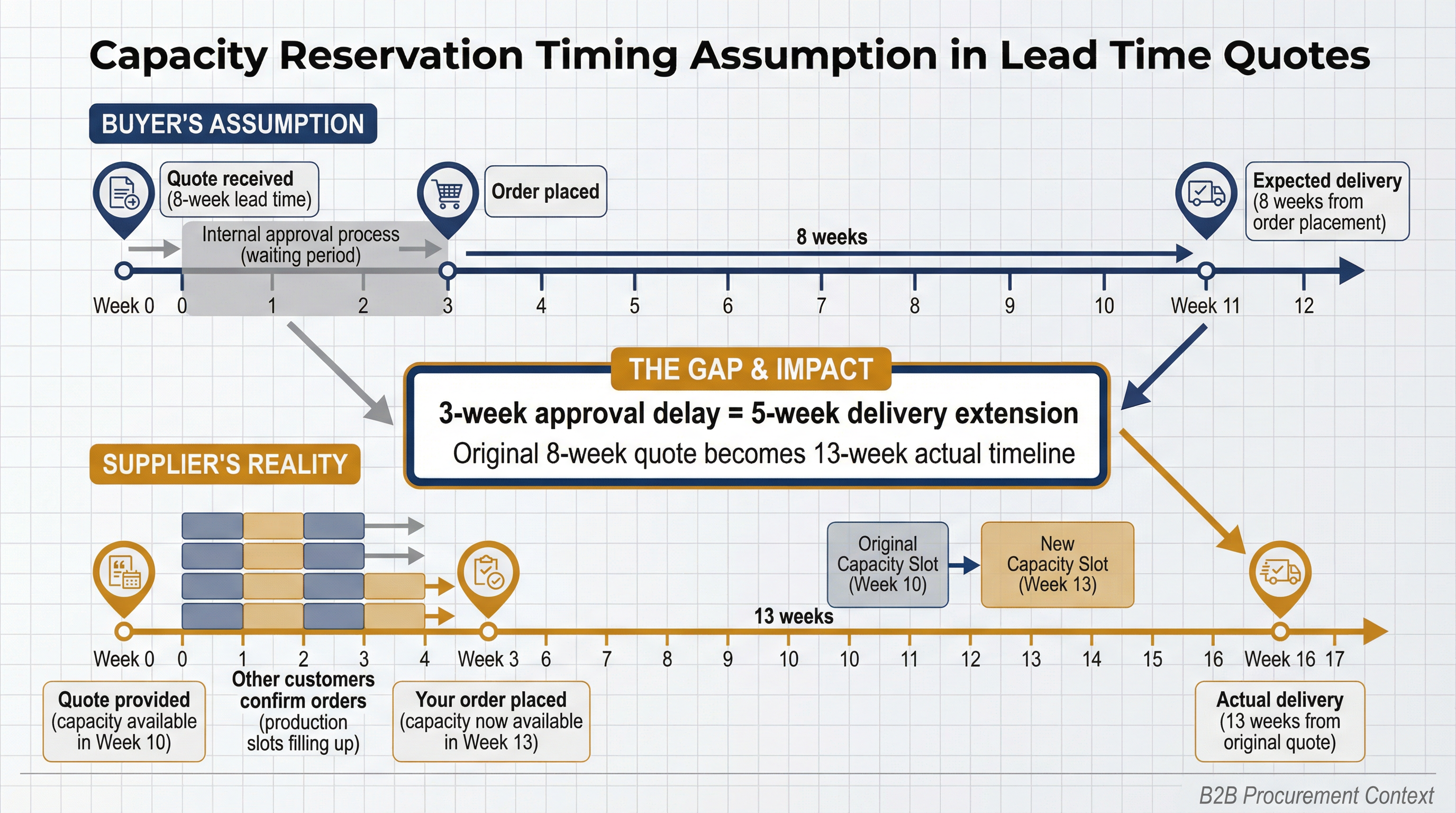
*Comparison of buyer's assumption versus supplier's capacity allocation reality. A three-week approval delay transforms an eight-week quoted timeline into a thirteen-week actual delivery period as other customers fill the originally available production slots.*
What happens during the two to four weeks that procurement teams typically spend on internal approvals? The supplier's production queue continues to fill. Other customers who receive quotes during the same period move faster through their approval processes and place orders. Each confirmed order occupies a production slot, pushing the next available window further out. By the time your organization completes budget sign-offs, stakeholder alignments, and design finalizations, the supplier's capacity situation has changed. The Week 10 slot that was available when you received the quote is now occupied by another customer's order. Your order, when finally confirmed, gets scheduled into Week 13 or Week 14—not because the supplier "changed" the lead time, but because the original quote's validity period has expired.
This timing assumption creates a compounding effect when combined with other lead time variables. Consider a scenario where your procurement team receives a quote for premium leather gift boxes with custom embossing. The supplier quotes eight weeks, which includes two weeks for material sourcing, one week for sample production and approval, four weeks for bulk manufacturing, and one week for quality inspection and packaging. Your team takes three weeks to complete internal approvals. During those three weeks, the supplier receives and confirms orders from three other clients. Their production queue, which had capacity starting in Week 2 when they quoted you, now has capacity starting in Week 5. When you finally place your order, the supplier recalculates: material sourcing still requires two weeks, but now they cannot start this process until Week 5 (not Week 2). The total timeline becomes eleven weeks, not eight.
The procurement team perceives this as the supplier "extending" the lead time or "not honoring" the original quote. From the supplier's perspective, they provided an accurate quote based on available capacity at the time of inquiry, and the buyer's delayed confirmation consumed that capacity window. Neither party is being dishonest, but the buyer's assumption that the quote remains valid indefinitely creates a disconnect that results in delivery delays and strained relationships.
This misjudgment becomes particularly problematic in corporate gift box production because these orders often have fixed delivery deadlines tied to events, conferences, or holiday seasons. When a procurement manager calculates backward from a December 15 event date and determines that placing an order by October 1 (allowing for the quoted eight-week lead time plus a one-week buffer) will ensure on-time delivery, they are building their timeline on an invalid assumption. If the organization takes three weeks to approve the order internally, and the order is not placed until October 22, the supplier's available capacity has shifted. The actual lead time becomes eleven weeks, pushing delivery to early January—well past the event date. The procurement manager, who believed they had built in adequate buffer time, now faces a crisis that appears to be the supplier's fault but actually originated from the capacity reservation timing assumption.
The challenge is compounded by the fact that most lead time quotes do not explicitly state their validity period. A supplier might include "Quote valid for 30 days" in the pricing section, but this typically refers to material costs and labor rates, not production capacity availability. The lead time estimate, buried in the production timeline section, carries no expiration date. Procurement teams reasonably interpret this as an open-ended commitment. Suppliers, operating in a first-come-first-served capacity allocation model, assume that buyers understand the time-sensitive nature of production scheduling. This gap in shared understanding creates systematic delays that neither party recognizes until orders are placed and delivery dates are recalculated.
From a compliance and quality perspective, this timing assumption introduces additional risks. When procurement teams delay order confirmation, they not only lose their original production slot but also compress the timeline available for quality assurance and compliance verification. If the original eight-week quote included one week for quality inspection, and the delayed order confirmation extends the lead time to eleven weeks, the supplier may feel pressure to maintain the original delivery date by reducing inspection time. This creates a scenario where quality standards are compromised to accommodate a timeline that was invalidated by the buyer's delayed confirmation. The procurement team, unaware that their approval delay caused the capacity shift, may push back against any suggestion of extended delivery dates, inadvertently incentivizing the supplier to cut corners on quality verification.
!Production Queue Capacity Allocation
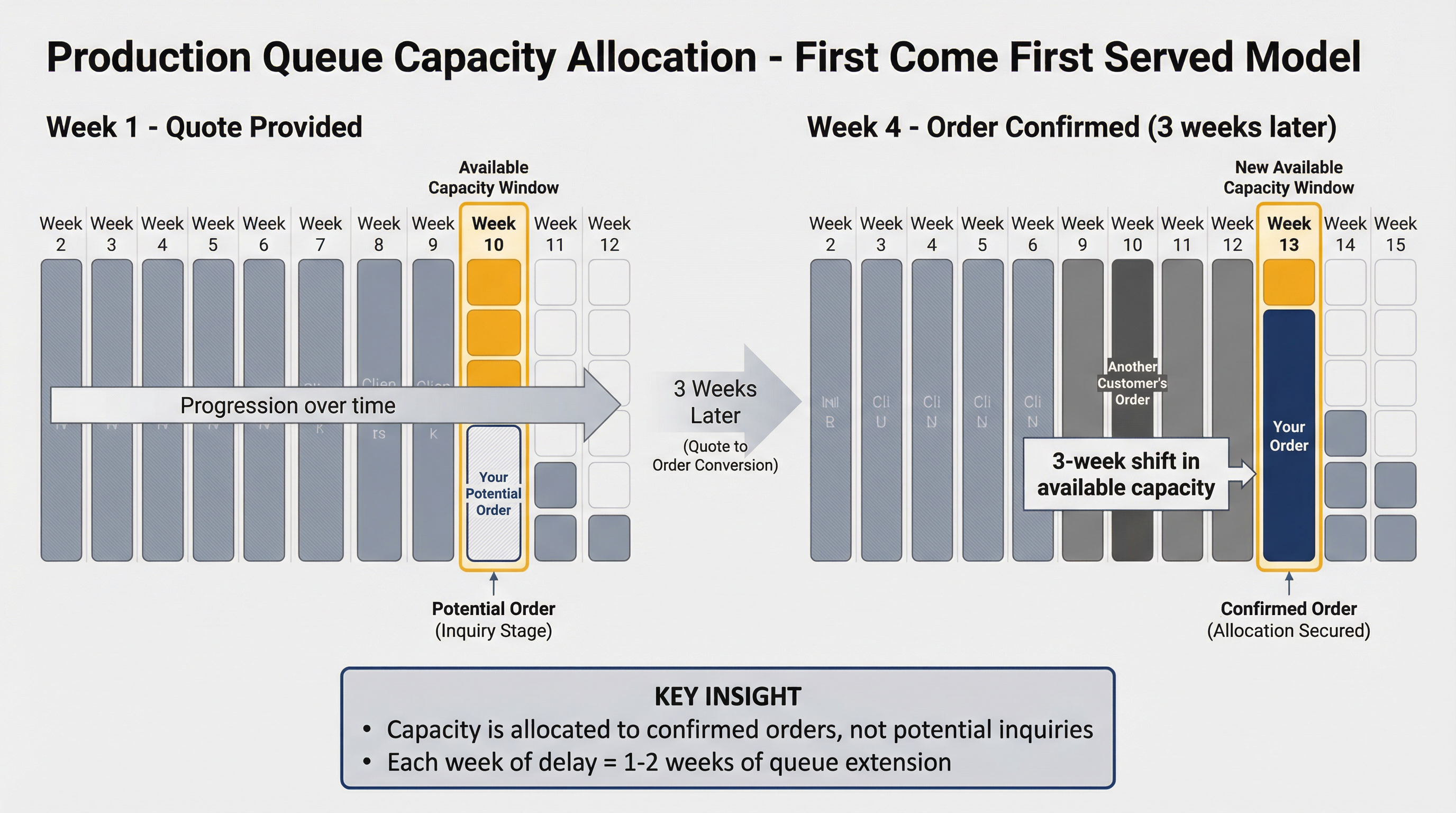
*First-come-first-served capacity allocation model showing how a three-week delay between quote and order confirmation shifts available production windows. The originally available Week 10 slot becomes occupied by other customers, pushing your order to Week 13.*
The root cause of this misjudgment is that procurement teams treat lead time quotes as static commitments rather than dynamic assessments. They view the quote as a contract term that binds the supplier to a specific timeline regardless of when the order is placed. Suppliers, however, view lead time quotes as capacity snapshots that reflect current availability and assume prompt order confirmation. This fundamental difference in interpretation creates a systematic pattern where buyers consistently underestimate actual delivery times by failing to account for the capacity consumption that occurs during their internal approval periods.
Understanding how production scheduling actually works in corporate gift box manufacturing reveals why this assumption is flawed. Factories operate with finite production capacity—a specific number of machines, operators, and work hours available each week. When a supplier receives an inquiry, their production planner reviews the current order book and identifies the next available slot where your order could be accommodated. This slot is not reserved for you. It remains available to any customer who confirms an order. The production planner's assessment is based on the assumption that if you are serious about the order, you will confirm within a reasonable timeframe. In manufacturing, "reasonable" typically means within the same week for urgent orders or within ten days for standard orders. A three-week delay between quote and confirmation falls outside this reasonable window, and the supplier's capacity allocation moves forward without you.
This dynamic becomes even more pronounced during peak seasons. If you request a quote for corporate gift boxes in September for December delivery, the supplier's production queue is filling rapidly with holiday orders. The eight-week lead time quoted in early September assumes you will confirm by mid-September, securing a production slot in early November. If you delay confirmation until late September, the supplier's November slots are fully booked, and your order gets pushed to mid-November or even early December. The original eight-week timeline is no longer achievable, not because the supplier cannot produce in eight weeks, but because the available capacity window has shifted.
The financial implications of this misjudgment extend beyond late deliveries. When procurement teams realize that their delayed confirmation has extended the lead time beyond their event date, they often request expedited production. Suppliers can sometimes accommodate this by shifting other orders, working overtime, or prioritizing your production, but these adjustments come at a cost. Expedite fees typically range from 15% to 30% of the order value, and they may still not fully recover the lost time. The procurement team, operating under budget constraints, may resist these additional costs, arguing that the supplier should honor the original quote. This creates a standoff where the buyer feels the supplier is being unreasonable, and the supplier feels the buyer is asking them to absorb the cost of the buyer's delayed decision-making.
From a risk management perspective, the capacity reservation timing assumption creates a hidden vulnerability in supply chain planning. Procurement teams build their timelines based on quoted lead times without accounting for the capacity consumption that occurs during internal approval processes. This means that every corporate gift box order carries an unrecognized risk of a three-to-six-week delay that only becomes visible when the order is finally placed and the supplier recalculates based on current capacity. Organizations that place multiple orders throughout the year may experience this delay repeatedly without recognizing the pattern, attributing each instance to supplier unreliability rather than their own approval process timing.
The solution is not to eliminate internal approval processes—these serve important functions in budget control, stakeholder alignment, and design validation. Rather, the solution is to recognize that lead time quotes have an implicit validity period tied to production capacity availability, and that delayed order confirmation consumes this validity period. When a procurement team receives an eight-week lead time quote, they should understand that this timeline is accurate if the order is confirmed within approximately one week. For every week of delay in order confirmation, they should add an additional one to two weeks to the expected delivery timeline. A three-week approval process, therefore, should be planned as adding three to six weeks to the quoted lead time, resulting in an eleven-to-fourteen-week actual timeline rather than the quoted eight weeks.
This adjustment requires a shift in how procurement teams interpret supplier quotes and plan their timelines. Instead of treating the quoted lead time as a guaranteed delivery window that activates whenever they choose to place the order, they need to treat it as a capacity-dependent estimate that degrades over time. This shift in understanding allows for more accurate timeline planning and reduces the likelihood of delivery delays caused by capacity reservation timing assumptions. It also improves supplier relationships by aligning buyer expectations with supplier capacity allocation realities, reducing the friction that occurs when buyers feel suppliers are not honoring their quotes.
In the context of how production schedules are constructed and managed across different order types and complexity levels, recognizing that capacity reservation requires confirmed orders rather than potential inquiries helps procurement teams make more informed decisions about when to request quotes and how quickly to move through approval processes. Organizations that understand this dynamic can structure their procurement workflows to minimize the gap between quote receipt and order confirmation, or they can build realistic buffers into their timelines that account for capacity consumption during approval periods. Either approach is more effective than assuming that quoted lead times remain valid indefinitely and then being surprised when actual delivery dates extend beyond expectations.
The operational mechanics of this misjudgment reveal why it persists across organizations and industries. When a procurement manager receives a lead time quote, they typically forward it to stakeholders for review, initiate budget approval workflows, and schedule design review meetings. Each of these steps consumes calendar time, and the cumulative effect is that two to four weeks pass before the order can be confirmed. During this period, the procurement manager is not idle—they are actively working to secure approvals and finalize specifications. From their perspective, they are moving as quickly as internal processes allow. The disconnect occurs because the supplier's production capacity does not pause during this internal work. Other customers continue to place orders, and each confirmed order fills a production slot that was available when the original quote was provided.
This creates a scenario where both parties are operating rationally within their own frameworks, but these frameworks are misaligned. The procurement manager is optimizing for internal approval efficiency and believes they are moving quickly by completing approvals within three weeks. The supplier is optimizing for production capacity utilization and allocates slots to confirmed orders on a first-come basis. Neither party is making an error within their own operational logic, but the lack of shared understanding about how capacity allocation works creates systematic delays that appear to be supplier unreliability from the buyer's perspective and buyer indecisiveness from the supplier's perspective.
The compounding effect of this timing assumption becomes particularly visible when organizations place multiple orders throughout the year. A company that orders corporate gift boxes quarterly may experience the same pattern four times annually: receive quote, take three weeks for approvals, place order, discover that actual lead time is three weeks longer than quoted, scramble to adjust delivery expectations or pay expedite fees. After several iterations, the procurement team may conclude that this particular supplier consistently underestimates lead times and begin adding their own buffer to future quotes. This buffer, however, does not solve the underlying problem. If the procurement team receives an eight-week quote and internally plans for eleven weeks to account for perceived supplier unreliability, but then takes three weeks to confirm the order, the actual delivery time becomes fourteen weeks—still exceeding their adjusted expectations.
The pattern persists because the root cause—the capacity reservation timing assumption—remains unrecognized. Procurement teams attribute delays to supplier capacity constraints or production inefficiencies rather than to the timing gap between quote receipt and order confirmation. Suppliers, for their part, may not explicitly communicate that their quotes are time-sensitive because they assume this is understood industry practice. The result is a systematic misalignment that creates recurring delays and erodes trust on both sides.
From a strategic procurement perspective, this misjudgment has implications beyond individual order delays. Organizations that consistently experience longer-than-quoted lead times may begin to question supplier reliability and consider switching to alternative vendors. However, if the new supplier operates under the same capacity allocation model—which most manufacturers do—the same pattern will repeat. The procurement team will receive quotes, take several weeks for internal approvals, place orders, and discover that actual lead times exceed quoted timelines. Switching suppliers does not solve a problem that originates from the buyer's approval process timing rather than the supplier's production capabilities.
The challenge is further complicated by the fact that procurement teams often manage multiple suppliers and product categories simultaneously. A procurement manager handling corporate gift boxes, promotional items, office supplies, and event materials may receive dozens of quotes each month. The cognitive load of tracking which quotes have implicit validity periods and how quickly each needs to be confirmed becomes overwhelming. In the absence of explicit expiration dates on lead time estimates, procurement managers default to treating all quotes as valid until they choose to act on them. This default assumption works reasonably well for commodity products with stable pricing and immediate availability, but it breaks down for custom manufacturing where production capacity is finite and allocated on a first-come basis.
The distinction between material cost validity and capacity availability validity is rarely made explicit in supplier quotes. A typical quote document might state "Pricing valid for 30 days" in the terms and conditions section, which procurement teams interpret as meaning the entire quote—including lead time—remains valid for 30 days. In reality, the 30-day validity period applies to material costs and labor rates, which can fluctuate with market conditions. The lead time estimate, by contrast, is valid only for the current capacity situation, which changes as orders are confirmed. A supplier might honor the quoted price for 30 days, but the quoted lead time may become outdated within one week if their production queue fills quickly.
This ambiguity in quote validity creates a systematic information gap that procurement teams are not equipped to navigate without explicit guidance from suppliers. Most procurement professionals are trained to evaluate pricing, quality standards, and delivery reliability, but they are not typically trained in production capacity management or manufacturing scheduling dynamics. They understand that suppliers have limited capacity, but they may not fully grasp that this capacity is allocated in real-time to confirmed orders rather than reserved for potential orders. This knowledge gap, combined with the absence of explicit validity periods on lead time estimates, creates the conditions for the capacity reservation timing assumption to persist.
The financial impact of this misjudgment extends beyond expedite fees and late delivery penalties. When organizations consistently underestimate actual lead times due to capacity reservation timing assumptions, they may find themselves unable to fulfill commitments to their own customers or stakeholders. A company planning a client appreciation event in December that orders gift boxes in early October, expecting eight-week delivery, may discover in late October that actual delivery will be eleven weeks—pushing delivery into early January and forcing event cancellation or last-minute substitution of lower-quality alternatives. The reputational cost of these failures can far exceed the direct financial cost of the delayed order.
Moreover, the pattern of delayed order confirmation followed by rushed production creates quality risks that may not be immediately visible. When procurement teams realize that their approval delays have consumed the available capacity window, they often pressure suppliers to maintain the original delivery date despite the changed capacity situation. Suppliers, eager to preserve customer relationships, may agree to expedited production that compresses quality inspection time or requires overtime work that increases error rates. The resulting products may meet basic specifications but lack the attention to detail that would have been possible under the original timeline. These quality compromises may not manifest as obvious defects but rather as subtle issues—slightly misaligned embossing, minor color variations, or less robust packaging—that diminish the perceived value of the corporate gift boxes.
The procurement team, unaware that their approval timing contributed to these quality issues, may attribute them to supplier carelessness or inadequate quality control. This misattribution further erodes trust and may lead to supplier changes that do not address the underlying problem. The new supplier, facing the same pattern of delayed order confirmation followed by pressure to maintain original delivery dates, will encounter the same quality challenges. The cycle repeats, and the organization continues to experience quality issues that could have been avoided by aligning order confirmation timing with capacity availability.
Understanding the operational reality of how suppliers manage production capacity helps clarify why the capacity reservation timing assumption is fundamentally flawed. Manufacturing facilities operate with fixed resources—machines, operators, floor space, and time. These resources can be allocated to different orders, but they cannot be expanded on short notice. When a supplier provides a lead time quote, they are making a prediction about when they can allocate these fixed resources to your order based on current commitments. This prediction assumes that you will confirm the order promptly, allowing them to reserve the identified capacity window for your production. If confirmation is delayed, the prediction becomes outdated because other customers have claimed the available capacity.
This dynamic is not unique to corporate gift box manufacturing—it applies across most custom manufacturing sectors. However, it is particularly pronounced in industries where orders have high customization requirements and relatively short production runs. A factory producing standardized components in large volumes may maintain buffer inventory that allows them to fulfill orders from stock, making lead time quotes less sensitive to order confirmation timing. A factory producing custom corporate gift boxes with client-specific branding, materials, and packaging has no buffer inventory and must schedule each order individually. Every order consumes a specific production window, and delayed confirmation directly impacts capacity availability.
The solution framework for addressing this misjudgment involves both process changes and communication improvements. On the procurement side, organizations can implement policies that require quote requests to be made only when internal approvals are substantially complete, reducing the gap between quote receipt and order confirmation. Alternatively, they can establish realistic timeline buffers that account for both internal approval time and the capacity consumption that occurs during this period. On the supplier side, manufacturers can make capacity availability validity explicit in their quotes, stating clearly that the lead time estimate is based on current capacity and will be recalculated at the time of order confirmation if more than one week has elapsed since the quote was provided.
These adjustments require both parties to acknowledge that lead time quotes are time-sensitive capacity assessments rather than guaranteed delivery commitments that remain valid indefinitely. This shift in understanding aligns buyer expectations with supplier operational realities and creates a foundation for more accurate timeline planning and more reliable delivery outcomes. It also reduces the friction and mistrust that arise when buyers feel suppliers are not honoring their quotes and suppliers feel buyers are making unreasonable demands based on outdated capacity assessments.