Compliance Verification Assumption in Corporate Gift Box Production Lead Time Quotes
Procurement teams treat factory production lead time quotes as compliance-inclusive timelines, overlooking the 4-8 week testing phase required for food contact materials, electrical safety, and chemical composition verification. This blind spot transforms 8-week quotes into 16-20 week actual delivery timelines.
Procurement teams frequently treat factory-quoted production lead times as comprehensive project timelines, assuming that all necessary compliance verifications are either already complete or embedded within the quoted timeframe. This assumption creates a critical blind spot in timeline planning for corporate gift box projects, particularly when products are destined for regulated markets. The distinction between production lead time and compliance-inclusive lead time is not merely semantic—it represents a structural gap in how procurement teams interpret supplier quotes and plan project schedules.
!Compliance verification assumption versus actual timeline with mandatory testing phases
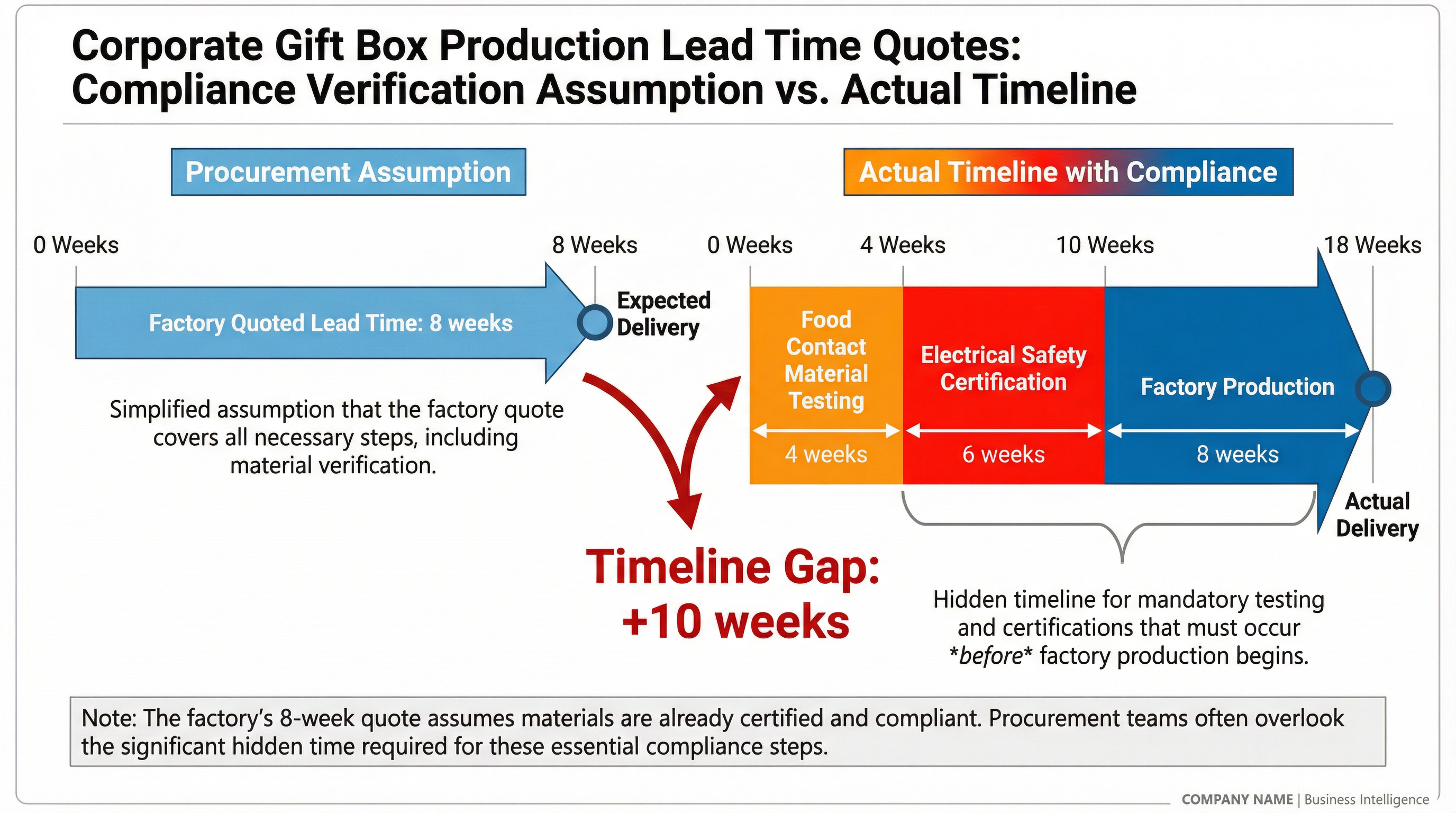
The confusion arises from a fundamental misalignment of responsibility assumptions. Procurement teams typically view their role as ending when they place an order with the factory. The factory's quoted lead time is then treated as the definitive project timeline. However, what procurement teams often overlook is that the factory's production lead time assumes materials are already available and compliance requirements are either not applicable or have been addressed separately. If materials require compliance testing—such as food contact material (FCM) certification, electrical safety certification, or chemical composition verification—the production timeline does not begin. Instead, the order enters a waiting state, and the actual project lead time extends far beyond what was originally quoted.
Consider a typical scenario. A corporate client approves a design for a rigid gift box with custom printing and specialty finishes. The procurement team receives a quote of "8-week lead time" and plans their project accordingly. However, the factory's 8-week estimate assumes that specialty papers, inks, and finishing materials are either in stock or can be sourced quickly. In reality, certain materials—particularly those used in contact with food or those containing metallic components—require compliance testing before they can be used in production. Food contact materials must undergo migration testing to ensure that harmful substances do not transfer from the packaging to the food. This testing typically requires 4 weeks from when samples arrive at the test laboratory. If the test fails, retesting adds another 4 weeks. The factory's 8-week production lead time, which procurement assumed represented the total project timeline, now extends to 16-20 weeks once compliance testing is factored in.
The problem is compounded by the fact that factories often do not proactively communicate compliance testing requirements. From the factory's perspective, compliance testing is the client's responsibility. The factory assumes that if the client requires compliance certification, they will explicitly request it and provide the necessary specifications. If the client does not mention compliance requirements, the factory assumes none are needed. This creates a situation where both parties believe the other is handling compliance, and the testing requirement only surfaces when the product is ready to ship and customs documentation is prepared. At this point, the project is already behind schedule, and the procurement team is forced to either accept the delay or expedite testing at a significantly higher cost.
The regulatory landscape varies significantly across markets, and procurement teams that do not understand these differences are particularly vulnerable to compliance-related delays. In the European Union, all food contact materials must comply with Regulation (EC) No 1935/2004, which requires rigorous testing to ensure that excessive amounts of harmful substances are not transported from the contact material to the food itself. In the United States, the Occupational Safety and Health Administration (OSHA) requires all electrical products in the workplace to be certified by a Nationally Recognized Testing Laboratory (NRTL). In Singapore, the Product Safety Act requires certain consumer products to meet safety standards before they can be sold. Each of these regulatory frameworks imposes specific testing requirements, and each test adds time to the project timeline.
Procurement teams that operate across multiple markets often assume that a single compliance certification will suffice for all regions. In practice, this is rarely the case. A product certified to meet EU standards may not automatically meet US standards, and vice versa. Each market requires separate testing and certification, and each certification adds 4-8 weeks to the project timeline. A procurement team planning a global corporate gifting campaign that includes the EU, US, and Singapore may discover that their 8-week production lead time has expanded to 20-24 weeks once all required certifications are obtained.
The cost implications of compliance testing are also frequently underestimated. Electrical safety certification for products containing radio frequency (RF) or electromagnetic compatibility (EMC) components can cost $10,000-$20,000, with external lab testing fees ranging from $1,000-$10,000 per day. Food contact material testing, while less expensive, still adds $2,000-$5,000 to the project budget. These costs are rarely included in the factory's initial quote, and procurement teams that do not budget for compliance testing may find themselves forced to absorb unexpected expenses or renegotiate with internal stakeholders.
!Cascade effect of compliance test failure showing best case, common case, and worst case scenarios
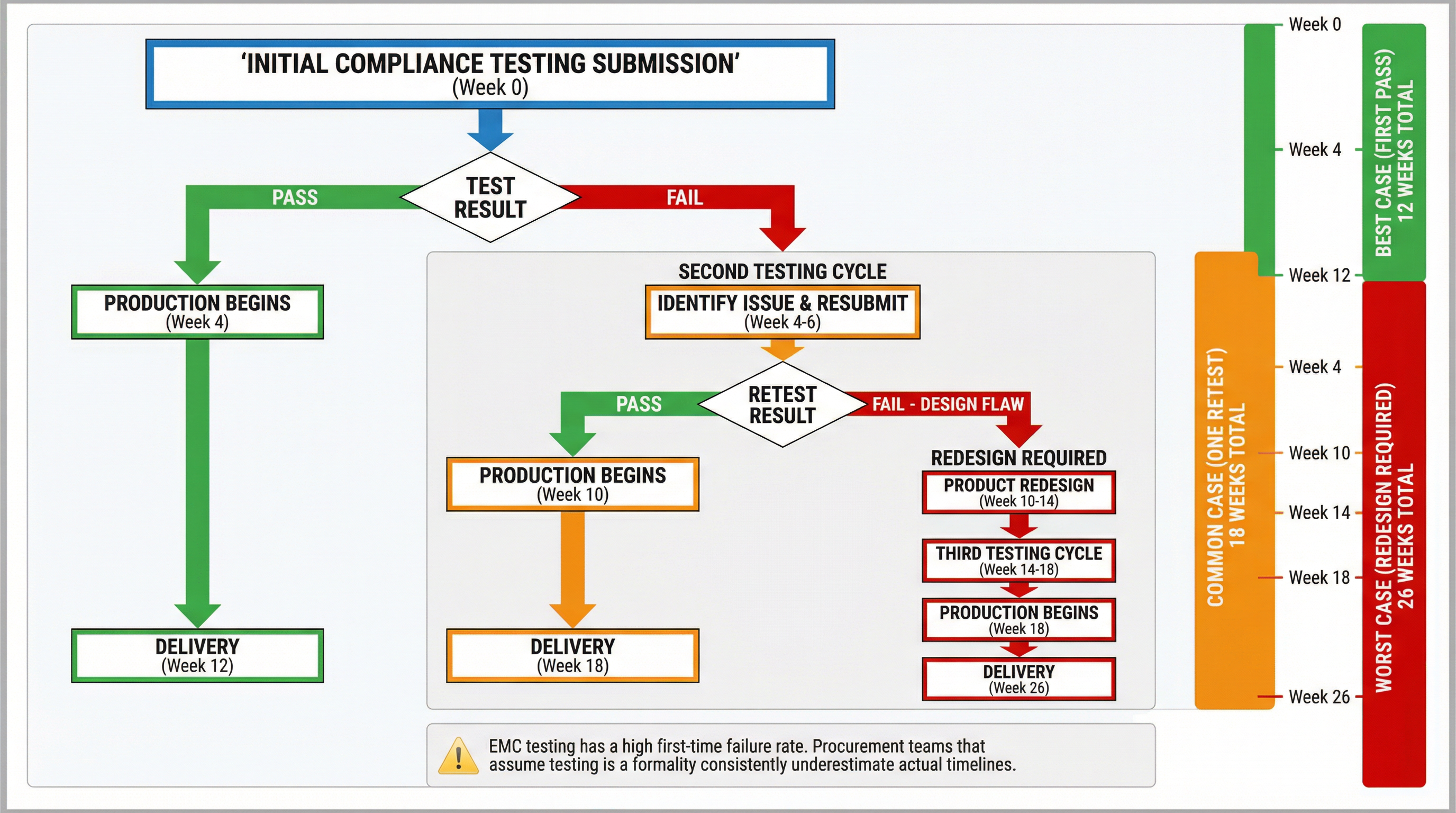
The risk of test failure is another factor that procurement teams consistently underestimate. Many products do not pass electromagnetic compatibility (EMC) standards on the first attempt, particularly if the product was not designed with compliance in mind from the outset. A failed test requires retesting, which adds another 4-8 weeks to the timeline. If the failure is due to a design flaw rather than a minor adjustment, the product may need to be redesigned and resubmitted for testing, which can add 12-16 weeks or more. Procurement teams that assume compliance testing is a formality—a simple box to check before shipment—are unprepared for the timeline and cost implications of test failure.
The assumption that compliance verification is embedded within the factory's quoted lead time is particularly problematic when procurement teams negotiate aggressive timelines. A factory that quotes an 8-week lead time may be able to meet that timeline if no compliance testing is required. However, if the procurement team later requests compliance certification, the factory cannot retroactively compress the testing timeline. Compliance testing is conducted by third-party laboratories, and these laboratories operate on fixed schedules. Expedited testing is sometimes available, but it typically costs 20-40% more than standard testing and may still require 2-3 weeks rather than the standard 4 weeks. A procurement team that discovers compliance requirements late in the project is left with two unappealing options: accept the delay and renegotiate the delivery date with internal stakeholders, or pay a premium for expedited testing and absorb the additional cost.
The structural issue underlying this blind spot is that procurement teams treat compliance verification as a transactional process rather than a critical path item. Compliance testing is not something that happens in parallel with production—it is a prerequisite for production. Materials cannot be used in manufacturing until they have been tested and certified. Products cannot be shipped until they have received the necessary certifications. Procurement teams that do not explicitly account for compliance testing timelines in their project planning are essentially planning around an incomplete timeline. The factory's quoted production lead time is accurate—for the production phase. The procurement team's responsibility is to ensure that compliance testing timelines are added to that production lead time to arrive at a realistic total project timeline.
The key to avoiding this blind spot is recognizing that compliance verification is not the factory's problem to solve—it is a project timeline component that procurement must actively manage. When negotiating lead times with suppliers, procurement teams should explicitly ask: "What compliance certifications are required for this product in our target markets? Are these certifications already in place, or will they need to be obtained after the order is placed? What is the lead time for each certification?" A supplier who can clearly answer these questions and provide a transparent breakdown of production time versus compliance testing time is demonstrating the level of communication and planning that reduces timeline risk. A supplier who provides only a single "lead time" figure without clarifying compliance assumptions is either not thinking through the full project timeline or is deliberately obscuring the compliance testing component to make their quoted lead time appear more competitive.
For corporate gift box projects, where products often include food items, electrical components, or specialty materials, compliance verification is not optional—it is a legal requirement. Understanding how production scheduling works across different order types can provide additional context for managing these compliance-dependent timelines effectively. Compliance testing delays cascade into timeline, cost, and legal risks that are entirely preventable when procurement teams explicitly account for compliance verification timelines as a separate component of the total project timeline. The factory's quoted production lead time is accurate—for the production phase. The procurement team's responsibility is to ensure that compliance testing timelines are added to that production lead time to arrive at a realistic total project timeline that accounts for the regulatory realities of the target market.
The disconnect between procurement expectations and compliance realities becomes particularly acute when dealing with multi-component gift boxes. A corporate gift box that includes a branded power bank, gourmet chocolates, and a ceramic mug represents three distinct compliance domains: electrical safety certification for the power bank, food contact material testing for the chocolate packaging, and potentially lead content testing for the ceramic glaze. Each component requires separate testing, and each test operates on its own timeline. Procurement teams that assume a single compliance certification will cover all components are setting themselves up for significant delays. The factory may be able to produce all three components simultaneously, but the compliance testing must be conducted sequentially or in parallel across different laboratories, each with its own queue and turnaround time.
The timing of when compliance requirements are identified is critical. Procurement teams that wait until the product is ready to ship before addressing compliance requirements have already lost control of the timeline. Compliance testing should be initiated at the design approval stage, not at the shipping stage. This requires procurement teams to ask compliance-related questions early in the sourcing process: "What materials are being used in this product? Do these materials require compliance testing in our target markets? What is the lead time for obtaining the necessary certifications?" These questions should be asked before the purchase order is issued, not after production has begun.
The challenge is that procurement teams often lack the technical expertise to identify compliance requirements independently. A procurement professional may not know that metallic inks used in printing require heavy metal content testing, or that silicone gaskets used in food containers require migration testing. This knowledge gap creates a dependency on the supplier to proactively identify compliance requirements. However, suppliers are not always incentivized to raise compliance issues. From the supplier's perspective, mentioning compliance requirements may make their quote less competitive or introduce complexity that could cause the client to seek alternative suppliers. As a result, suppliers may provide quotes that assume no compliance testing is required, leaving the procurement team to discover the compliance gap only when the product is ready to ship.
This dynamic creates a situation where both parties have incomplete information and misaligned incentives. The procurement team assumes the supplier has factored in all necessary compliance requirements. The supplier assumes the procurement team will explicitly request compliance testing if it is needed. Neither party proactively addresses the compliance timeline, and the gap only surfaces when customs documentation is prepared or when the product is inspected at the port of entry. At this point, the product may be held at customs pending compliance certification, creating not only a timeline delay but also potential storage fees and demurrage charges.
The regulatory environment is also constantly evolving, which adds another layer of complexity. Regulations that were not in effect when the initial quote was provided may come into force before the product is shipped. For example, the European Union's REACH regulation (Registration, Evaluation, Authorisation and Restriction of Chemicals) is regularly updated to include new substances of concern. A product that was compliant when the order was placed may no longer be compliant by the time it is ready to ship if a new substance has been added to the restricted list. Procurement teams that do not actively monitor regulatory changes in their target markets may find themselves with products that cannot be legally imported, despite having followed all known compliance requirements at the time of order placement.
The cost of non-compliance extends beyond timeline delays and expedited testing fees. Products that fail to meet regulatory requirements cannot be sold in the target market, which means the entire production run may need to be scrapped or reworked. If the non-compliance is discovered after the product has been shipped, the importer may face fines, penalties, or even criminal liability depending on the severity of the violation and the jurisdiction. In some cases, non-compliant products must be recalled, which creates not only financial costs but also reputational damage. A corporate gifting campaign that results in a product recall is not just a logistics failure—it is a brand crisis.
The practical implication for procurement teams is that compliance verification must be treated as a critical path item in project planning, not as an afterthought. This requires procurement to add 4-8 weeks to any quoted production lead time to account for compliance testing, assuming the order requires any level of compliance certification. If the order requires certifications for multiple markets or multiple product components, the compliance testing timeline may extend to 12-16 weeks. Procurement teams that fail to account for this timeline are not planning realistically—they are planning optimistically, and optimistic planning consistently leads to missed deadlines and budget overruns.
The solution is not to avoid products that require compliance testing—many corporate gift items inherently require testing due to their material composition or intended use. The solution is to explicitly account for compliance testing as a separate line item in the project timeline and budget. When requesting quotes from suppliers, procurement teams should ask for a breakdown that separates production time from compliance testing time. A quote that provides this level of transparency allows procurement to understand the true project timeline and to identify which components of the timeline are fixed and which are variable. Production time may be negotiable if the factory has available capacity. Compliance testing time is generally not negotiable, as it is determined by laboratory schedules and regulatory testing protocols.
Procurement teams should also establish relationships with compliance testing laboratories directly, rather than relying solely on the supplier to manage testing. This allows procurement to understand laboratory turnaround times, testing costs, and the specific documentation required for each certification. It also provides procurement with visibility into the testing process, so they can track progress and identify delays as they occur rather than discovering them only when the product is ready to ship. Direct relationships with testing laboratories also provide procurement with the option to expedite testing if necessary, although this should be viewed as a contingency option rather than a standard practice, given the cost premium associated with expedited testing.
The broader lesson is that compliance verification is not a supplier responsibility—it is a procurement responsibility. The factory is responsible for producing a product that meets the client's specifications. The procurement team is responsible for ensuring that those specifications include all necessary compliance requirements for the target market. If the procurement team does not explicitly specify compliance requirements, the factory will assume none are needed. This is not a failure on the factory's part—it is a failure of communication and project planning on the procurement team's part. Compliance verification timelines must be explicitly accounted for in project planning, and compliance requirements must be explicitly communicated to suppliers at the time of order placement, not after production has begun.