Material Sourcing Assumption in Corporate Gift Box Production Lead Time Quotes
Procurement teams treat factory production lead time quotes as total project timelines, overlooking the 4-6 week material sourcing phase that must occur before production begins. This blind spot transforms 8-week quotes into 14-week actual delivery timelines.
When a procurement team requests a lead time quote for corporate gift boxes, the supplier typically provides a production lead time—often stated as "6 weeks" or "8 weeks." This number refers specifically to the time required to manufacture the boxes once all materials have arrived at the factory and are ready for production. Yet in practice, procurement teams frequently treat this production lead time as the total timeline from order placement to delivery. This distinction creates a critical blind spot that surfaces only when material sourcing delays begin to accumulate.
!Material sourcing assumption timeline comparison
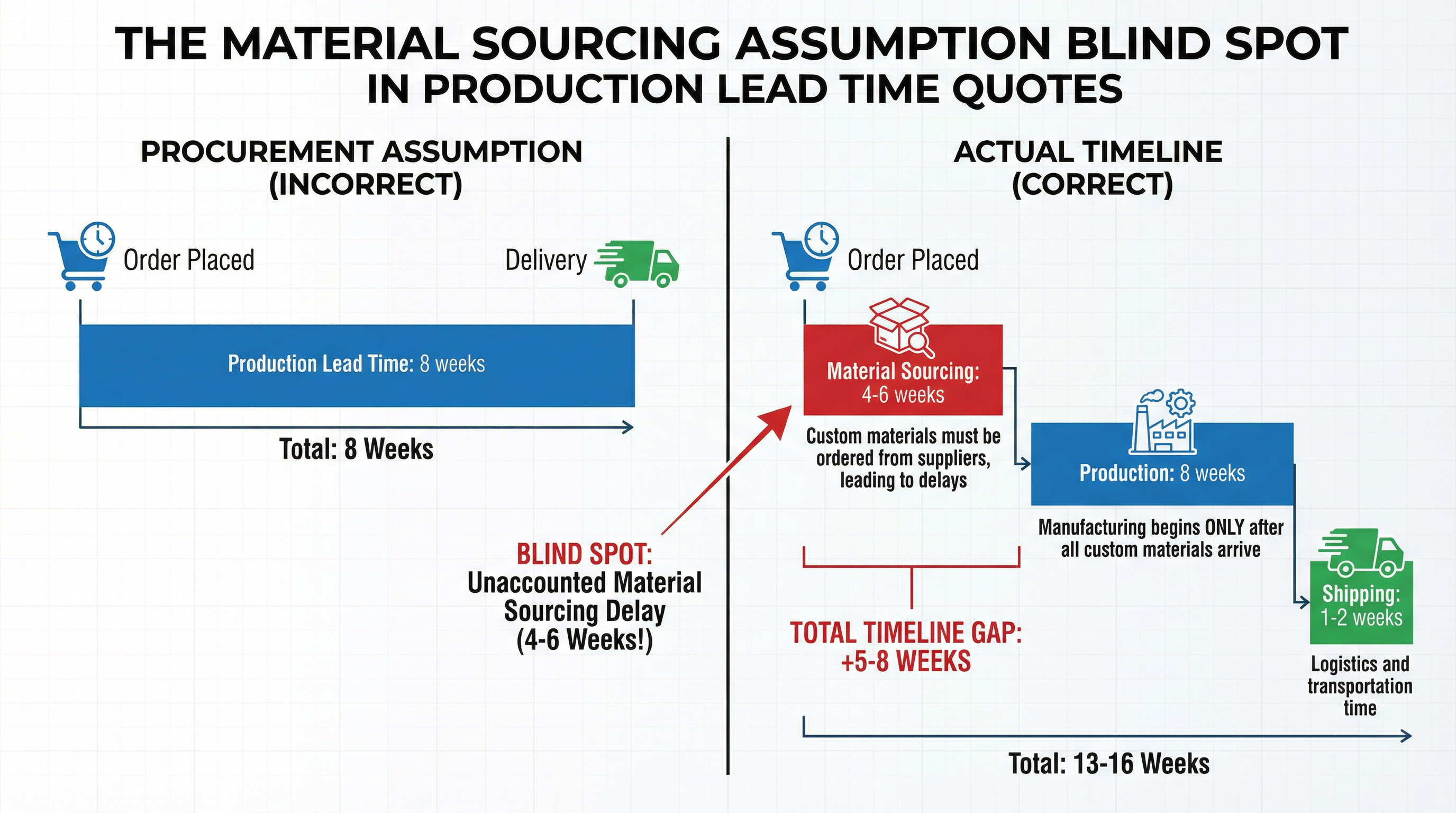
*Procurement teams often assume production lead time represents total project timeline, overlooking the 4-6 week material sourcing phase that must occur before manufacturing begins*
The confusion arises from a fundamental separation of responsibility. Procurement teams typically view their role as ending when they place an order with the factory. The factory's quoted lead time is then treated as the definitive project timeline. However, what procurement teams often overlook is that the factory's production lead time assumes materials are already available. If materials are not available—either because they must be sourced from a separate supplier or because the factory's material inventory is depleted—the production timeline does not begin. Instead, the order enters a waiting state, and the actual project lead time extends far beyond what was originally quoted.
Consider a typical scenario. A corporate client approves a design for a rigid gift box with custom printing and specialty finishes. The procurement team receives a quote stating "8-week production lead time" and plans their project accordingly. However, the factory's 8-week estimate assumes that specialty papers, inks, and finishing materials are either in stock or can be sourced quickly. In reality, certain materials—particularly specialty substrates, metallic inks, or embossing foils—may have their own lead times of 4-6 weeks from the material supplier. If the factory does not maintain inventory of these materials, the order cannot enter production until the materials arrive. The procurement team's 8-week timeline suddenly becomes 12-14 weeks, and the delay is attributed to the factory rather than recognized as a material sourcing issue.
This blind spot is particularly pronounced in corporate gift box manufacturing, where customization often requires materials that are not standard inventory items. A procurement team specifying a unique paper substrate, a custom color ink formulation, or a specialty embossing foil has inadvertently extended the material sourcing timeline. The factory cannot begin production until these materials are available. Yet procurement teams frequently do not explicitly ask about material availability or material lead times when negotiating production timelines. They assume that the factory's quoted lead time accounts for all necessary preparation, including material sourcing.
The reality is more nuanced. Most factories maintain some level of inventory for common materials—standard papers, basic inks, standard foils. For these materials, the factory's quoted production lead time is reasonably accurate. However, for any customization beyond standard offerings, material sourcing becomes a separate timeline component. A factory that quotes "8 weeks for production" may be quoting only the manufacturing phase, not accounting for the fact that custom materials may require 4-6 weeks to arrive. The factory's responsibility is to communicate this clearly, but many factories do not explicitly separate material lead time from production lead time in their quotes. They provide a single "lead time" figure that assumes materials are available.
From a factory project manager's perspective, this creates a communication challenge. When a procurement team requests a lead time quote, the factory must make assumptions about material availability. If the procurement team has specified standard materials, the factory can confidently quote a production-only lead time. If the procurement team has specified custom materials, the factory should ideally provide a breakdown: material sourcing (4-6 weeks) + production (8 weeks) + shipping (1-2 weeks) = total lead time (13-16 weeks). However, at the quoting stage, the factory may not yet have full visibility into which materials are in stock and which must be sourced. The factory may provide a production-only quote with the implicit assumption that material sourcing will be addressed separately once the order is confirmed.
This implicit assumption is where the blind spot emerges. The procurement team interprets the factory's "8-week production lead time" as the total timeline from order placement to delivery. The factory interprets the "8-week production lead time" as the timeline from material availability to production completion. Neither party explicitly clarifies this distinction during the quoting process. The misalignment surfaces only when the order is placed and the factory begins to assess material availability. At that point, the factory informs the procurement team that certain materials must be sourced and will require 4-6 weeks. The procurement team, having already communicated an 8-week timeline to their internal stakeholders, now faces a 12-14 week actual timeline and must explain the delay.
The consequences of this blind spot extend beyond simple timeline mismanagement. When procurement teams discover that material sourcing will delay their project, they often respond by requesting expedited material sourcing or asking the factory to source materials from alternative suppliers. Expedited material sourcing typically incurs significant costs—rush fees, premium pricing, or air freight charges. Alternative suppliers may provide materials at higher cost or with quality variations that require additional validation. These costs are often unexpected because procurement teams did not anticipate material sourcing as a separate timeline and budget component.
Additionally, when material sourcing is compressed or expedited, quality risks increase. A material supplier rushing to meet an expedited timeline may have less rigorous quality control. A factory forced to source materials from an unfamiliar supplier may encounter compatibility issues or quality variations. For corporate gift boxes, where brand reputation and quality standards are paramount, material sourcing shortcuts can result in final products that do not meet expectations. The procurement team's attempt to recover lost time by expediting material sourcing can paradoxically compromise the quality of the final product.
The procurement decision blind spot, then, is the assumption that the factory's quoted production lead time represents the total project timeline. In reality, material sourcing is a parallel or sequential process that must be completed before production can begin. Understanding this distinction requires procurement teams to explicitly ask suppliers about material lead times and to factor these into their total project planning. A transparent supplier will provide a breakdown such as: material sourcing (4-6 weeks) + production (8 weeks) + shipping (1-2 weeks) = total lead time (13-16 weeks). Without this breakdown, procurement teams are working with incomplete information and are exposed to significant timeline and budget risks.
!Standard vs custom material lead time comparison
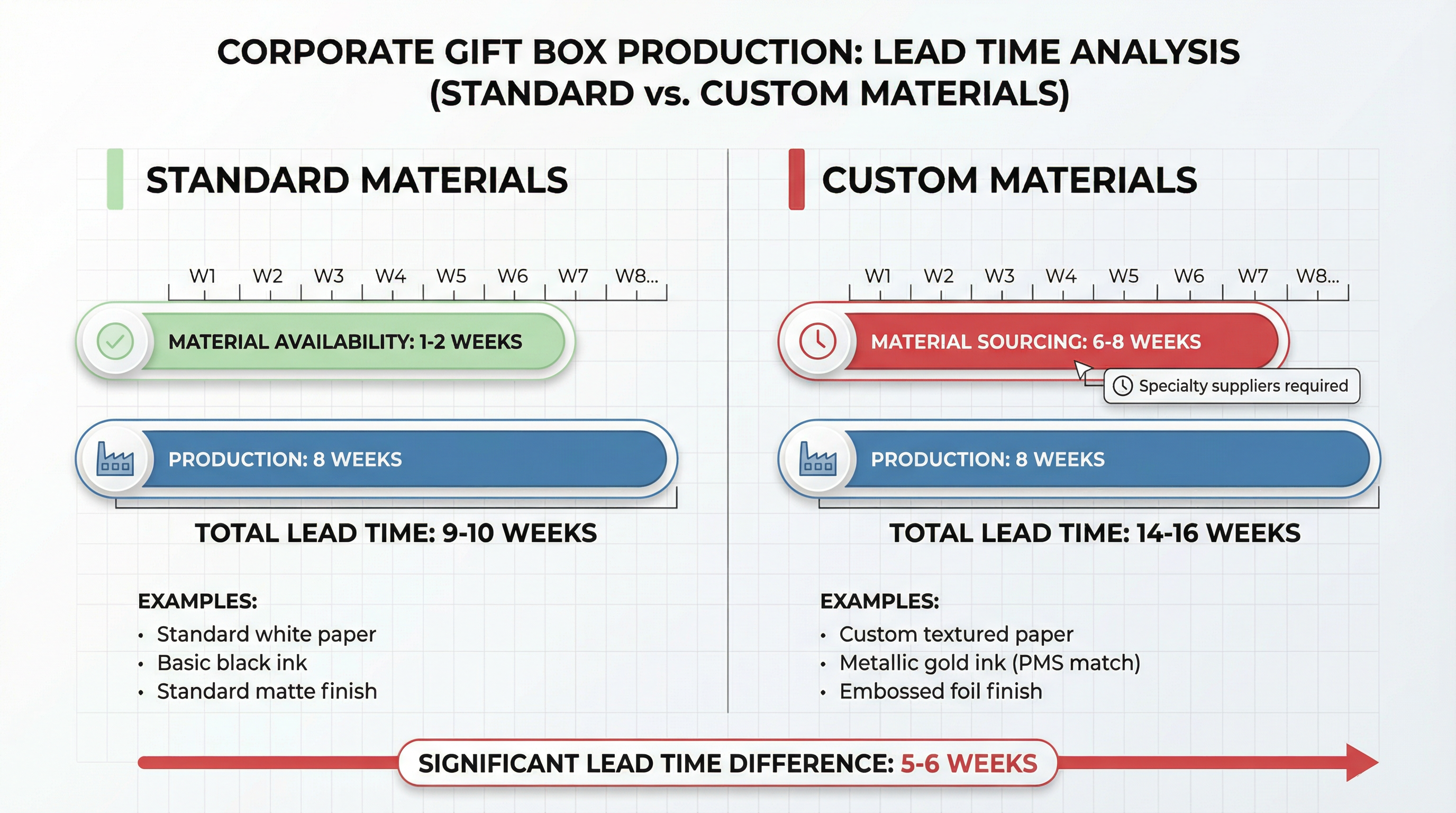
*Standard materials can be sourced in 1-2 weeks, while custom materials require 6-8 weeks from specialty suppliers, creating a 5-6 week lead time difference*
For corporate gift box projects, where materials are often customized to match brand specifications, material sourcing lead time is not a minor consideration—it is frequently the longest component of the total timeline. A procurement team that fails to account for material sourcing when planning a project is essentially planning around an incomplete timeline. The practical implication is that procurement should add 4-6 weeks to any quoted production lead time to account for material sourcing, assuming the order requires any level of material customization. If the order requires materials that must be sourced from specialty suppliers or if the factory does not maintain inventory of the specified materials, the material sourcing timeline may extend to 8-12 weeks.
Many factories operate on just-in-time (JIT) inventory strategies to minimize holding costs and reduce waste. JIT inventory management means that materials arrive at the factory as production is scheduled to begin, but no sooner. This strategy is highly efficient when material suppliers are reliable and lead times are predictable. However, JIT inventory management also means that the factory does not maintain buffer stock of materials. If a procurement team places an order that requires materials not currently in the factory's inventory, those materials must be sourced before production can begin. The factory's JIT strategy, which is invisible to the procurement team, directly impacts the total project timeline.
A procurement team that does not understand the factory's inventory strategy may assume that the factory maintains inventory of all materials required for production. In reality, the factory may maintain inventory only of high-turnover materials and source low-turnover or custom materials on a per-order basis. This distinction is critical when planning project timelines. A procurement team specifying custom materials should explicitly ask: "Do you maintain inventory of these materials, or will they need to be sourced after the order is placed?" A factory that maintains inventory can begin production immediately. A factory that must source materials will require additional lead time before production can begin.
When negotiating lead times with suppliers, procurement teams should explicitly ask: "What materials are included in your quoted lead time? What materials require separate sourcing? What is the lead time for each material component?" A supplier who can clearly answer these questions and provide a transparent breakdown of material sourcing versus production time is demonstrating the level of communication and planning that reduces timeline risk. A supplier who provides only a single "lead time" figure without clarifying material sourcing assumptions is either not thinking through the full project timeline or is deliberately obscuring the material sourcing component to make their quoted lead time appear more competitive.
The key to avoiding this blind spot is recognizing that procurement's responsibility extends beyond placing an order with the factory. Procurement must understand the full supply chain that feeds into the factory's production process. Material sourcing is not the factory's problem to solve—it is a project timeline component that procurement must actively manage. By explicitly accounting for material lead times in project planning and by asking suppliers for transparent breakdowns of material sourcing versus production timelines, procurement teams can set realistic expectations and avoid the costly surprises that arise when material sourcing delays cascade into production delays.
For corporate gift box projects, where customization is the norm and material sourcing is a critical path item, this level of timeline transparency is not optional—it is essential to project success. Understanding how production scheduling works across different order types can provide additional context for managing these material-dependent timelines effectively. Material sourcing delays cascade into timeline, cost, and quality impacts that are entirely preventable when procurement teams explicitly account for material lead times as a separate component of the total project timeline. The factory's quoted production lead time is accurate—for the production phase. The procurement team's responsibility is to ensure that material sourcing timelines are added to that production lead time to arrive at a realistic total project timeline.
The material sourcing blind spot becomes even more pronounced when procurement teams work with multiple stakeholders who each have approval authority over different aspects of the project. A marketing team may approve the design, a finance team may approve the budget, and a logistics team may approve the delivery schedule. Each stakeholder operates with their own timeline assumptions, and none may be aware of the material sourcing component. When the factory informs procurement that material sourcing will require 4-6 weeks, the procurement team must then re-negotiate timelines with multiple internal stakeholders, each of whom had planned around the original 8-week production lead time. This internal re-negotiation process can add additional weeks to the project timeline, compounding the delay caused by material sourcing.
From a factory project manager's perspective, the most frustrating aspect of this blind spot is that it is entirely preventable. If procurement teams explicitly asked about material availability and material lead times during the quoting process, the factory could provide a transparent breakdown of material sourcing versus production timelines. The procurement team could then plan their project around a realistic total timeline, and internal stakeholders could be informed of the correct timeline from the outset. Instead, the material sourcing component is often discovered only after the order is placed, at which point the procurement team is already committed to a timeline that does not account for material sourcing.
Another dimension of this blind spot relates to the distinction between standard materials and custom materials. Standard materials are those that the factory maintains in inventory or can source quickly from established suppliers. Custom materials are those that must be specially ordered, manufactured, or sourced from specialty suppliers. The lead time difference between standard and custom materials can be substantial. Standard materials may be available within 1-2 weeks. Custom materials may require 6-8 weeks or longer. A procurement team that specifies custom materials without understanding the lead time implications is inadvertently extending the total project timeline by 4-6 weeks or more.
The challenge is that procurement teams often do not have visibility into which materials are standard and which are custom. A procurement team may specify a particular paper substrate, ink color, or finishing technique without realizing that this specification requires custom materials. The factory, upon receiving the specification, recognizes that custom materials will be required and begins the material sourcing process. The procurement team, unaware that custom materials are involved, continues to plan around the factory's quoted production lead time. The misalignment surfaces only when the factory informs the procurement team that material sourcing will require additional time.
To address this blind spot, factories can adopt more transparent quoting practices. Rather than providing a single "production lead time" figure, factories can provide a breakdown that explicitly separates material sourcing from production. For example, a factory quote might state: "Material sourcing: 4-6 weeks (assuming custom paper substrate and specialty foil). Production: 8 weeks (once materials are available). Shipping: 1-2 weeks. Total lead time: 13-16 weeks." This level of transparency ensures that procurement teams understand the full timeline and can plan accordingly.
However, not all factories provide this level of detail in their quotes. Some factories provide only a production lead time and assume that procurement teams will understand that material sourcing is a separate component. Other factories may deliberately obscure the material sourcing component to make their quoted lead time appear more competitive. A factory that quotes "8 weeks" without mentioning material sourcing may appear more attractive than a factory that quotes "13-16 weeks including material sourcing," even though both factories may ultimately deliver on the same timeline. The procurement team, comparing quotes from multiple suppliers, may select the factory with the shortest quoted lead time without realizing that the quoted lead time does not include material sourcing.
This competitive dynamic creates an incentive for factories to provide incomplete lead time quotes. A factory that provides a transparent breakdown of material sourcing versus production timelines may lose business to a factory that provides only a production lead time. The procurement team, lacking visibility into the material sourcing component, selects the factory with the shortest quoted lead time. Only after the order is placed does the procurement team discover that material sourcing will add 4-6 weeks to the timeline. At that point, the procurement team is already committed to the factory and must accept the extended timeline.
The solution to this dynamic is for procurement teams to explicitly ask for material sourcing breakdowns during the quoting process. Rather than accepting a single "lead time" figure, procurement teams should ask: "Does this lead time include material sourcing? If not, what is the estimated material sourcing lead time?" By asking this question consistently across all suppliers, procurement teams can ensure that they are comparing apples to apples when evaluating quotes. A factory that quotes "8 weeks production + 4-6 weeks material sourcing" is providing a more accurate and transparent timeline than a factory that quotes "8 weeks" without clarifying whether material sourcing is included.
Another practical consideration is the impact of material sourcing on project budgets. Material sourcing delays often result in expedited material sourcing costs, which can add 10-20% to the total material cost. A procurement team that did not budget for material sourcing costs may find that their project budget is insufficient to cover the expedited material sourcing fees. This budget shortfall can delay the project further while the procurement team seeks additional budget approval from finance stakeholders. The cascading effects of material sourcing delays—timeline extensions, expedited sourcing costs, budget shortfalls, and internal re-negotiations—can transform a straightforward project into a complex and costly undertaking.
For procurement teams managing corporate gift box projects, the key takeaway is that material sourcing is not an afterthought—it is a critical path component that must be explicitly accounted for in project planning. A procurement team that treats the factory's quoted production lead time as the total project timeline is setting themselves up for delays, cost overruns, and quality compromises. By explicitly asking about material availability, material lead times, and material sourcing costs during the quoting process, procurement teams can set realistic expectations and avoid the costly surprises that arise when material sourcing delays cascade into production delays.
The factory's quoted production lead time is accurate—for the production phase. The procurement team's responsibility is to ensure that material sourcing timelines are added to that production lead time to arrive at a realistic total project timeline. This distinction is not obvious, and it is not always communicated clearly by factories. But it is essential to project success. For corporate gift box projects, where customization is the norm and material sourcing is a critical path item, this level of timeline transparency is not optional—it is essential to project success.