Standard Operating Conditions Assumption in Corporate Gift Box Production Lead Time Quotes
Standard Operating Conditions Assumption in Corporate Gift Box Production Lead Time Quotes
When procurement teams receive an eight-week lead time quote for corporate gift box production, the number itself rarely reveals what it actually represents. Most quotes are built on a foundation of unstated assumptions about the operating environment where production will take place. The supplier assumes climate-controlled facilities, stable temperature and humidity ranges, and standard material handling protocols. The procurement team, in turn, assumes the quote accounts for their actual project conditions. In practice, this is often where lead time decisions start to be misjudged.
The gap between quoted and actual delivery timelines frequently originates not from capacity constraints or approval delays, but from a fundamental mismatch between the supplier's assumed "standard" operating conditions and the real-world environment where production must occur. An eight-week quote based on a climate-controlled facility operating at 20-25°C with 40-60% humidity can easily extend to eleven or thirteen weeks when the actual installation environment is a non-climate-controlled warehouse experiencing temperature swings from 5°C to 35°C and humidity levels reaching 70-80%.
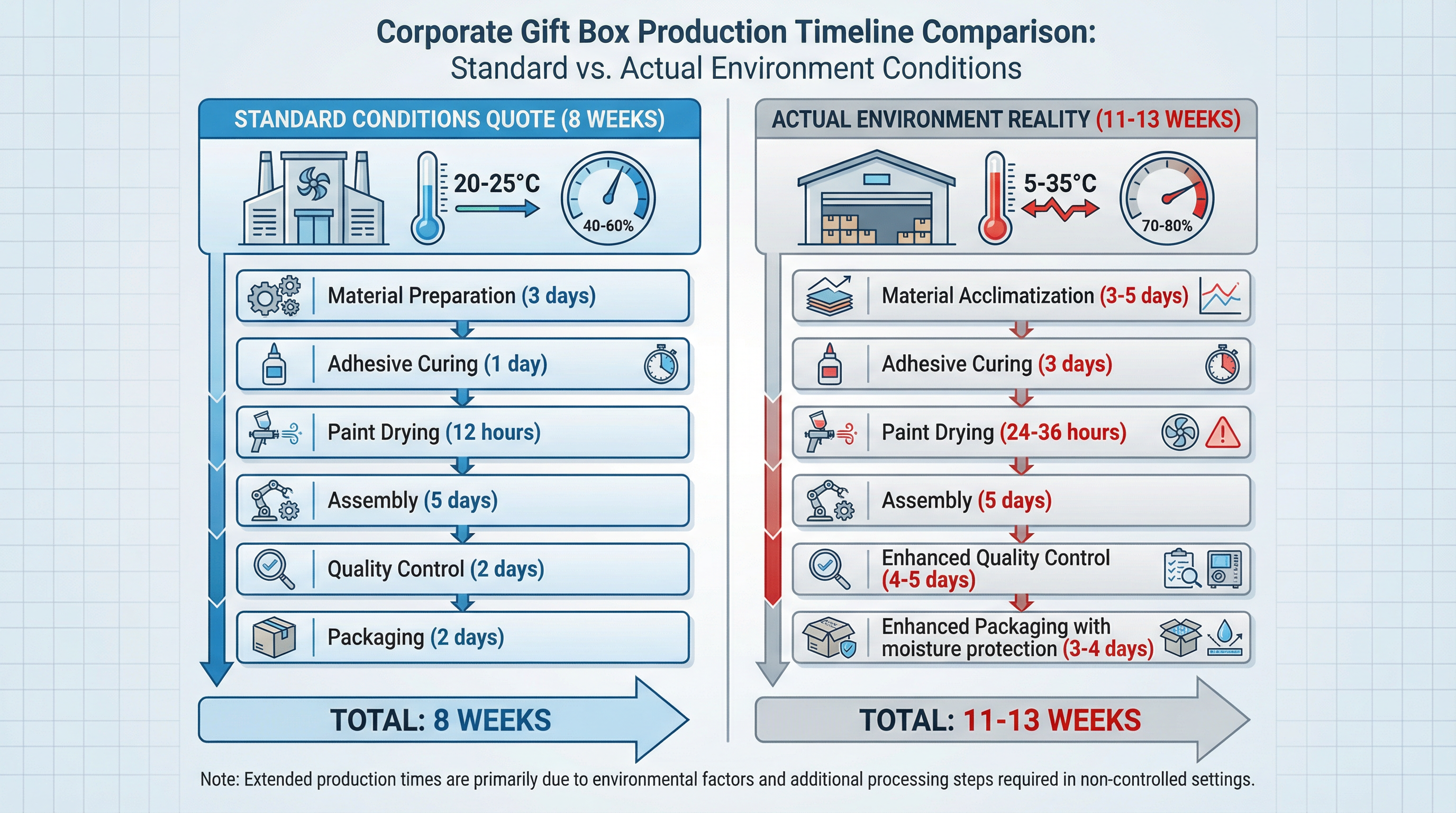
This is not a matter of supplier dishonesty or procurement oversight. It reflects a structural communication gap in how manufacturing quotes are constructed and interpreted. Suppliers quote based on their typical operating parameters because those parameters represent their most efficient production environment. Procurement teams accept those quotes because they lack visibility into which environmental assumptions are embedded in the timeline. Neither party explicitly discusses what "standard conditions" means until production is already underway and delays begin to accumulate.
The issue becomes visible only when materials behave differently than expected. Adhesives that cure in twenty-four hours under controlled conditions require forty-eight to seventy-two hours in cold temperatures because chemical reaction rates slow significantly below optimal ranges. Paint that dries in twelve hours at moderate humidity takes twenty-four to thirty-six hours when ambient moisture levels are high. Wood components that can be assembled immediately in a climate-controlled workshop need three to five days of acclimatization in a non-controlled environment to prevent warping or cracking after assembly.
Each of these adjustments appears minor in isolation. An extra day for adhesive curing, another day for paint drying, a few days for material stabilization. But corporate gift box production involves multiple sequential processes where each step depends on the completion of the previous one. When adhesive curing extends from one day to three days, every subsequent operation—assembly, printing, quality inspection, packaging—shifts backward by the same margin. When this pattern repeats across multiple production stages, the cumulative delay can add three to five weeks to the original timeline.
The problem is compounded by packaging and storage requirements that change based on environmental conditions. Standard cardboard shipper cartons that perform adequately in climate-controlled warehouses lose structural integrity in high-humidity environments. They become moldy, absorb moisture, and collapse during transit. This necessitates double or triple-layered cartons with plastic straps for reinforcement, plus desiccant packets or silica gel inserts to manage moisture. Each of these packaging modifications adds time—not just for material procurement, but for assembly, quality verification, and storage before shipping to allow materials to stabilize.
Quality control protocols also expand when operating conditions deviate from standard assumptions. In a controlled environment, visual inspection and dimensional checks may be sufficient. In variable temperature and humidity conditions, inspectors must verify adhesive bond strength, check for moisture content in packaging materials, confirm that paint finishes have fully cured despite environmental challenges, and ensure that wood or paper components have not warped during storage. These additional inspection steps typically add two to three days to the quality assurance phase, and if any issues are detected, the time required for rework extends the schedule further.
!Environmental conditions impact on material behavior and required production adaptations
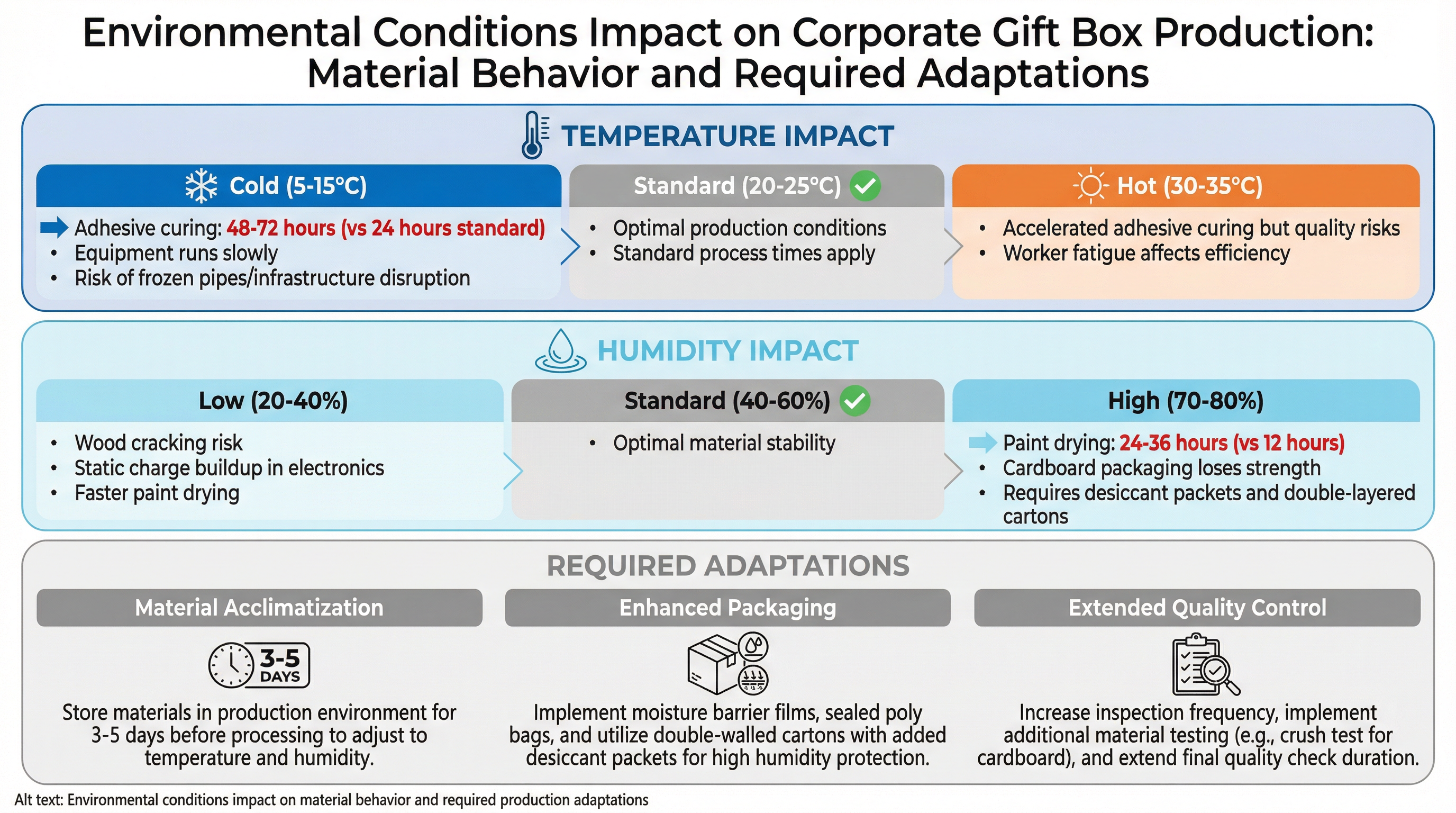
From a factory project manager's perspective, the challenge is that these environmental adaptations are not discretionary. They are necessary adjustments to maintain product quality and ensure that corporate gift boxes arrive in acceptable condition. A supplier cannot simply ignore the fact that adhesives cure more slowly in cold temperatures or that packaging materials degrade in high humidity. The choice is not between meeting the original timeline and adapting to conditions—it is between adapting to conditions and delivering defective products.
Yet procurement teams rarely ask about environmental assumptions during the quoting phase. They focus on price, quantity, customization options, and delivery date. The question "What temperature and humidity range does your quote assume?" is almost never posed. Neither is "How do curing and drying times change outside that range?" or "What additional packaging is required for non-climate-controlled storage?" Without these questions, the supplier has no reason to disclose that their eight-week quote assumes conditions that may not match the buyer's actual installation environment.
This creates a situation where both parties operate in good faith but with incompatible expectations. The supplier believes they have provided an accurate quote based on their standard production environment. The procurement team believes they have received a quote that accounts for their project's actual conditions. The mismatch only becomes apparent when production begins and the supplier realizes that materials are not behaving as expected, processes are taking longer than planned, and additional steps are required to prevent quality failures.
The time impact of these environmental mismatches is not linear. It does not simply add a fixed number of days to the schedule. Instead, it introduces variability and uncertainty that ripple through the entire production timeline. When adhesive curing time is unpredictable because ambient temperature fluctuates daily, the supplier cannot confidently schedule the next production step. When humidity levels vary, paint drying times become inconsistent, making it difficult to maintain a steady production rhythm. This variability forces the supplier to build in buffer time between operations, which further extends the overall lead time.
In some cases, environmental conditions can halt production entirely. Factories in regions prone to extreme weather may experience infrastructure disruptions—frozen pipes, power outages, transportation delays—that suspend operations for days at a time. Pollution control regulations in certain jurisdictions can require factories to shut down during red alert periods when air quality reaches hazardous levels. These events are not reflected in standard lead time quotes because they fall outside the supplier's assumed "normal" operating conditions, yet they can add significant delays to delivery schedules.
The solution is not to demand that suppliers account for every possible environmental scenario in their quotes. That would make quotes impossibly complex and inflate costs to cover worst-case contingencies. Instead, the solution is to make environmental assumptions explicit during the quoting process. Procurement teams need to ask what conditions the supplier's quote assumes, and suppliers need to disclose those assumptions clearly. If the actual project environment differs from those assumptions, both parties can then discuss what adjustments will be necessary and how those adjustments will affect the timeline.
This conversation should happen before production begins, not after delays have already occurred. Once materials have been ordered, production schedules have been set, and delivery commitments have been made, it becomes much more difficult and expensive to adapt to environmental mismatches. Early disclosure allows procurement teams to make informed decisions—whether to accept a longer lead time, invest in climate control for the installation environment, or select a supplier whose standard operating conditions more closely match the project's actual conditions.
For corporate gift box production, where quality and presentation are critical to the buyer's brand image, environmental mismatches carry particularly high risk. A gift box that arrives with warped components, peeling paint, or moisture-damaged packaging undermines the entire purpose of the gift. The cost of these quality failures—both financial and reputational—far exceeds the cost of adding a few weeks to the production timeline to ensure proper environmental adaptation.
Understanding how production schedules are structured helps procurement teams recognize that lead time quotes are not universal constants but context-dependent estimates built on specific assumptions. When those assumptions do not match reality, the timeline must adjust accordingly. The question is whether that adjustment happens proactively, through clear communication during the quoting phase, or reactively, through delays and quality issues during production.
From a factory project manager's perspective, the most effective procurement partners are those who ask about environmental assumptions upfront. They want to know what temperature range the supplier's processes are optimized for, how humidity affects material behavior, what packaging adaptations are needed for non-standard storage conditions, and whether the supplier has experience producing similar items in environments that match the buyer's actual installation conditions. These questions signal that the procurement team understands manufacturing is not a black box that produces outputs on demand, but a complex system where physical conditions directly affect process timelines and product quality.
The eight-week quote that becomes an eleven-week delivery is not a failure of planning or execution. It is a predictable consequence of unstated environmental assumptions colliding with actual operating conditions. The gap between quoted and actual lead times will persist as long as procurement teams and suppliers continue to discuss timelines without explicitly discussing the environmental conditions those timelines assume. Making those assumptions visible and verifiable is the first step toward more accurate lead time estimates and fewer surprises during production.
The environmental assumptions embedded in lead time quotes extend beyond temperature and humidity to include operational factors that are equally consequential but even less visible. Suppliers typically quote based on single-shift operation with experienced operators working under stable conditions. When actual production requires multi-shift operation to meet accelerated timelines, the efficiency assumptions underlying the quote no longer hold. Second and third shift operators may be less experienced, requiring additional supervision and quality checks. Handoffs between shifts introduce coordination delays and increase the risk of miscommunication about process adjustments made during previous shifts.
This operational complexity is rarely discussed during the quoting phase because procurement teams focus on calendar time rather than production hours. An eight-week quote may assume forty hours of production per week across a single shift. If the buyer requests expedited delivery and the supplier agrees to run two shifts, the procurement team may expect the timeline to compress proportionally. In reality, multi-shift operation introduces inefficiencies that partially offset the additional hours. Training time, coordination overhead, and quality control complexity mean that two shifts do not deliver twice the output of one shift.
Material handling protocols also change based on environmental conditions in ways that affect lead time. In a climate-controlled facility, materials can be stored in open racks and moved directly to production as needed. In a non-controlled environment, materials must be protected from temperature fluctuations and humidity exposure. This requires sealed storage containers, acclimatization periods before use, and careful tracking of which materials have been conditioned and which have not. Each of these steps adds time to material preparation and increases the risk of production delays if materials are not ready when needed.
The impact of environmental conditions on material behavior is not always predictable in advance. Suppliers may have extensive experience producing corporate gift boxes in their standard facility, but limited experience adapting those processes to non-standard environments. When a procurement team specifies a delivery location with significantly different temperature or humidity conditions, the supplier may not immediately recognize how those differences will affect production timelines. They quote based on their standard processes, assuming that minor environmental variations will not materially impact the schedule.
This assumption breaks down when environmental differences are not minor. A facility operating at 15°C instead of 25°C represents a ten-degree temperature difference that significantly affects chemical reaction rates in adhesives, coatings, and finishes. A warehouse with 75% humidity instead of 50% humidity creates moisture management challenges that require additional drying time and protective packaging. These are not edge cases or worst-case scenarios—they are common variations in real-world production environments that fall outside the narrow range of "standard" conditions most quotes assume.
From a risk management perspective, environmental assumptions represent a category of lead time risk that is distinct from the more commonly discussed risks of capacity constraints, approval delays, or material sourcing challenges. Those risks are process-based and can be mitigated through better planning, clearer communication, or alternative suppliers. Environmental risks are physics-based and cannot be negotiated away. Adhesives will cure more slowly in cold temperatures regardless of how urgently the buyer needs the product or how much they are willing to pay for expedited delivery.
This creates a situation where procurement teams have limited leverage to compress timelines once environmental mismatches are discovered. If a supplier realizes mid-production that adhesive curing is taking twice as long as expected due to cold temperatures, the buyer cannot simply demand that the supplier "find a way" to meet the original deadline. The supplier can potentially add heating equipment to accelerate curing, but that requires time to procure and install, plus additional cost that was not included in the original quote. The more practical response is to acknowledge that the timeline must extend to accommodate the actual environmental conditions.
The challenge for procurement teams is that environmental assumptions are not typically documented in quotes or contracts. A quote may specify quantity, unit price, customization details, and delivery date, but it rarely states "This timeline assumes production in a climate-controlled facility operating at 20-25°C with 40-60% humidity." Without that explicit statement, procurement teams have no basis for questioning whether the supplier's assumed conditions match their actual project environment. The assumption remains invisible until it causes a problem.
Suppliers, for their part, may not realize they are making environmental assumptions because those conditions are so deeply embedded in their standard operations that they no longer think of them as assumptions. A factory that has operated in the same climate-controlled facility for twenty years may not consciously consider that temperature and humidity are variables rather than constants. When they quote an eight-week lead time, they are quoting based on their accumulated experience in that specific environment, not based on a generalized understanding of how environmental conditions affect production processes.
This creates a knowledge gap that neither party is well-positioned to bridge. Procurement teams lack the technical expertise to know which environmental factors affect production timelines and by how much. Suppliers lack visibility into the buyer's actual installation environment and may not think to ask about conditions they take for granted in their own facility. The result is a systematic underestimation of lead time whenever the buyer's environment differs from the supplier's standard conditions.
The time impact of environmental mismatches can be particularly severe for corporate gift box production because these products often involve multiple materials and processes that each respond differently to environmental conditions. Wood components are sensitive to humidity and require acclimatization. Metal components may require corrosion protection in high-humidity environments. Paper and cardboard packaging materials absorb moisture and lose strength. Adhesives, coatings, and finishes all have temperature-dependent curing times. When a single product incorporates multiple materials with different environmental sensitivities, the cumulative time impact of non-standard conditions can be substantial.
In some cases, environmental conditions may require process changes that go beyond simply extending drying or curing times. A supplier accustomed to water-based coatings in a controlled environment may need to switch to solvent-based coatings for production in a high-humidity warehouse. This change affects not only the timeline but also the cost, quality characteristics, and regulatory compliance of the finished product. Such changes cannot be made unilaterally by the supplier—they require discussion and approval from the procurement team, which adds further delays to an already extended timeline.
The most effective approach to managing environmental assumptions is to treat them as a standard element of the quoting process, similar to quantity, specifications, and delivery location. Procurement teams should routinely ask suppliers to disclose the environmental conditions their quotes assume, and suppliers should proactively document those conditions in their proposals. This creates a shared understanding of what "standard" means and provides a basis for discussing adjustments if actual conditions differ from assumptions.
For procurement teams working with suppliers in unfamiliar regions or climates, it may be valuable to conduct a pre-production environmental assessment. This involves sharing detailed information about the installation environment—temperature ranges, humidity levels, storage conditions, handling protocols—and asking the supplier to evaluate how those conditions compare to their standard operations. If significant differences exist, the supplier can then provide a revised timeline that accounts for necessary adaptations rather than discovering those needs mid-production.
This proactive approach requires additional effort during the quoting phase, but it prevents much larger problems during production. The time invested in clarifying environmental assumptions and adjusting timelines upfront is minimal compared to the delays, quality issues, and relationship strain that result from discovering environmental mismatches after production has begun. It also allows procurement teams to make more informed decisions about supplier selection, recognizing that a supplier whose standard operating conditions closely match the project's actual environment may deliver more reliably than a lower-cost supplier whose conditions differ significantly.
The eight-week quote that extends to eleven or thirteen weeks due to environmental mismatches is not an isolated incident but a recurring pattern in corporate gift box procurement. It reflects a fundamental gap in how manufacturing timelines are communicated and understood. Closing that gap requires making environmental assumptions explicit, verifiable, and subject to discussion during the quoting phase rather than discovering them through delays during production. Until that shift occurs, procurement teams will continue to experience unexpected timeline extensions that could have been anticipated and managed if the underlying assumptions had been made visible from the start.