Theoretical Capacity vs Available Capacity in Corporate Gift Box Production Lead Time Quotes
Procurement teams treat supplier capacity figures as available bandwidth, overlooking that 85% utilization leaves only 15% for new orders. A factory stating 50,000 units/month capacity has 7,500 units actually available, transforming 8-week quotes into 12-14 week actual delivery timelines.
When a supplier quotes "50,000 units per month capacity" during negotiations, most procurement teams treat that figure as a commitment—a guarantee that the factory can absorb your order without strain. In practice, this is often where lead time decisions start to be misjudged. The number represents theoretical maximum output under ideal conditions, not the actual production bandwidth available to your project at the moment you need it. The distinction matters because a factory running at 85% utilization—a healthy operational level by industry standards—has already allocated most of its capacity to existing clients. Your order competes for the remaining 15%, not the full 100% the supplier cited in their capability deck.
!Theoretical vs Available Capacity Comparison
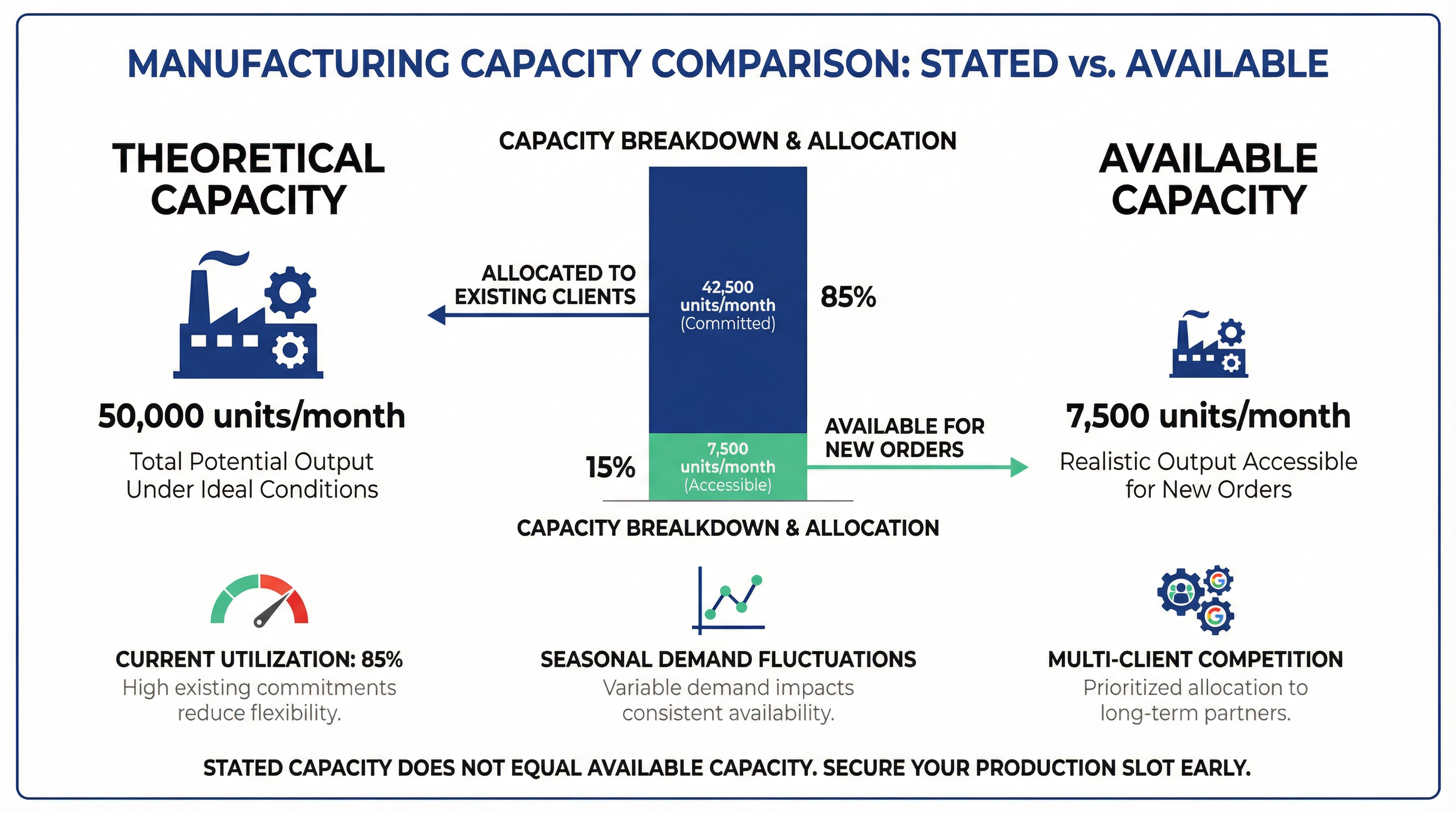
This gap between stated capacity and available capacity creates a predictable pattern of delivery failures that procurement teams rarely anticipate during the quoting phase. Suppliers present their production ceiling as if it were fungible inventory, ready to deploy on demand. Buyers, operating under time pressure and evaluating multiple vendors, accept these figures at face value and build project timelines around them. The misalignment surfaces weeks later, when the factory acknowledges it cannot meet the agreed schedule without displacing other customers or compromising quality checkpoints. By then, the procurement team has already committed to internal stakeholders, locked in launch dates, and exhausted the buffer that might have absorbed the delay.
The core issue is not dishonesty—it is a structural mismatch in how capacity information is communicated and interpreted. Factories quote their installed capacity because that is the metric they track internally and the number that sounds most competitive. Procurement teams, lacking visibility into current utilization rates or competing order loads, assume that capacity figure translates directly into availability for their specific project. Neither party explicitly discusses what percentage of that capacity is already spoken for, how seasonal demand fluctuations affect allocation, or what happens when multiple clients submit orders during the same production window. The result is a lead time quote built on an assumption that does not hold under real operating conditions.
Consider the mechanics of how corporate gift box production capacity is typically structured. A factory might have five production lines, each capable of producing 10,000 units per month, yielding a theoretical capacity of 50,000 units. During the quoting process, the sales team presents this figure to demonstrate scale and reliability. What they do not disclose—because the question is rarely asked—is that three of those lines are already committed to long-term contracts with anchor clients, one line is reserved for sampling and prototyping work, and the fifth line operates at variable capacity depending on raw material availability and workforce scheduling. The actual available capacity for new orders is closer to 7,000 to 10,000 units per month, not 50,000. When a procurement team places an order for 15,000 units and expects delivery within four weeks based on the stated capacity, the factory must either delay other clients, run overtime shifts that increase defect rates, or push your delivery date out by several weeks.
This dynamic intensifies during peak seasons, when multiple clients converge on the same production window. Corporate gifting demand spikes predictably around year-end holidays, Chinese New Year, and major corporate events. A factory operating at 80% utilization in July might hit 95% by November, leaving almost no slack capacity for rush orders or unexpected volume increases. Procurement teams placing orders in October, based on capacity figures quoted in June, discover too late that the factory's available bandwidth has evaporated. The supplier, unwilling to turn away business, accepts the order anyway and manages the conflict by stretching lead times, splitting shipments, or quietly deprioritizing quality assurance steps to keep production moving. None of these adjustments were factored into the original lead time quote, because the quote assumed capacity would remain constant between the negotiation phase and the production phase.
The problem compounds when procurement teams evaluate multiple suppliers simultaneously and select based on lead time competitiveness. Supplier A quotes eight weeks and discloses that their current utilization is 85%, leaving limited available capacity. Supplier B quotes six weeks and presents their 50,000-unit-per-month capacity without mentioning that they are already running at 90% utilization. Procurement, prioritizing speed and lacking a framework to verify utilization rates, awards the contract to Supplier B. Six weeks later, Supplier B requests a two-week extension because "unexpected production delays" have emerged. The delays were not unexpected—they were inevitable, given the mismatch between stated capacity and actual availability. But the procurement team, having already communicated the six-week timeline to internal stakeholders, now faces the choice of accepting the delay or scrambling to find an alternative supplier mid-project.
This pattern repeats across industries because the incentive structures are misaligned. Suppliers compete on lead time and price, so they present their capacity in the most favorable light possible. Procurement teams, evaluated on cost savings and delivery speed, prioritize vendors who offer the shortest timelines. Neither party has a strong incentive to surface the utilization data that would reveal the fragility of the commitment. The factory does not want to disclose that they are already near capacity, because it might cost them the contract. The procurement team does not want to ask probing questions about utilization, because it might slow down the vendor selection process or reveal that the aggressive timeline they promised internally is not feasible. The result is a lead time quote that both parties know is optimistic, but neither party is willing to challenge until the production phase forces the issue.
The distinction between theoretical capacity and available capacity is not academic—it directly determines whether a lead time quote is a realistic projection or a best-case scenario that assumes perfect conditions. Theoretical capacity measures what a factory could produce if all lines ran continuously, all raw materials arrived on schedule, all equipment operated without breakdowns, and no other clients competed for the same resources. Available capacity measures what the factory can realistically allocate to your order, given current commitments, seasonal demand patterns, workforce constraints, and the need to maintain quality standards. The gap between these two figures is often 30% to 50%, but it rarely appears in supplier quotations or procurement evaluations.
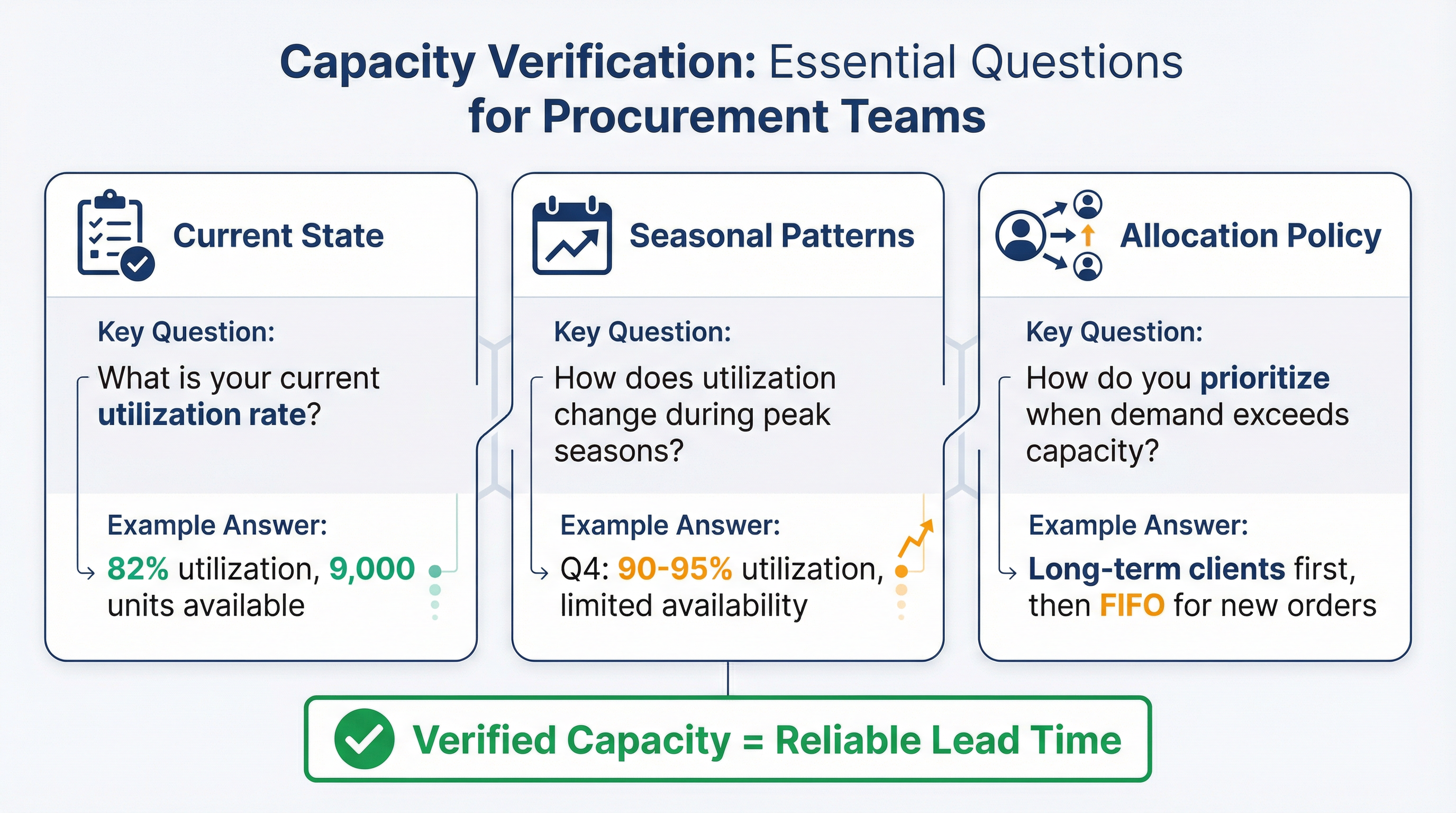
Experienced procurement teams address this gap by asking a different set of questions during the quoting phase. Instead of accepting the stated capacity figure, they request current utilization data: "What percentage of your capacity is currently committed to existing clients?" They ask about seasonal fluctuations: "How does your utilization rate change during Q4?" They probe for allocation policies: "If multiple clients submit orders during the same production window, how do you prioritize?" They request references from clients who placed orders during peak periods: "Can you provide contact information for a client whose order was fulfilled during your busiest season?" These questions shift the conversation from theoretical capability to practical availability, forcing the supplier to either disclose their true capacity constraints or risk being caught in a commitment they cannot honor.
!Capacity Verification Process and Key Questions
Some procurement teams go further and conduct capacity audits before awarding contracts. A capacity audit involves visiting the factory, counting production lines, reviewing order logs to assess current utilization, and interviewing production managers to understand how capacity is allocated during peak periods. The audit reveals whether the supplier's stated capacity aligns with their installed equipment, whether their current order book leaves room for your project, and whether their production planning systems can handle the complexity of managing multiple clients with overlapping deadlines. Factories that operate transparently welcome these audits, because they provide an opportunity to demonstrate operational discipline. Factories that resist audits or provide incomplete data during the visit are signaling that their capacity claims may not withstand scrutiny.
The timing of capacity verification also matters. Verifying capacity during the RFQ phase, before awarding the contract, allows the procurement team to adjust timelines or select alternative suppliers if the data reveals constraints. Verifying capacity after the contract is signed, when the factory is already committed to a delivery date, provides less leverage and fewer options. Yet many procurement teams defer capacity verification until the production phase, either because they lack the resources to conduct audits upfront or because they assume the supplier's stated capacity is accurate. By the time the verification happens, the project timeline is locked in, and any capacity shortfall translates directly into a delivery delay.
The consequences of accepting theoretical capacity as available capacity extend beyond schedule slippage. Factories operating near maximum utilization often sacrifice quality to maintain throughput. Overtime shifts increase worker fatigue, which raises defect rates. Accelerated production schedules compress quality assurance checkpoints, allowing defects to reach the customer. Material substitutions become more common when the factory cannot wait for the specified components to arrive. These quality compromises are not always visible during the production phase, but they surface during inspection, in customer complaints, or through higher return rates. The procurement team, focused on meeting the delivery deadline, may not realize that the aggressive lead time they negotiated has forced the supplier into a mode of operation that undermines product quality.
Another consequence is the erosion of supplier relationships. When a factory accepts an order they cannot realistically fulfill, they create a situation where either they must disappoint the client by missing the deadline, or they must disappoint other clients by reallocating capacity away from existing commitments. Either outcome damages trust. The new client, whose order was delayed, questions the supplier's reliability and may seek alternative vendors for future projects. The existing clients, whose orders were deprioritized to accommodate the new contract, reconsider their loyalty and explore other options. The factory, caught between competing commitments, loses credibility with multiple clients simultaneously. This dynamic is particularly damaging in industries like corporate gifting, where long-term relationships and repeat business are critical to profitability.
The solution is not to avoid suppliers operating at high utilization—factories running at 80% to 85% utilization are often the most efficient and financially stable. The solution is to verify that the supplier's available capacity, not their theoretical capacity, aligns with your project requirements. This verification requires asking direct questions about current utilization, requesting data on how capacity is allocated during peak periods, and conducting site visits to validate the supplier's claims. It also requires adjusting lead time expectations based on the supplier's actual availability, rather than their maximum output under ideal conditions.
For procurement teams managing corporate gift box projects, this means treating capacity verification as a mandatory step in the supplier selection process, not an optional audit reserved for high-risk contracts. It means building lead time quotes around available capacity, not theoretical capacity. It means recognizing that a supplier who discloses their utilization constraints upfront is more reliable than a supplier who presents an optimistic capacity figure without context. And it means understanding that how production schedules are structured and capacity is allocated determines whether a lead time quote is a realistic commitment or a placeholder that will require renegotiation once production begins.
The gap between theoretical capacity and available capacity is not a secret—it is a structural feature of how manufacturing operations work. Factories operate most efficiently when they maintain high utilization rates, which means most of their capacity is already committed at any given time. The portion available for new orders is smaller than the headline capacity figure suggests, and it fluctuates based on seasonal demand, client mix, and production planning decisions. Procurement teams who understand this dynamic ask better questions, verify capacity before awarding contracts, and build lead time expectations around realistic availability rather than optimistic projections. Those who do not understand it accept capacity claims at face value, build project timelines around assumptions that do not hold, and discover the mismatch only when it is too late to adjust without significant cost or disruption.
The practical mechanics of capacity allocation reveal why this gap persists even when both parties operate in good faith. Production planners at manufacturing facilities work with a concept called "effective capacity," which accounts for planned downtime, maintenance windows, material lead times, and workforce availability. Effective capacity is typically 85% to 90% of theoretical capacity under normal operating conditions. When a factory quotes their theoretical capacity of 50,000 units per month, their effective capacity might be 42,500 to 45,000 units. If they are already running at 85% utilization against that effective capacity—a healthy operational level—they have approximately 6,375 to 6,750 units of available bandwidth. An order for 15,000 units does not fit within that available bandwidth without displacing other work, extending lead times, or running overtime shifts that reduce efficiency and increase costs.
Procurement teams rarely see this calculation because it happens internally, within the factory's production planning system. The sales team, focused on winning the contract, presents the theoretical capacity figure because it sounds more impressive and suggests greater flexibility. The production team, operating under pressure to maximize utilization and minimize idle time, accepts orders that exceed available capacity because they believe they can manage the overload through scheduling adjustments, overtime, or minor delays to other clients. Neither team explicitly communicates the utilization constraint to the buyer, because doing so might cost them the business. The buyer, lacking visibility into the factory's internal planning process, assumes the capacity figure represents available bandwidth and builds their project timeline accordingly.
This information asymmetry is particularly pronounced in industries where suppliers serve multiple market segments with different demand patterns. A factory producing corporate gift boxes might also manufacture retail packaging, promotional materials, and custom display units. Each segment has its own peak season, order volume patterns, and lead time expectations. During Q4, corporate gifting demand surges while retail packaging demand remains steady. During Q2, promotional materials for summer campaigns spike while corporate gifting orders decline. The factory's overall capacity remains constant, but the available capacity for any specific segment fluctuates based on demand from other segments. A procurement team placing a corporate gift box order in November, when corporate gifting demand is at its peak, competes for capacity not only with other corporate clients but also with retail and promotional clients whose orders are already in the production queue.
The challenge intensifies when suppliers operate on a first-come, first-served allocation model. In this model, the factory accepts orders in the sequence they arrive and allocates capacity accordingly. Early orders lock in production slots, leaving later orders to compete for whatever capacity remains. A procurement team that delays their order until October, hoping to negotiate better pricing or finalize internal approvals, may discover that the factory's November and December production slots are already fully booked. The supplier, unwilling to turn away business, accepts the order anyway and quotes a lead time based on the assumption that some existing orders will cancel, some clients will accept delayed delivery, or the factory can add overtime shifts to absorb the excess volume. These assumptions are optimistic, and when they do not materialize, the late-arriving order gets pushed into January or February, well beyond the timeline the procurement team communicated to internal stakeholders.
Some factories address this issue by implementing capacity reservation systems, where clients can pre-book production slots months in advance. These systems provide greater visibility into available capacity and allow procurement teams to secure production bandwidth before finalizing order details. However, capacity reservation systems require upfront commitment, often in the form of deposits or minimum order guarantees, which many procurement teams are reluctant to provide until they have final approval from internal stakeholders. The result is a standoff: the factory wants commitment before reserving capacity, and the procurement team wants capacity confirmation before making a commitment. In the absence of a reservation system, both parties operate on informal assurances that break down when demand exceeds supply.
Another factor that complicates capacity verification is the variability in production complexity across different orders. Not all units require the same amount of production time or resources. A simple gift box with standard materials and minimal customization might take 30 minutes of production time per unit. A complex gift box with custom die-cut inserts, foil stamping, embossing, and multi-component assembly might take 90 minutes per unit. When a factory quotes capacity in units per month, they are typically assuming an average production time based on their historical order mix. If your order is significantly more complex than the average, it consumes more capacity than the unit count suggests. A 10,000-unit order of complex gift boxes might consume as much production time as a 30,000-unit order of simple boxes. The factory's stated capacity of 50,000 units per month does not account for this variability, and neither does the procurement team's timeline calculation.
Experienced suppliers address this by quoting capacity in production hours rather than units, which provides a more accurate measure of available bandwidth. A factory might have 8,000 production hours available per month across all lines. An order requiring 90 minutes per unit consumes 250 hours per 10,000 units, leaving 7,750 hours for other work. This approach makes capacity allocation more transparent and reduces the risk of over-commitment. However, many suppliers continue to quote capacity in units because it is simpler to communicate and easier for procurement teams to evaluate. The simplicity comes at the cost of accuracy, and the inaccuracy manifests as delivery delays when production complexity exceeds the assumptions embedded in the capacity figure.
The role of raw material availability further complicates the relationship between theoretical capacity and available capacity. A factory might have the production lines, workforce, and scheduling flexibility to produce 50,000 units per month, but if their raw material suppliers can only deliver enough material to support 40,000 units per month, the effective capacity drops to 40,000 units. Material constraints are particularly common for custom components like branded ribbons, specialty papers, or custom-molded inserts, which require longer lead times and minimum order quantities. A procurement team placing an order that requires custom materials discovers that the factory's capacity to produce the finished product is limited not by their production lines but by their ability to source the necessary inputs. This constraint is rarely visible during the quoting phase, because suppliers assume they can source materials on demand or substitute alternative components if the specified materials are unavailable.
The interaction between capacity utilization and quality assurance processes also affects lead time reliability. Factories operating at high utilization often compress or skip quality checkpoints to maintain throughput. A factory running at 70% utilization has time to conduct thorough inspections, run test batches, and address defects before they reach the customer. A factory running at 95% utilization faces pressure to keep production moving, which means inspections become faster and less thorough, test batches get skipped, and defects are caught later in the process—or not at all. The procurement team, focused on meeting the delivery deadline, may not realize that the aggressive lead time they negotiated has forced the supplier into a production mode that increases defect risk. The defects surface during final inspection, triggering rework that adds days or weeks to the delivery timeline, or they reach the customer and generate complaints that damage the brand's reputation.
This dynamic explains why some of the most reliable suppliers are not the ones who quote the shortest lead times or the highest capacity figures. Reliable suppliers operate at moderate utilization rates (75% to 85%), maintain buffer capacity to absorb unexpected demand spikes or material delays, and build lead time quotes around realistic production schedules rather than optimistic assumptions. They disclose their current utilization during the quoting phase, explain how they allocate capacity during peak periods, and provide references from clients who placed orders during high-demand windows. These suppliers may quote longer lead times than their competitors, but the lead times they quote are the lead times they deliver. Procurement teams who prioritize reliability over speed recognize that a conservative lead time quote from a transparent supplier is more valuable than an aggressive lead time quote from a supplier who cannot disclose their utilization constraints.
The verification process itself need not be complex or time-consuming. A basic capacity verification involves three questions: What is your current utilization rate? How does your utilization rate change during peak seasons? What percentage of your capacity is available for new orders during the production window we are targeting? Suppliers who can answer these questions with specific data—"We are currently at 82% utilization, we typically reach 90% in November and December, and we have approximately 8,000 units of available capacity for Q4 orders"—demonstrate operational transparency and planning discipline. Suppliers who deflect these questions or provide vague answers—"We have plenty of capacity" or "We can handle your order, no problem"—signal that they either do not track utilization data or are unwilling to disclose constraints that might affect their competitiveness.
For larger or more complex projects, a site visit provides additional verification. During the visit, the procurement team can observe production lines in operation, review order logs to assess current workload, and interview production managers to understand how capacity is allocated when demand exceeds supply. The visit also reveals whether the factory's stated capacity aligns with their installed equipment. A factory claiming 50,000 units per month capacity should have enough production lines, workforce, and floor space to support that output. If the physical infrastructure does not match the stated capacity, it suggests the capacity figure is aspirational rather than operational. Site visits also provide an opportunity to assess the factory's quality management systems, material inventory levels, and maintenance practices—all of which affect their ability to deliver on lead time commitments.
The cost of conducting capacity verification is modest compared to the cost of a delivery delay. A site visit might require one or two days of travel and a few thousand dollars in expenses. A delivery delay that forces a product launch to be postponed, disrupts a corporate event, or requires emergency air freight to meet a deadline can cost tens of thousands of dollars in direct expenses, plus the indirect costs of damaged stakeholder relationships and lost market opportunity. Procurement teams who view capacity verification as an unnecessary expense are optimizing for the wrong metric—they are minimizing upfront costs while accepting much larger downstream risks.
The broader lesson is that lead time quotes are only as reliable as the assumptions they rest on. When those assumptions include the belief that a supplier's stated capacity translates directly into available capacity for your order, the quote is fragile. When the assumptions are validated through capacity verification, utilization data, and transparent communication about allocation policies, the quote becomes a realistic projection that both parties can commit to with confidence. Procurement teams who understand this distinction build more reliable supply chains, avoid preventable delays, and develop stronger relationships with suppliers who operate transparently and plan conservatively. Those who do not understand it continue to accept optimistic lead time quotes, experience delivery failures, and wonder why the supplier who seemed so capable during negotiations could not deliver when it mattered.